

Problems
181
energy of sound is sent out from your mouth with 60 dB 1 cm away, and is spread in
all directions over a hemisphere (and not reflected from any surface)?
5.32 Describe how you might design and operate an instrument which can measure
the threshold of hearing of an individual, minimizing the psychology of individuals
who want to exaggerate or minimize their hearing abilities.
5.33 What is the largest difference in arrival time to each ear of a pulse of sound in
air if the ears are 16 cm apart.
5.34 Most humans enjoy music. Speculate on how this characteristic might have
come about in evolution.
5.35 Damage to the Broca area of the brain can cause aphasia, the inability to
formulate speech. However, the ability to sing a song persists. Investigate how this
is possible.
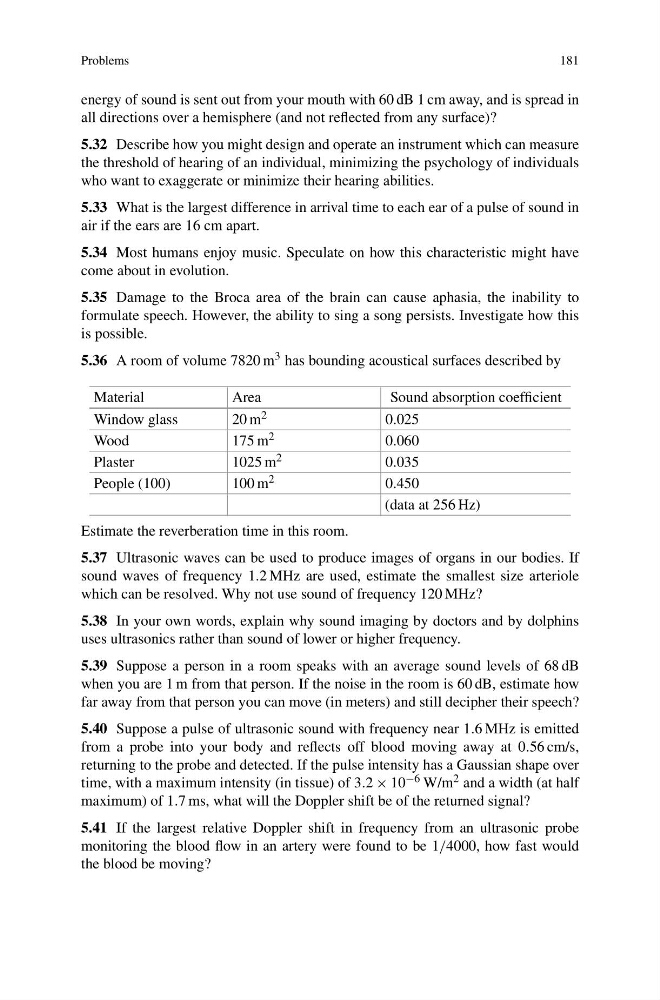
5.36 A room of volume 7820 m 3 has bounding acoustical surfaces described by
Material
Area
Sound absorption coefficient
Window glass
20 m 2
0.025
Wood
175 m 2
0.060
Plaster
1025 m 2
0.035
People (100)
100 m 2
0.450
(data at 256 Hz)
Estimate the reverberation time in this room.
5.37 Ultrasonic waves can be used to produce images of organs in our bodies. If
sound waves of frequency 1.2 MHz are used, estimate the smallest size arteriole
which can be resolved. Why not use sound of frequency 120 MHz?
5.38 In your own words, explain why sound imaging by doctors and by dolphins
uses ultrasonics rather than sound of lower or higher frequency.
5.39 Suppose a person in a room speaks with an average sound levels of 68 dB
when you are 1 m from that person. If the noise in the room is 60 dB, estimate how
far away from that person you can move (in meters) and still decipher their speech?
5.40 Suppose a pulse of ultrasonic sound with frequency near 1.6 MHz is emitted
from a probe into your body and reflects off blood moving away at 0.56 cm/s,
returning to the probe and detected. If the pulse intensity has a Gaussian shape over
time, with a maximum intensity (in tissue) of 3.2 × 10 −6 W/m 2 and a width (at half
maximum) of 1.7 ms, what will the Doppler shift be of the returned signal?
5.41 If the largest relative Doppler shift in frequency from an ultrasonic probe
monitoring the blood flow in an artery were found to be 1/4000, how fast would
the blood be moving?
181
energy of sound is sent out from your mouth with 60 dB 1 cm away, and is spread in
all directions over a hemisphere (and not reflected from any surface)?
5.32 Describe how you might design and operate an instrument which can measure
the threshold of hearing of an individual, minimizing the psychology of individuals
who want to exaggerate or minimize their hearing abilities.
5.33 What is the largest difference in arrival time to each ear of a pulse of sound in
air if the ears are 16 cm apart.
5.34 Most humans enjoy music. Speculate on how this characteristic might have
come about in evolution.
5.35 Damage to the Broca area of the brain can cause aphasia, the inability to
formulate speech. However, the ability to sing a song persists. Investigate how this
is possible.
5.36 A room of volume 7820 m 3 has bounding acoustical surfaces described by
Material
Area
Sound absorption coefficient
Window glass
20 m 2
0.025
Wood
175 m 2
0.060
Plaster
1025 m 2
0.035
People (100)
100 m 2
0.450
(data at 256 Hz)
Estimate the reverberation time in this room.
5.37 Ultrasonic waves can be used to produce images of organs in our bodies. If
sound waves of frequency 1.2 MHz are used, estimate the smallest size arteriole
which can be resolved. Why not use sound of frequency 120 MHz?
5.38 In your own words, explain why sound imaging by doctors and by dolphins
uses ultrasonics rather than sound of lower or higher frequency.
5.39 Suppose a person in a room speaks with an average sound levels of 68 dB
when you are 1 m from that person. If the noise in the room is 60 dB, estimate how
far away from that person you can move (in meters) and still decipher their speech?
5.40 Suppose a pulse of ultrasonic sound with frequency near 1.6 MHz is emitted
from a probe into your body and reflects off blood moving away at 0.56 cm/s,
returning to the probe and detected. If the pulse intensity has a Gaussian shape over
time, with a maximum intensity (in tissue) of 3.2 × 10 −6 W/m 2 and a width (at half
maximum) of 1.7 ms, what will the Doppler shift be of the returned signal?
5.41 If the largest relative Doppler shift in frequency from an ultrasonic probe
monitoring the blood flow in an artery were found to be 1/4000, how fast would
the blood be moving?