

178
5 Acoustics in Biology and Medicine
limits are given for spatial peak and temporal averaged intensities (I SP T A ). Tissue
exposure limits are also imposed on heating over time and on cavitation.
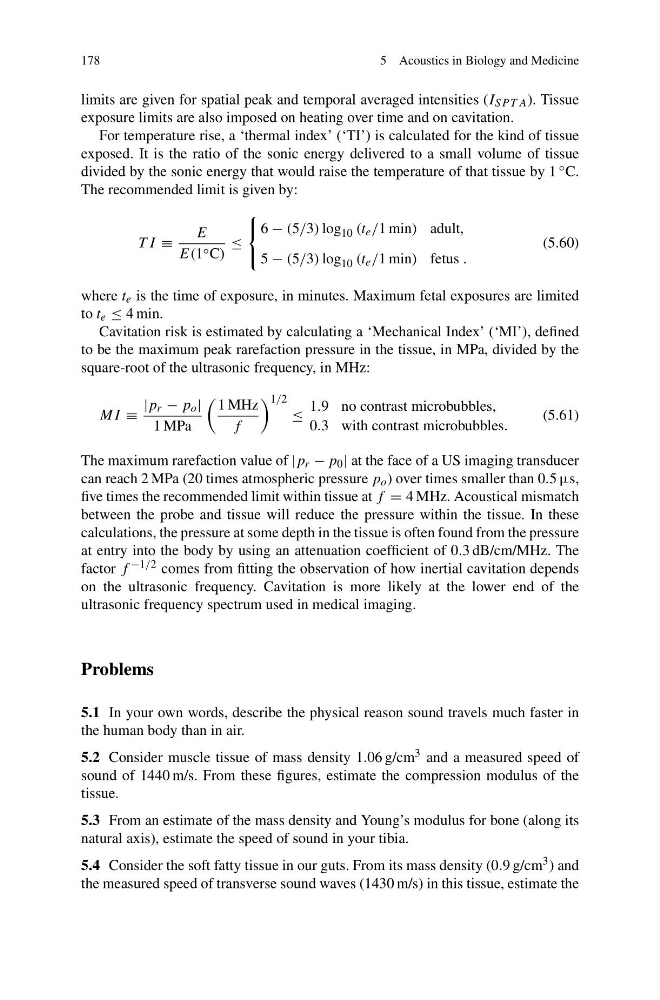
For temperature rise, a ‘thermal index’ (‘TI’) is calculated for the kind of tissue
exposed. It is the ratio of the sonic energy delivered to a small volume of tissue
divided by the sonic energy that would raise the temperature of that tissue by 1 ◦ C.
The recommended limit is given by:
T I ≡
E
E(1 ◦ C)
≤
⎧
⎨
⎩
6 − (5/3) log 10 (t e /1 min) adult,
5 − (5/3) log 10 (t e /1 min) fetus .
(5.60)
where t e is the time of exposure, in minutes. Maximum fetal exposures are limited
to t e ≤ 4 min.
Cavitation risk is estimated by calculating a ‘Mechanical Index’ (‘MI’), defined
to be the maximum peak rarefaction pressure in the tissue, in MPa, divided by the
square-root of the ultrasonic frequency, in MHz:
MI ≡
|p r − p o |
1 MPa
1 MHz
f
1/2
≤
1.9 no contrast microbubbles,
0.3 with contrast microbubbles.
(5.61)
The maximum rarefaction value of |p r − p 0 | at the face of a US imaging transducer
can reach 2 MPa (20 times atmospheric pressure p o ) over times smaller than 0.5 μs,
five times the recommended limit within tissue at f = 4 MHz. Acoustical mismatch
between the probe and tissue will reduce the pressure within the tissue. In these
calculations, the pressure at some depth in the tissue is often found from the pressure
at entry into the body by using an attenuation coefficient of 0.3 dB/cm/MHz. The
factor f −1/2 comes from fitting the observation of how inertial cavitation depends
on the ultrasonic frequency. Cavitation is more likely at the lower end of the
ultrasonic frequency spectrum used in medical imaging.
Problems
5.1 In your own words, describe the physical reason sound travels much faster in
the human body than in air.
5.2 Consider muscle tissue of mass density 1.06 g/cm 3 and a measured speed of
sound of 1440 m/s. From these figures, estimate the compression modulus of the
tissue.
5.3 From an estimate of the mass density and Young’s modulus for bone (along its
natural axis), estimate the speed of sound in your tibia.
5.4 Consider the soft fatty tissue in our guts. From its mass density (0.9 g/cm 3 ) and
the measured speed of transverse sound waves (1430 m/s) in this tissue, estimate the
5 Acoustics in Biology and Medicine
limits are given for spatial peak and temporal averaged intensities (I SP T A ). Tissue
exposure limits are also imposed on heating over time and on cavitation.
For temperature rise, a ‘thermal index’ (‘TI’) is calculated for the kind of tissue
exposed. It is the ratio of the sonic energy delivered to a small volume of tissue
divided by the sonic energy that would raise the temperature of that tissue by 1 ◦ C.
The recommended limit is given by:
T I ≡
E
E(1 ◦ C)
≤
⎧
⎨
⎩
6 − (5/3) log 10 (t e /1 min) adult,
5 − (5/3) log 10 (t e /1 min) fetus .
(5.60)
where t e is the time of exposure, in minutes. Maximum fetal exposures are limited
to t e ≤ 4 min.
Cavitation risk is estimated by calculating a ‘Mechanical Index’ (‘MI’), defined
to be the maximum peak rarefaction pressure in the tissue, in MPa, divided by the
square-root of the ultrasonic frequency, in MHz:
MI ≡
|p r − p o |
1 MPa
1 MHz
f
1/2
≤
1.9 no contrast microbubbles,
0.3 with contrast microbubbles.
(5.61)
The maximum rarefaction value of |p r − p 0 | at the face of a US imaging transducer
can reach 2 MPa (20 times atmospheric pressure p o ) over times smaller than 0.5 μs,
five times the recommended limit within tissue at f = 4 MHz. Acoustical mismatch
between the probe and tissue will reduce the pressure within the tissue. In these
calculations, the pressure at some depth in the tissue is often found from the pressure
at entry into the body by using an attenuation coefficient of 0.3 dB/cm/MHz. The
factor f −1/2 comes from fitting the observation of how inertial cavitation depends
on the ultrasonic frequency. Cavitation is more likely at the lower end of the
ultrasonic frequency spectrum used in medical imaging.
Problems
5.1 In your own words, describe the physical reason sound travels much faster in
the human body than in air.
5.2 Consider muscle tissue of mass density 1.06 g/cm 3 and a measured speed of
sound of 1440 m/s. From these figures, estimate the compression modulus of the
tissue.
5.3 From an estimate of the mass density and Young’s modulus for bone (along its
natural axis), estimate the speed of sound in your tibia.
5.4 Consider the soft fatty tissue in our guts. From its mass density (0.9 g/cm 3 ) and
the measured speed of transverse sound waves (1430 m/s) in this tissue, estimate the