

160
5 Acoustics in Biology and Medicine
Scala Tympani:
A second duct to carry sound vibration back from the
heliotrema to the elastic round window
Cochlear Nerve:
The auditory nerve from the cochlea to the brain
Eustachian tubes:
The pressure-equalizing tubes from the throat to each middle ear
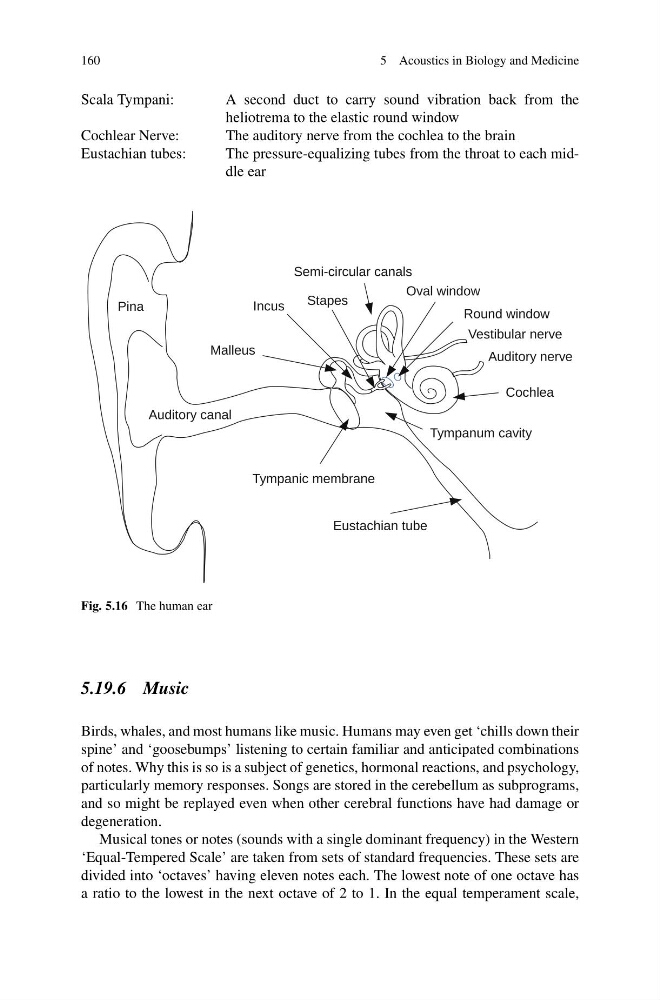
Fig. 5.16 The human ear
5.19.6 Music
Birds, whales, and most humans like music. Humans may even get ‘chills down their
spine’ and ‘goosebumps’ listening to certain familiar and anticipated combinations
of notes. Why this is so is a subject of genetics, hormonal reactions, and psychology,
particularly memory responses. Songs are stored in the cerebellum as subprograms,
and so might be replayed even when other cerebral functions have had damage or
degeneration.
Musical tones or notes (sounds with a single dominant frequency) in the Western
‘Equal-Tempered Scale’ are taken from sets of standard frequencies. These sets are
divided into ‘octaves’ having eleven notes each. The lowest note of one octave has
a ratio to the lowest in the next octave of 2 to 1. In the equal temperament scale,
5 Acoustics in Biology and Medicine
Scala Tympani:
A second duct to carry sound vibration back from the
heliotrema to the elastic round window
Cochlear Nerve:
The auditory nerve from the cochlea to the brain
Eustachian tubes:
The pressure-equalizing tubes from the throat to each middle ear
Fig. 5.16 The human ear
5.19.6 Music
Birds, whales, and most humans like music. Humans may even get ‘chills down their
spine’ and ‘goosebumps’ listening to certain familiar and anticipated combinations
of notes. Why this is so is a subject of genetics, hormonal reactions, and psychology,
particularly memory responses. Songs are stored in the cerebellum as subprograms,
and so might be replayed even when other cerebral functions have had damage or
degeneration.
Musical tones or notes (sounds with a single dominant frequency) in the Western
‘Equal-Tempered Scale’ are taken from sets of standard frequencies. These sets are
divided into ‘octaves’ having eleven notes each. The lowest note of one octave has
a ratio to the lowest in the next octave of 2 to 1. In the equal temperament scale,