

130
5 Acoustics in Biology and Medicine
factors determine the impedance of a material: The inertial properties of the material
as measured by its density, the degree of coupling between adjacent layers which
determines the speed of sound in the material, and the dissipative processes within
the material affecting the conversion of sound energy to heat or other forms, even
before a sound wave can develop. We measure impedance by a ratio of the pressure
needed to cause motion to the current that pressure causes.
The definition of impedance for sound transmission is perfectly analogous to
impedance used to describe the general resistance to the flow of current in an
electrical circuit. Within the subject of electricity, impedance is given by the relation
Z = V /i, where V is the electric potential across a circuit (i.e. the difference
in energy per unit charge), and i is the resultant current due to that difference in
potential. The intrinsic electrical impedance, z, is defined to be the electric field
needed to produce a current divided by the resulting current density: z = E/J . The
quantity z gives an intrinsic measure of impedance since it does not depend on the
size of the resisting material being used.
In analogy to the electric case, instead of electric energy per unit charge, in
acoustics we use acoustical energy per unit volume, that energy determined by the
mechanical pressure. Instead of electrical current density measured by the number
of charges moving through an area per unit area and unit time, for fluids we use the
volume of fluid moving through an area per unit area per unit time. If the response
of a material to an external pressure is a smaller motion in comparison to a second
material, then the impedance of the first material is larger.
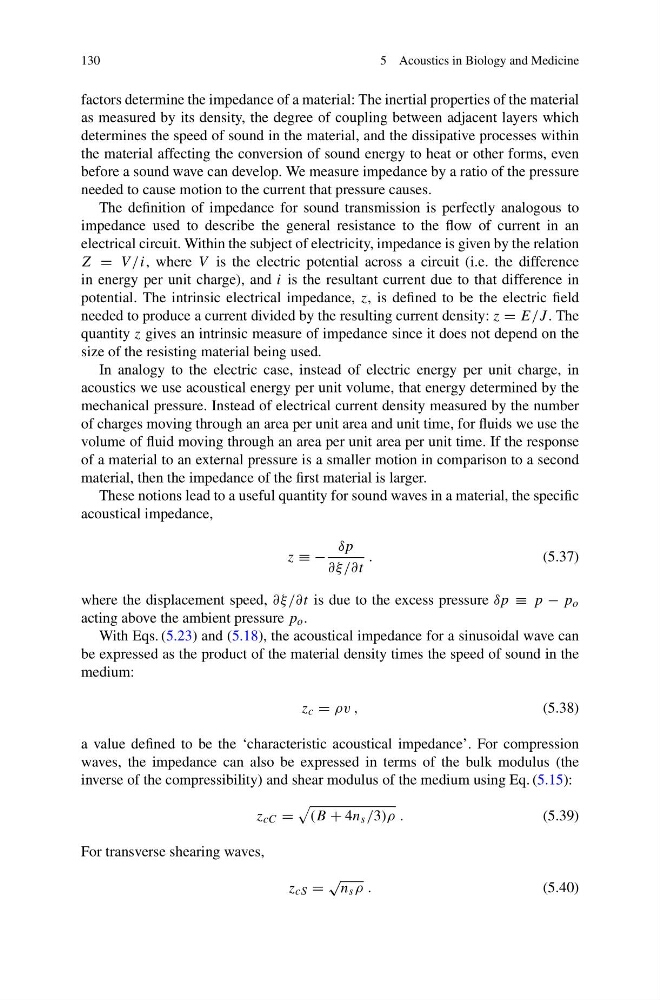
These notions lead to a useful quantity for sound waves in a material, the specific
acoustical impedance,
z ≡ −
δp
∂ξ/∂t
.
(5.37)
where the displacement speed, ∂ξ/∂t is due to the excess pressure δp ≡ p − p o
acting above the ambient pressure p o .
With Eqs. (5.23) and (5.18), the acoustical impedance for a sinusoidal wave can
be expressed as the product of the material density times the speed of sound in the
medium:
z c = ρv ,
(5.38)
a value defined to be the ‘characteristic acoustical impedance’. For compression
waves, the impedance can also be expressed in terms of the bulk modulus (the
inverse of the compressibility) and shear modulus of the medium using Eq. (5.15):
z cC =
(B + 4n s /3)ρ .
(5.39)
For transverse shearing waves,
z cS =
√
n s ρ .
(5.40)
5 Acoustics in Biology and Medicine
factors determine the impedance of a material: The inertial properties of the material
as measured by its density, the degree of coupling between adjacent layers which
determines the speed of sound in the material, and the dissipative processes within
the material affecting the conversion of sound energy to heat or other forms, even
before a sound wave can develop. We measure impedance by a ratio of the pressure
needed to cause motion to the current that pressure causes.
The definition of impedance for sound transmission is perfectly analogous to
impedance used to describe the general resistance to the flow of current in an
electrical circuit. Within the subject of electricity, impedance is given by the relation
Z = V /i, where V is the electric potential across a circuit (i.e. the difference
in energy per unit charge), and i is the resultant current due to that difference in
potential. The intrinsic electrical impedance, z, is defined to be the electric field
needed to produce a current divided by the resulting current density: z = E/J . The
quantity z gives an intrinsic measure of impedance since it does not depend on the
size of the resisting material being used.
In analogy to the electric case, instead of electric energy per unit charge, in
acoustics we use acoustical energy per unit volume, that energy determined by the
mechanical pressure. Instead of electrical current density measured by the number
of charges moving through an area per unit area and unit time, for fluids we use the
volume of fluid moving through an area per unit area per unit time. If the response
of a material to an external pressure is a smaller motion in comparison to a second
material, then the impedance of the first material is larger.
These notions lead to a useful quantity for sound waves in a material, the specific
acoustical impedance,
z ≡ −
δp
∂ξ/∂t
.
(5.37)
where the displacement speed, ∂ξ/∂t is due to the excess pressure δp ≡ p − p o
acting above the ambient pressure p o .
With Eqs. (5.23) and (5.18), the acoustical impedance for a sinusoidal wave can
be expressed as the product of the material density times the speed of sound in the
medium:
z c = ρv ,
(5.38)
a value defined to be the ‘characteristic acoustical impedance’. For compression
waves, the impedance can also be expressed in terms of the bulk modulus (the
inverse of the compressibility) and shear modulus of the medium using Eq. (5.15):
z cC =
(B + 4n s /3)ρ .
(5.39)
For transverse shearing waves,
z cS =
√
n s ρ .
(5.40)