

5.2 Fourier Decomposition of Sound
123
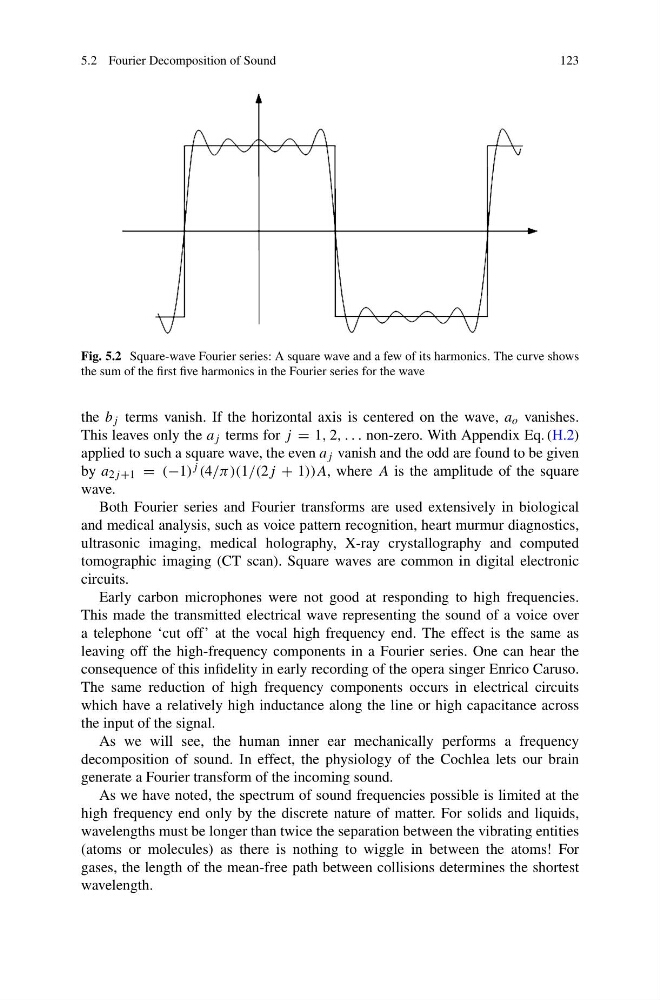
Fig. 5.2 Square-wave Fourier series: A square wave and a few of its harmonics. The curve shows
the sum of the first five harmonics in the Fourier series for the wave
the b j terms vanish. If the horizontal axis is centered on the wave, a o vanishes.
This leaves only the a j terms for j = 1, 2, . . . non-zero. With Appendix Eq. (H.2)
applied to such a square wave, the even a j vanish and the odd are found to be given
by a 2j +1 = (−1) j (4/π )(1/(2j + 1))A, where A is the amplitude of the square
wave.
Both Fourier series and Fourier transforms are used extensively in biological
and medical analysis, such as voice pattern recognition, heart murmur diagnostics,
ultrasonic imaging, medical holography, X-ray crystallography and computed
tomographic imaging (CT scan). Square waves are common in digital electronic
circuits.
Early carbon microphones were not good at responding to high frequencies.
This made the transmitted electrical wave representing the sound of a voice over
a telephone ‘cut off’ at the vocal high frequency end. The effect is the same as
leaving off the high-frequency components in a Fourier series. One can hear the
consequence of this infidelity in early recording of the opera singer Enrico Caruso.
The same reduction of high frequency components occurs in electrical circuits
which have a relatively high inductance along the line or high capacitance across
the input of the signal.
As we will see, the human inner ear mechanically performs a frequency
decomposition of sound. In effect, the physiology of the Cochlea lets our brain
generate a Fourier transform of the incoming sound.
As we have noted, the spectrum of sound frequencies possible is limited at the
high frequency end only by the discrete nature of matter. For solids and liquids,
wavelengths must be longer than twice the separation between the vibrating entities
(atoms or molecules) as there is nothing to wiggle in between the atoms! For
gases, the length of the mean-free path between collisions determines the shortest
wavelength.
123
Fig. 5.2 Square-wave Fourier series: A square wave and a few of its harmonics. The curve shows
the sum of the first five harmonics in the Fourier series for the wave
the b j terms vanish. If the horizontal axis is centered on the wave, a o vanishes.
This leaves only the a j terms for j = 1, 2, . . . non-zero. With Appendix Eq. (H.2)
applied to such a square wave, the even a j vanish and the odd are found to be given
by a 2j +1 = (−1) j (4/π )(1/(2j + 1))A, where A is the amplitude of the square
wave.
Both Fourier series and Fourier transforms are used extensively in biological
and medical analysis, such as voice pattern recognition, heart murmur diagnostics,
ultrasonic imaging, medical holography, X-ray crystallography and computed
tomographic imaging (CT scan). Square waves are common in digital electronic
circuits.
Early carbon microphones were not good at responding to high frequencies.
This made the transmitted electrical wave representing the sound of a voice over
a telephone ‘cut off’ at the vocal high frequency end. The effect is the same as
leaving off the high-frequency components in a Fourier series. One can hear the
consequence of this infidelity in early recording of the opera singer Enrico Caruso.
The same reduction of high frequency components occurs in electrical circuits
which have a relatively high inductance along the line or high capacitance across
the input of the signal.
As we will see, the human inner ear mechanically performs a frequency
decomposition of sound. In effect, the physiology of the Cochlea lets our brain
generate a Fourier transform of the incoming sound.
As we have noted, the spectrum of sound frequencies possible is limited at the
high frequency end only by the discrete nature of matter. For solids and liquids,
wavelengths must be longer than twice the separation between the vibrating entities
(atoms or molecules) as there is nothing to wiggle in between the atoms! For
gases, the length of the mean-free path between collisions determines the shortest
wavelength.