

5.1 The Nature of Sound Waves
121
In materials, the speed of the sound may depend on its wavelength. If so, different
wavelength waves can be made to disperse in that material, i.e. each would separate
into a different direction. This behavior is more familiar for light when it passes
through a prism, making red light separate from blue. We will see that the dispersion
of waves is determined by how the wave speed depends on wavelength (a ‘dispersion
relation’).
The wave equation (5.7) applies to waves with displacement allowed in just one
direction, such as pressure waves and transverse vibrations of long thin materials.
Sounds in solids, such as tissue and bones, can have simultaneous vibrations in three
directions. Assuming an isotropic and homogeneous material, a straight forward
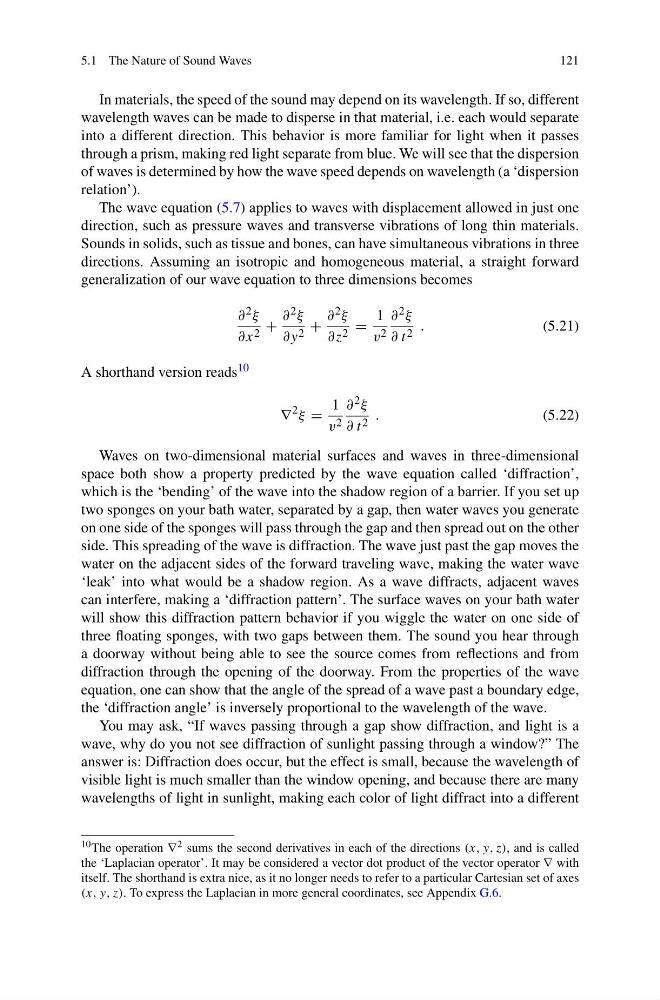
generalization of our wave equation to three dimensions becomes
∂ 2 ξ
∂x 2 +
∂ 2 ξ
∂y 2 +
∂ 2 ξ
∂z 2 =
1
v 2
∂ 2 ξ
∂ t 2 .
(5.21)
A shorthand version reads 10
∇
2 ξ =
1
v 2
∂ 2 ξ
∂ t 2 .
(5.22)
Waves on two-dimensional material surfaces and waves in three-dimensional
space both show a property predicted by the wave equation called ‘diffraction’,
which is the ‘bending’ of the wave into the shadow region of a barrier. If you set up
two sponges on your bath water, separated by a gap, then water waves you generate
on one side of the sponges will pass through the gap and then spread out on the other
side. This spreading of the wave is diffraction. The wave just past the gap moves the
water on the adjacent sides of the forward traveling wave, making the water wave
‘leak’ into what would be a shadow region. As a wave diffracts, adjacent waves
can interfere, making a ‘diffraction pattern’. The surface waves on your bath water
will show this diffraction pattern behavior if you wiggle the water on one side of
three floating sponges, with two gaps between them. The sound you hear through
a doorway without being able to see the source comes from reflections and from
diffraction through the opening of the doorway. From the properties of the wave
equation, one can show that the angle of the spread of a wave past a boundary edge,
the ‘diffraction angle’ is inversely proportional to the wavelength of the wave.
You may ask, “If waves passing through a gap show diffraction, and light is a
wave, why do you not see diffraction of sunlight passing through a window?” The
answer is: Diffraction does occur, but the effect is small, because the wavelength of
visible light is much smaller than the window opening, and because there are many
wavelengths of light in sunlight, making each color of light diffract into a different
10 The operation ∇ 2 sums the second derivatives in each of the directions (x, y, z), and is called
the ‘Laplacian operator’. It may be considered a vector dot product of the vector operator ∇ with
itself. The shorthand is extra nice, as it no longer needs to refer to a particular Cartesian set of axes
(x, y, z). To express the Laplacian in more general coordinates, see Appendix G.6.
121
In materials, the speed of the sound may depend on its wavelength. If so, different
wavelength waves can be made to disperse in that material, i.e. each would separate
into a different direction. This behavior is more familiar for light when it passes
through a prism, making red light separate from blue. We will see that the dispersion
of waves is determined by how the wave speed depends on wavelength (a ‘dispersion
relation’).
The wave equation (5.7) applies to waves with displacement allowed in just one
direction, such as pressure waves and transverse vibrations of long thin materials.
Sounds in solids, such as tissue and bones, can have simultaneous vibrations in three
directions. Assuming an isotropic and homogeneous material, a straight forward
generalization of our wave equation to three dimensions becomes
∂ 2 ξ
∂x 2 +
∂ 2 ξ
∂y 2 +
∂ 2 ξ
∂z 2 =
1
v 2
∂ 2 ξ
∂ t 2 .
(5.21)
A shorthand version reads 10
∇
2 ξ =
1
v 2
∂ 2 ξ
∂ t 2 .
(5.22)
Waves on two-dimensional material surfaces and waves in three-dimensional
space both show a property predicted by the wave equation called ‘diffraction’,
which is the ‘bending’ of the wave into the shadow region of a barrier. If you set up
two sponges on your bath water, separated by a gap, then water waves you generate
on one side of the sponges will pass through the gap and then spread out on the other
side. This spreading of the wave is diffraction. The wave just past the gap moves the
water on the adjacent sides of the forward traveling wave, making the water wave
‘leak’ into what would be a shadow region. As a wave diffracts, adjacent waves
can interfere, making a ‘diffraction pattern’. The surface waves on your bath water
will show this diffraction pattern behavior if you wiggle the water on one side of
three floating sponges, with two gaps between them. The sound you hear through
a doorway without being able to see the source comes from reflections and from
diffraction through the opening of the doorway. From the properties of the wave
equation, one can show that the angle of the spread of a wave past a boundary edge,
the ‘diffraction angle’ is inversely proportional to the wavelength of the wave.
You may ask, “If waves passing through a gap show diffraction, and light is a
wave, why do you not see diffraction of sunlight passing through a window?” The
answer is: Diffraction does occur, but the effect is small, because the wavelength of
visible light is much smaller than the window opening, and because there are many
wavelengths of light in sunlight, making each color of light diffract into a different
10 The operation ∇ 2 sums the second derivatives in each of the directions (x, y, z), and is called
the ‘Laplacian operator’. It may be considered a vector dot product of the vector operator ∇ with
itself. The shorthand is extra nice, as it no longer needs to refer to a particular Cartesian set of axes
(x, y, z). To express the Laplacian in more general coordinates, see Appendix G.6.