

118
5 Acoustics in Biology and Medicine
Table 5.2 Speed of sound in
various materials, and their
density
Density
Speed
Material
(g/cm 3 )
(m/s)
Air
1.39×10 −3
331.45
Helium
1.78×10 −4
972.
Ethanol
0.79
1207.
Fat
0.95
1450.
Water
1.00
1496.
Muscle
1.07
1580.
Bone of skull
1.91
4080.
Steel
7.86
5940.
The speeds in air and helium are for 0 ◦ C, 1 atm. The
speeds are for compressional waves
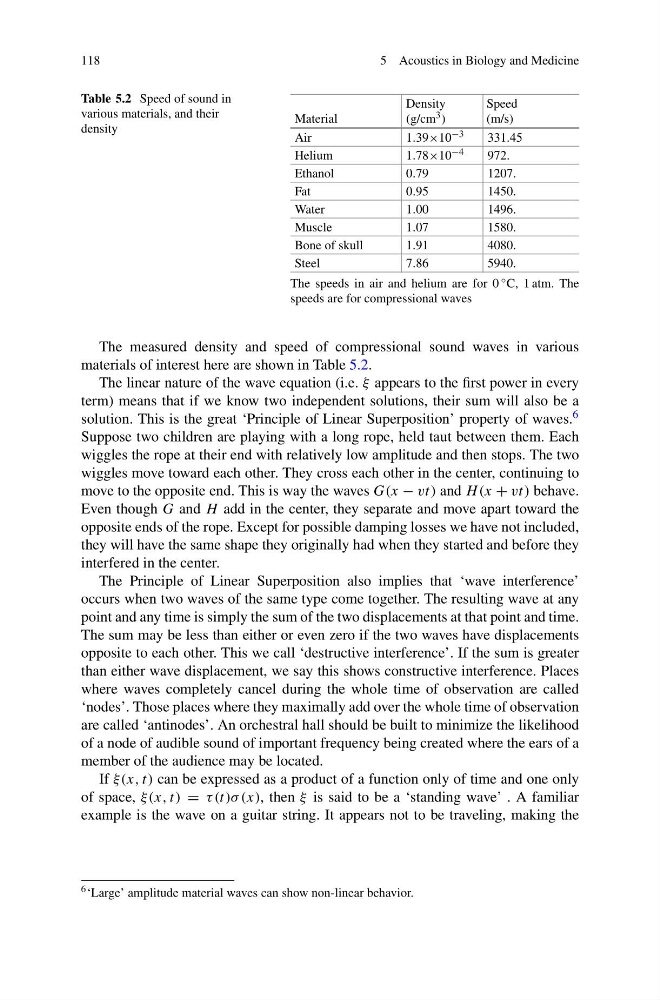
The measured density and speed of compressional sound waves in various
materials of interest here are shown in Table 5.2.
The linear nature of the wave equation (i.e. ξ appears to the first power in every
term) means that if we know two independent solutions, their sum will also be a
solution. This is the great ‘Principle of Linear Superposition’ property of waves. 6
Suppose two children are playing with a long rope, held taut between them. Each
wiggles the rope at their end with relatively low amplitude and then stops. The two
wiggles move toward each other. They cross each other in the center, continuing to
move to the opposite end. This is way the waves G(x − vt) and H (x + vt) behave.
Even though G and H add in the center, they separate and move apart toward the
opposite ends of the rope. Except for possible damping losses we have not included,
they will have the same shape they originally had when they started and before they
interfered in the center.
The Principle of Linear Superposition also implies that ‘wave interference’
occurs when two waves of the same type come together. The resulting wave at any
point and any time is simply the sum of the two displacements at that point and time.
The sum may be less than either or even zero if the two waves have displacements
opposite to each other. This we call ‘destructive interference’. If the sum is greater
than either wave displacement, we say this shows constructive interference. Places
where waves completely cancel during the whole time of observation are called
‘nodes’. Those places where they maximally add over the whole time of observation
are called ‘antinodes’. An orchestral hall should be built to minimize the likelihood
of a node of audible sound of important frequency being created where the ears of a
member of the audience may be located.
If ξ(x, t) can be expressed as a product of a function only of time and one only
of space, ξ(x, t) = τ (t)σ (x), then ξ is said to be a ‘standing wave’ . A familiar
example is the wave on a guitar string. It appears not to be traveling, making the
6 ‘Large’ amplitude material waves can show non-linear behavior.
5 Acoustics in Biology and Medicine
Table 5.2 Speed of sound in
various materials, and their
density
Density
Speed
Material
(g/cm 3 )
(m/s)
Air
1.39×10 −3
331.45
Helium
1.78×10 −4
972.
Ethanol
0.79
1207.
Fat
0.95
1450.
Water
1.00
1496.
Muscle
1.07
1580.
Bone of skull
1.91
4080.
Steel
7.86
5940.
The speeds in air and helium are for 0 ◦ C, 1 atm. The
speeds are for compressional waves
The measured density and speed of compressional sound waves in various
materials of interest here are shown in Table 5.2.
The linear nature of the wave equation (i.e. ξ appears to the first power in every
term) means that if we know two independent solutions, their sum will also be a
solution. This is the great ‘Principle of Linear Superposition’ property of waves. 6
Suppose two children are playing with a long rope, held taut between them. Each
wiggles the rope at their end with relatively low amplitude and then stops. The two
wiggles move toward each other. They cross each other in the center, continuing to
move to the opposite end. This is way the waves G(x − vt) and H (x + vt) behave.
Even though G and H add in the center, they separate and move apart toward the
opposite ends of the rope. Except for possible damping losses we have not included,
they will have the same shape they originally had when they started and before they
interfered in the center.
The Principle of Linear Superposition also implies that ‘wave interference’
occurs when two waves of the same type come together. The resulting wave at any
point and any time is simply the sum of the two displacements at that point and time.
The sum may be less than either or even zero if the two waves have displacements
opposite to each other. This we call ‘destructive interference’. If the sum is greater
than either wave displacement, we say this shows constructive interference. Places
where waves completely cancel during the whole time of observation are called
‘nodes’. Those places where they maximally add over the whole time of observation
are called ‘antinodes’. An orchestral hall should be built to minimize the likelihood
of a node of audible sound of important frequency being created where the ears of a
member of the audience may be located.
If ξ(x, t) can be expressed as a product of a function only of time and one only
of space, ξ(x, t) = τ (t)σ (x), then ξ is said to be a ‘standing wave’ . A familiar
example is the wave on a guitar string. It appears not to be traveling, making the
6 ‘Large’ amplitude material waves can show non-linear behavior.