

100
4 Fluid Mechanics Applied to Biosystems
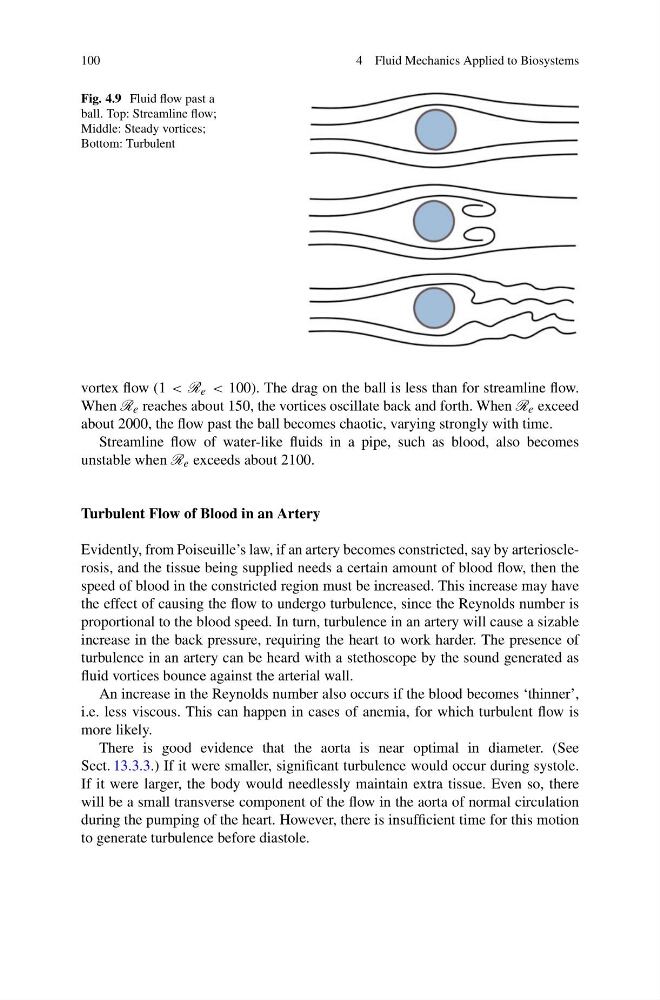
Fig. 4.9 Fluid flow past a
ball. Top: Streamline flow;
Middle: Steady vortices;
Bottom: Turbulent
vortex flow (1 < R e < 100). The drag on the ball is less than for streamline flow.
When R e reaches about 150, the vortices oscillate back and forth. When R e exceed
about 2000, the flow past the ball becomes chaotic, varying strongly with time.
Streamline flow of water-like fluids in a pipe, such as blood, also becomes
unstable when R e exceeds about 2100.
Turbulent Flow of Blood in an Artery
Evidently, from Poiseuille’s law, if an artery becomes constricted, say by arteriosclerosis, and the tissue being supplied needs a certain amount of blood flow, then the
speed of blood in the constricted region must be increased. This increase may have
the effect of causing the flow to undergo turbulence, since the Reynolds number is
proportional to the blood speed. In turn, turbulence in an artery will cause a sizable
increase in the back pressure, requiring the heart to work harder. The presence of
turbulence in an artery can be heard with a stethoscope by the sound generated as
fluid vortices bounce against the arterial wall.
An increase in the Reynolds number also occurs if the blood becomes ‘thinner’,
i.e. less viscous. This can happen in cases of anemia, for which turbulent flow is
more likely.
There is good evidence that the aorta is near optimal in diameter. (See
Sect. 13.3.3.) If it were smaller, significant turbulence would occur during systole.
If it were larger, the body would needlessly maintain extra tissue. Even so, there
will be a small transverse component of the flow in the aorta of normal circulation
during the pumping of the heart. However, there is insufficient time for this motion
to generate turbulence before diastole.
4 Fluid Mechanics Applied to Biosystems
Fig. 4.9 Fluid flow past a
ball. Top: Streamline flow;
Middle: Steady vortices;
Bottom: Turbulent
vortex flow (1 < R e < 100). The drag on the ball is less than for streamline flow.
When R e reaches about 150, the vortices oscillate back and forth. When R e exceed
about 2000, the flow past the ball becomes chaotic, varying strongly with time.
Streamline flow of water-like fluids in a pipe, such as blood, also becomes
unstable when R e exceeds about 2100.
Turbulent Flow of Blood in an Artery
Evidently, from Poiseuille’s law, if an artery becomes constricted, say by arteriosclerosis, and the tissue being supplied needs a certain amount of blood flow, then the
speed of blood in the constricted region must be increased. This increase may have
the effect of causing the flow to undergo turbulence, since the Reynolds number is
proportional to the blood speed. In turn, turbulence in an artery will cause a sizable
increase in the back pressure, requiring the heart to work harder. The presence of
turbulence in an artery can be heard with a stethoscope by the sound generated as
fluid vortices bounce against the arterial wall.
An increase in the Reynolds number also occurs if the blood becomes ‘thinner’,
i.e. less viscous. This can happen in cases of anemia, for which turbulent flow is
more likely.
There is good evidence that the aorta is near optimal in diameter. (See
Sect. 13.3.3.) If it were smaller, significant turbulence would occur during systole.
If it were larger, the body would needlessly maintain extra tissue. Even so, there
will be a small transverse component of the flow in the aorta of normal circulation
during the pumping of the heart. However, there is insufficient time for this motion
to generate turbulence before diastole.