

96
4 Fluid Mechanics Applied to Biosystems
The first term on the right is the net stress acting on surfaces of the fluid element
(see Eq. (3.16). If the stress is proportional to the strain in the fluid, we say the fluid
is ‘Newtonian’. (Non-Newtonian fluids include lava, magma, blood in capillaries,
and suspensions of cornstarch with water.) The second term on the right is the net
external force per unit volume acting on the whole volume of the fluid element.
If the shearing forces within the fluid come only from viscous drag, and the
volume force comes from gravity, there results
ρ
dv
dt
= −∇p + η∇
2 v +
ζ +
1
3
η
∇ (∇ · v) − ρ∇ g .
(4.41)
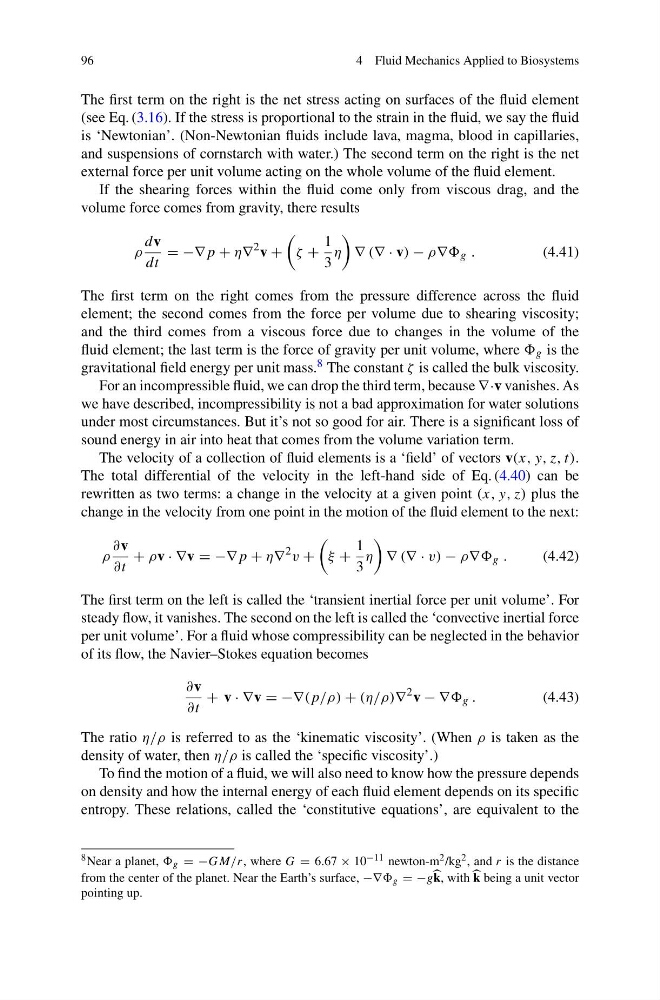
The first term on the right comes from the pressure difference across the fluid
element; the second comes from the force per volume due to shearing viscosity;
and the third comes from a viscous force due to changes in the volume of the
fluid element; the last term is the force of gravity per unit volume, where g is the
gravitational field energy per unit mass. 8 The constant ζ is called the bulk viscosity.
For an incompressible fluid, we can drop the third term, because ∇·v vanishes. As
we have described, incompressibility is not a bad approximation for water solutions
under most circumstances. But it’s not so good for air. There is a significant loss of
sound energy in air into heat that comes from the volume variation term.
The velocity of a collection of fluid elements is a ‘field’ of vectors v(x, y, z, t).
The total differential of the velocity in the left-hand side of Eq. (4.40) can be
rewritten as two terms: a change in the velocity at a given point (x, y, z) plus the
change in the velocity from one point in the motion of the fluid element to the next:
ρ
∂v
∂t
+ ρv · ∇v = −∇p + η∇
2 v +
ξ +
1
3
η
∇ (∇ · v) − ρ∇ g .
(4.42)
The first term on the left is called the ‘transient inertial force per unit volume’. For
steady flow, it vanishes. The second on the left is called the ‘convective inertial force
per unit volume’. For a fluid whose compressibility can be neglected in the behavior
of its flow, the Navier–Stokes equation becomes
∂v
∂t
+ v · ∇v = −∇(p/ρ) + (η/ρ)∇
2 v − ∇ g .
(4.43)
The ratio η/ρ is referred to as the ‘kinematic viscosity’. (When ρ is taken as the
density of water, then η/ρ is called the ‘specific viscosity’.)
To find the motion of a fluid, we will also need to know how the pressure depends
on density and how the internal energy of each fluid element depends on its specific
entropy. These relations, called the ‘constitutive equations’, are equivalent to the
8 Near a planet, g = −GM/r, where G = 6.67 × 10 −11 newton-m 2 /kg 2 , and r is the distance
from the center of the planet. Near the Earth’s surface, −∇ g = −g k, with k being a unit vector
pointing up.
4 Fluid Mechanics Applied to Biosystems
The first term on the right is the net stress acting on surfaces of the fluid element
(see Eq. (3.16). If the stress is proportional to the strain in the fluid, we say the fluid
is ‘Newtonian’. (Non-Newtonian fluids include lava, magma, blood in capillaries,
and suspensions of cornstarch with water.) The second term on the right is the net
external force per unit volume acting on the whole volume of the fluid element.
If the shearing forces within the fluid come only from viscous drag, and the
volume force comes from gravity, there results
ρ
dv
dt
= −∇p + η∇
2 v +
ζ +
1
3
η
∇ (∇ · v) − ρ∇ g .
(4.41)
The first term on the right comes from the pressure difference across the fluid
element; the second comes from the force per volume due to shearing viscosity;
and the third comes from a viscous force due to changes in the volume of the
fluid element; the last term is the force of gravity per unit volume, where g is the
gravitational field energy per unit mass. 8 The constant ζ is called the bulk viscosity.
For an incompressible fluid, we can drop the third term, because ∇·v vanishes. As
we have described, incompressibility is not a bad approximation for water solutions
under most circumstances. But it’s not so good for air. There is a significant loss of
sound energy in air into heat that comes from the volume variation term.
The velocity of a collection of fluid elements is a ‘field’ of vectors v(x, y, z, t).
The total differential of the velocity in the left-hand side of Eq. (4.40) can be
rewritten as two terms: a change in the velocity at a given point (x, y, z) plus the
change in the velocity from one point in the motion of the fluid element to the next:
ρ
∂v
∂t
+ ρv · ∇v = −∇p + η∇
2 v +
ξ +
1
3
η
∇ (∇ · v) − ρ∇ g .
(4.42)
The first term on the left is called the ‘transient inertial force per unit volume’. For
steady flow, it vanishes. The second on the left is called the ‘convective inertial force
per unit volume’. For a fluid whose compressibility can be neglected in the behavior
of its flow, the Navier–Stokes equation becomes
∂v
∂t
+ v · ∇v = −∇(p/ρ) + (η/ρ)∇
2 v − ∇ g .
(4.43)
The ratio η/ρ is referred to as the ‘kinematic viscosity’. (When ρ is taken as the
density of water, then η/ρ is called the ‘specific viscosity’.)
To find the motion of a fluid, we will also need to know how the pressure depends
on density and how the internal energy of each fluid element depends on its specific
entropy. These relations, called the ‘constitutive equations’, are equivalent to the
8 Near a planet, g = −GM/r, where G = 6.67 × 10 −11 newton-m 2 /kg 2 , and r is the distance
from the center of the planet. Near the Earth’s surface, −∇ g = −g k, with k being a unit vector
pointing up.