

94
4 Fluid Mechanics Applied to Biosystems
/ y
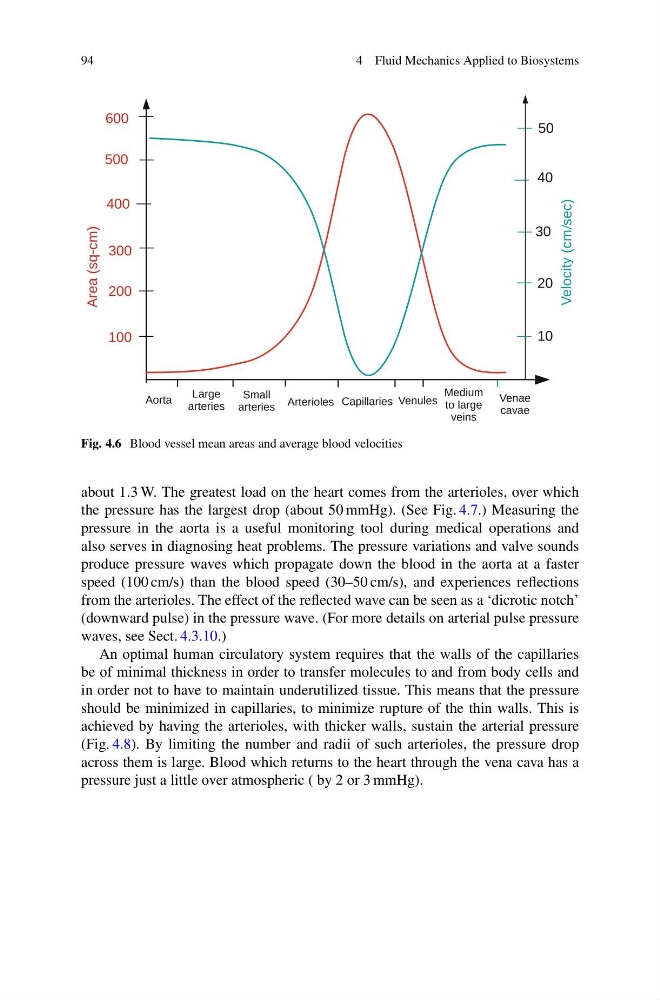
Fig. 4.6 Blood vessel mean areas and average blood velocities
about 1.3 W. The greatest load on the heart comes from the arterioles, over which
the pressure has the largest drop (about 50 mmHg). (See Fig. 4.7.) Measuring the
pressure in the aorta is a useful monitoring tool during medical operations and
also serves in diagnosing heat problems. The pressure variations and valve sounds
produce pressure waves which propagate down the blood in the aorta at a faster
speed (100 cm/s) than the blood speed (30–50 cm/s), and experiences reflections
from the arterioles. The effect of the reflected wave can be seen as a ‘dicrotic notch’
(downward pulse) in the pressure wave. (For more details on arterial pulse pressure
waves, see Sect. 4.3.10.)
An optimal human circulatory system requires that the walls of the capillaries
be of minimal thickness in order to transfer molecules to and from body cells and
in order not to have to maintain underutilized tissue. This means that the pressure
should be minimized in capillaries, to minimize rupture of the thin walls. This is
achieved by having the arterioles, with thicker walls, sustain the arterial pressure
(Fig. 4.8). By limiting the number and radii of such arterioles, the pressure drop
across them is large. Blood which returns to the heart through the vena cava has a
pressure just a little over atmospheric ( by 2 or 3 mmHg).
4 Fluid Mechanics Applied to Biosystems
/ y
Fig. 4.6 Blood vessel mean areas and average blood velocities
about 1.3 W. The greatest load on the heart comes from the arterioles, over which
the pressure has the largest drop (about 50 mmHg). (See Fig. 4.7.) Measuring the
pressure in the aorta is a useful monitoring tool during medical operations and
also serves in diagnosing heat problems. The pressure variations and valve sounds
produce pressure waves which propagate down the blood in the aorta at a faster
speed (100 cm/s) than the blood speed (30–50 cm/s), and experiences reflections
from the arterioles. The effect of the reflected wave can be seen as a ‘dicrotic notch’
(downward pulse) in the pressure wave. (For more details on arterial pulse pressure
waves, see Sect. 4.3.10.)
An optimal human circulatory system requires that the walls of the capillaries
be of minimal thickness in order to transfer molecules to and from body cells and
in order not to have to maintain underutilized tissue. This means that the pressure
should be minimized in capillaries, to minimize rupture of the thin walls. This is
achieved by having the arterioles, with thicker walls, sustain the arterial pressure
(Fig. 4.8). By limiting the number and radii of such arterioles, the pressure drop
across them is large. Blood which returns to the heart through the vena cava has a
pressure just a little over atmospheric ( by 2 or 3 mmHg).