

Mechanistic Understanding of Methane …
79
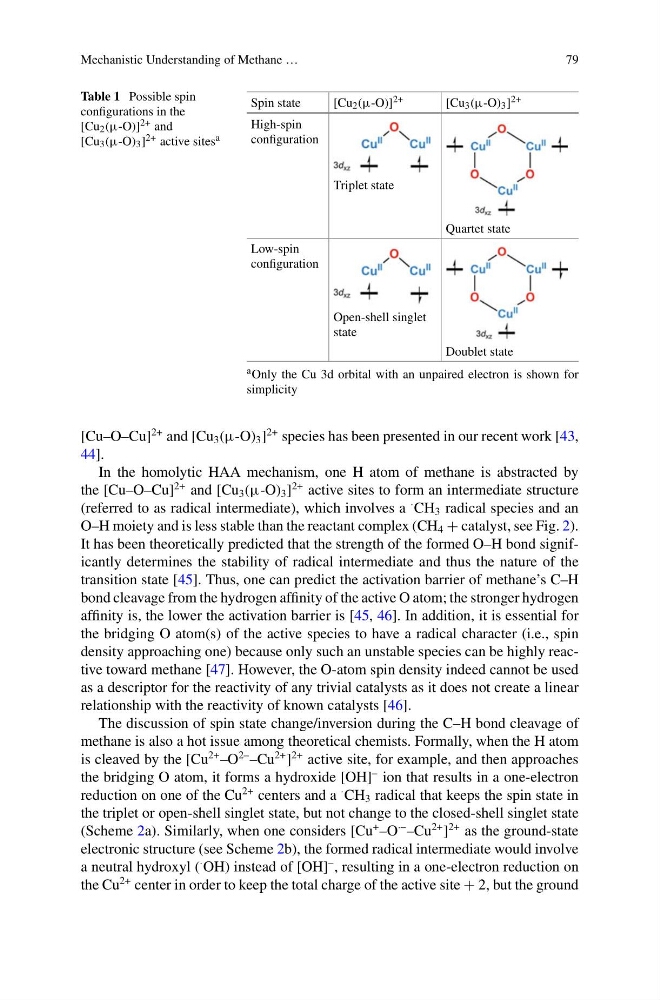
Table 1 Possible spin
configurations in the
[Cu 2 (μ-O)] 2+ and
[Cu 3 (μ-O) 3 ] 2+ active sites a
Spin state
[Cu 2 (μ-O)] 2+
[Cu 3 (μ-O) 3 ] 2+
High-spin
configuration
Triplet state
Quartet state
Low-spin
configuration
Open-shell singlet
state
Doublet state
a Only the Cu 3d orbital with an unpaired electron is shown for
simplicity
[Cu–O–Cu]
2+ and [Cu 3 (μ-O) 3 ]
2+ species has been presented in our recent work [43,
44].
In the homolytic HAA mechanism, one H atom of methane is abstracted by
the [Cu–O–Cu]
2+ and [Cu 3 (μ-O) 3 ]
2+ active sites to form an intermediate structure
(referred to as radical intermediate), which involves a
· CH 3 radical species and an
O–H moiety and is less stable than the reactant complex (CH 4 + catalyst, see Fig. 2).
It has been theoretically predicted that the strength of the formed O–H bond significantly determines the stability of radical intermediate and thus the nature of the
transition state [45]. Thus, one can predict the activation barrier of methane’s C–H
bond cleavage from the hydrogen affinity of the active O atom; the stronger hydrogen
affinity is, the lower the activation barrier is [45, 46]. In addition, it is essential for
the bridging O atom(s) of the active species to have a radical character (i.e., spin
density approaching one) because only such an unstable species can be highly reactive toward methane [47]. However, the O-atom spin density indeed cannot be used
as a descriptor for the reactivity of any trivial catalysts as it does not create a linear
relationship with the reactivity of known catalysts [46].
The discussion of spin state change/inversion during the C–H bond cleavage of
methane is also a hot issue among theoretical chemists. Formally, when the H atom
is cleaved by the [Cu
2+ –O
2– –Cu
2+ ]
2+ active site, for example, and then approaches
the bridging O atom, it forms a hydroxide [OH]
– ion that results in a one-electron
reduction on one of the Cu
2+ centers and a
· CH 3 radical that keeps the spin state in
the triplet or open-shell singlet state, but not change to the closed-shell singlet state
(Scheme 2a). Similarly, when one considers [Cu
+ –O
·– –Cu
2+ ]
2+ as the ground-state
electronic structure (see Scheme 2b), the formed radical intermediate would involve
a neutral hydroxyl (
· OH) instead of [OH]
– , resulting in a one-electron reduction on
the Cu
2+ center in order to keep the total charge of the active site + 2, but the ground
79
Table 1 Possible spin
configurations in the
[Cu 2 (μ-O)] 2+ and
[Cu 3 (μ-O) 3 ] 2+ active sites a
Spin state
[Cu 2 (μ-O)] 2+
[Cu 3 (μ-O) 3 ] 2+
High-spin
configuration
Triplet state
Quartet state
Low-spin
configuration
Open-shell singlet
state
Doublet state
a Only the Cu 3d orbital with an unpaired electron is shown for
simplicity
[Cu–O–Cu]
2+ and [Cu 3 (μ-O) 3 ]
2+ species has been presented in our recent work [43,
44].
In the homolytic HAA mechanism, one H atom of methane is abstracted by
the [Cu–O–Cu]
2+ and [Cu 3 (μ-O) 3 ]
2+ active sites to form an intermediate structure
(referred to as radical intermediate), which involves a
· CH 3 radical species and an
O–H moiety and is less stable than the reactant complex (CH 4 + catalyst, see Fig. 2).
It has been theoretically predicted that the strength of the formed O–H bond significantly determines the stability of radical intermediate and thus the nature of the
transition state [45]. Thus, one can predict the activation barrier of methane’s C–H
bond cleavage from the hydrogen affinity of the active O atom; the stronger hydrogen
affinity is, the lower the activation barrier is [45, 46]. In addition, it is essential for
the bridging O atom(s) of the active species to have a radical character (i.e., spin
density approaching one) because only such an unstable species can be highly reactive toward methane [47]. However, the O-atom spin density indeed cannot be used
as a descriptor for the reactivity of any trivial catalysts as it does not create a linear
relationship with the reactivity of known catalysts [46].
The discussion of spin state change/inversion during the C–H bond cleavage of
methane is also a hot issue among theoretical chemists. Formally, when the H atom
is cleaved by the [Cu
2+ –O
2– –Cu
2+ ]
2+ active site, for example, and then approaches
the bridging O atom, it forms a hydroxide [OH]
– ion that results in a one-electron
reduction on one of the Cu
2+ centers and a
· CH 3 radical that keeps the spin state in
the triplet or open-shell singlet state, but not change to the closed-shell singlet state
(Scheme 2a). Similarly, when one considers [Cu
+ –O
·– –Cu
2+ ]
2+ as the ground-state
electronic structure (see Scheme 2b), the formed radical intermediate would involve
a neutral hydroxyl (
· OH) instead of [OH]
– , resulting in a one-electron reduction on
the Cu
2+ center in order to keep the total charge of the active site + 2, but the ground