

50
T. Yumura et al.
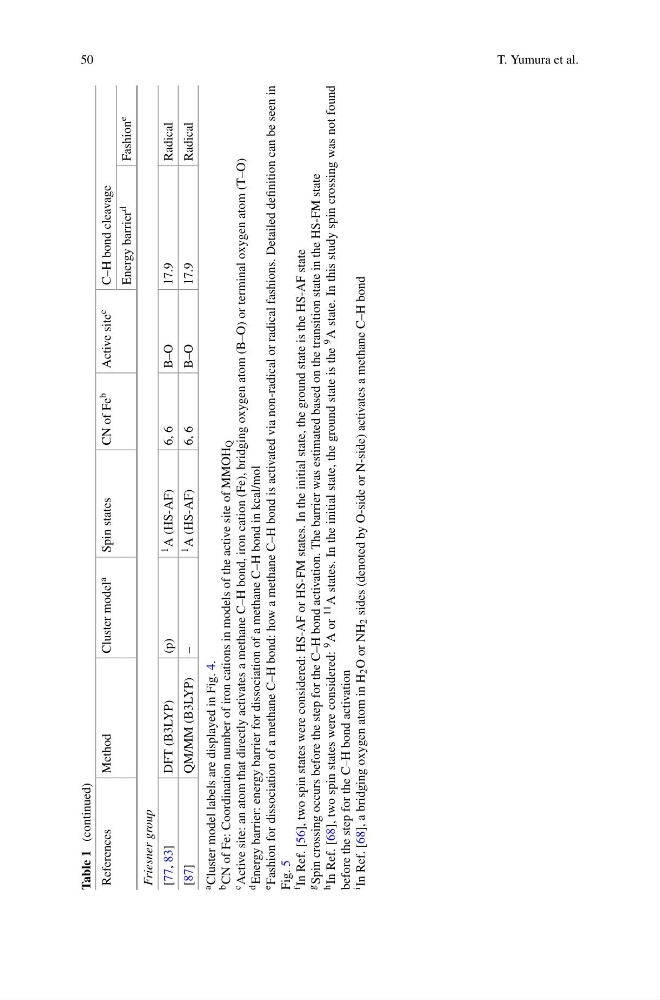
Table 1
(continued)
References
Method
Cluster model a
Spin states
CN of Fe b
Active site c
C–H bond cleavage
Energy barrier d
Fashion e
Friesner group
[77, 83]
DFT (B3LYP)
(p)
1
A (HS-AF)
6, 6
B–O
17.9
Radical
[87]
QM/MM (B3LYP)
–
1
A (HS-AF)
6, 6
B–O
17.9
Radical
a
Cluster model labels are displayed in Fig. 4.
b
CN of Fe: Coordination number of iron cations in models of the active site of MMOH
Q
c
Active site: an atom that directly activates a methane C–H bond, iron cation (Fe), bridging oxygen atom (B–O) or terminal oxygen atom (T–O)
d
Energy barrier: energy barrier for dissociation of a methane C–H bond in kcal/mol
e
Fashion for dissociation of a methane C–H bond: how a methane C–H bond is activated via non-radical or radical fashions. Detailed definition can be seen in
Fig. 5
f
In Ref. [56], two spin states were considered: HS-AF or HS-FM states. In the initial state, the ground state is the HS-AF state
g
Spin crossing occurs before the step for the C–H bond activation. The barrier was estimated based on the transition state in the HS-FM state
h
In Ref. [68], two spin states were considered: 9
A or 11
A states. In the initial state, the ground state is the 9
A state. In this study spin crossing was not found
before the step for the C–H bond activation
i
In Ref. [68], a bridging oxygen atom in H
2 O or NH
2 sides (denoted by O-side or N-side) activates a methane C–H bond
T. Yumura et al.
Table 1
(continued)
References
Method
Cluster model a
Spin states
CN of Fe b
Active site c
C–H bond cleavage
Energy barrier d
Fashion e
Friesner group
[77, 83]
DFT (B3LYP)
(p)
1
A (HS-AF)
6, 6
B–O
17.9
Radical
[87]
QM/MM (B3LYP)
–
1
A (HS-AF)
6, 6
B–O
17.9
Radical
a
Cluster model labels are displayed in Fig. 4.
b
CN of Fe: Coordination number of iron cations in models of the active site of MMOH
Q
c
Active site: an atom that directly activates a methane C–H bond, iron cation (Fe), bridging oxygen atom (B–O) or terminal oxygen atom (T–O)
d
Energy barrier: energy barrier for dissociation of a methane C–H bond in kcal/mol
e
Fashion for dissociation of a methane C–H bond: how a methane C–H bond is activated via non-radical or radical fashions. Detailed definition can be seen in
Fig. 5
f
In Ref. [56], two spin states were considered: HS-AF or HS-FM states. In the initial state, the ground state is the HS-AF state
g
Spin crossing occurs before the step for the C–H bond activation. The barrier was estimated based on the transition state in the HS-FM state
h
In Ref. [68], two spin states were considered: 9
A or 11
A states. In the initial state, the ground state is the 9
A state. In this study spin crossing was not found
before the step for the C–H bond activation
i
In Ref. [68], a bridging oxygen atom in H
2 O or NH
2 sides (denoted by O-side or N-side) activates a methane C–H bond