

Enzymatic Methane Hydroxylation: sMMO and pMMO
47
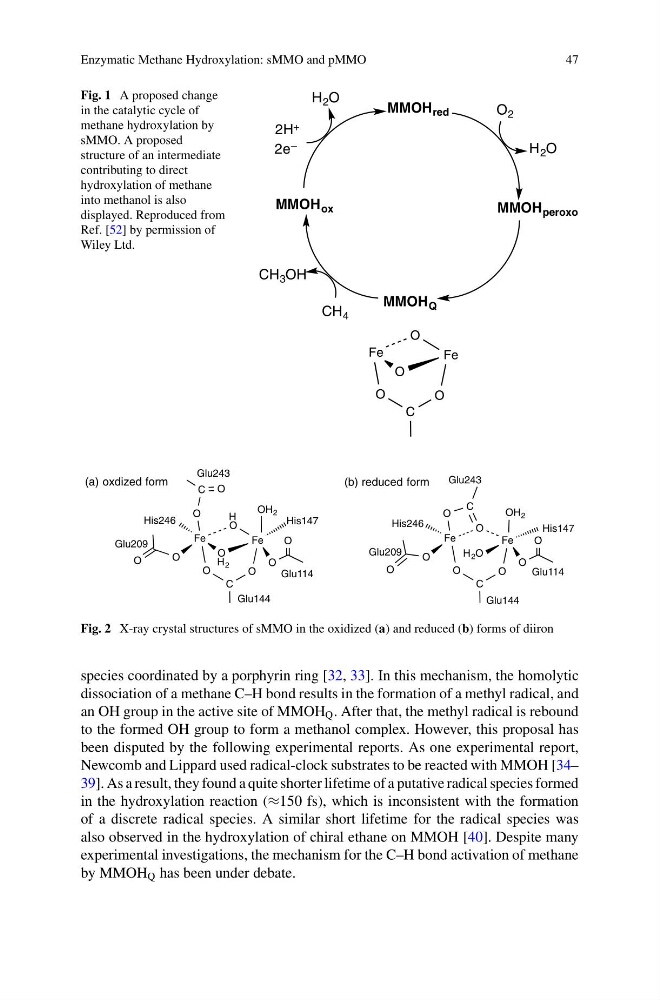
Fig. 1 A proposed change
in the catalytic cycle of
methane hydroxylation by
sMMO. A proposed
structure of an intermediate
contributing to direct
hydroxylation of methane
into methanol is also
displayed. Reproduced from
Ref. [52] by permission of
Wiley Ltd.
MMOH Q
MMOH peroxo
O 2
H 2 O
CH 4
CH 3 OH
H 2 O
MMOH ox
2H +
2e
MMOH red
Fe
Fe
O
O
O
O
C
Fe
Fe
O
H
O
O
H 2
O
O
O
O
C
C
O
O
O
Fe
Fe
O
O
O
OH 2
O
O
C
C
O
O
O
H 2 O
His147
His246
Glu209
Glu114
Glu144
Glu243
Glu144
His147
Glu114
Glu209
Glu243
His246
OH 2
(b) reduced form
(a) oxdized form
Fig. 2 X-ray crystal structures of sMMO in the oxidized (a) and reduced (b) forms of diiron
species coordinated by a porphyrin ring [32, 33]. In this mechanism, the homolytic
dissociation of a methane C–H bond results in the formation of a methyl radical, and
an OH group in the active site of MMOH Q . After that, the methyl radical is rebound
to the formed OH group to form a methanol complex. However, this proposal has
been disputed by the following experimental reports. As one experimental report,
Newcomb and Lippard used radical-clock substrates to be reacted with MMOH [34–
39]. As a result, they found a quite shorter lifetime of a putative radical species formed
in the hydroxylation reaction (≈150 fs), which is inconsistent with the formation
of a discrete radical species. A similar short lifetime for the radical species was
also observed in the hydroxylation of chiral ethane on MMOH [40]. Despite many
experimental investigations, the mechanism for the C–H bond activation of methane
by MMOH Q has been under debate.
47
Fig. 1 A proposed change
in the catalytic cycle of
methane hydroxylation by
sMMO. A proposed
structure of an intermediate
contributing to direct
hydroxylation of methane
into methanol is also
displayed. Reproduced from
Ref. [52] by permission of
Wiley Ltd.
MMOH Q
MMOH peroxo
O 2
H 2 O
CH 4
CH 3 OH
H 2 O
MMOH ox
2H +
2e
MMOH red
Fe
Fe
O
O
O
O
C
Fe
Fe
O
H
O
O
H 2
O
O
O
O
C
C
O
O
O
Fe
Fe
O
O
O
OH 2
O
O
C
C
O
O
O
H 2 O
His147
His246
Glu209
Glu114
Glu144
Glu243
Glu144
His147
Glu114
Glu209
Glu243
His246
OH 2
(b) reduced form
(a) oxdized form
Fig. 2 X-ray crystal structures of sMMO in the oxidized (a) and reduced (b) forms of diiron
species coordinated by a porphyrin ring [32, 33]. In this mechanism, the homolytic
dissociation of a methane C–H bond results in the formation of a methyl radical, and
an OH group in the active site of MMOH Q . After that, the methyl radical is rebound
to the formed OH group to form a methanol complex. However, this proposal has
been disputed by the following experimental reports. As one experimental report,
Newcomb and Lippard used radical-clock substrates to be reacted with MMOH [34–
39]. As a result, they found a quite shorter lifetime of a putative radical species formed
in the hydroxylation reaction (≈150 fs), which is inconsistent with the formation
of a discrete radical species. A similar short lifetime for the radical species was
also observed in the hydroxylation of chiral ethane on MMOH [40]. Despite many
experimental investigations, the mechanism for the C–H bond activation of methane
by MMOH Q has been under debate.