

40
Y. Shiota and K. Yoshizawa
This intersection arises from the fact that the equilibrium geometries of the hydroxo
intermediates of the spin states differ, whereas the quartet state and the sextet state
are close in energy. Because the
6
+
−
4
Δ 1 SOC value is 21.4 cm
−1 in the hydroxo
intermediate, the transition between the
6
+ and
4
Δ 1 states is unlikely to occur in
the second crossing seam.
The second half of the reaction pathway is responsible for the formation of the
product complex via TS2. The essential process in the second half of the reaction is
the dissociation of the Fe–C bond and the formation of the C–O bond. We calculated
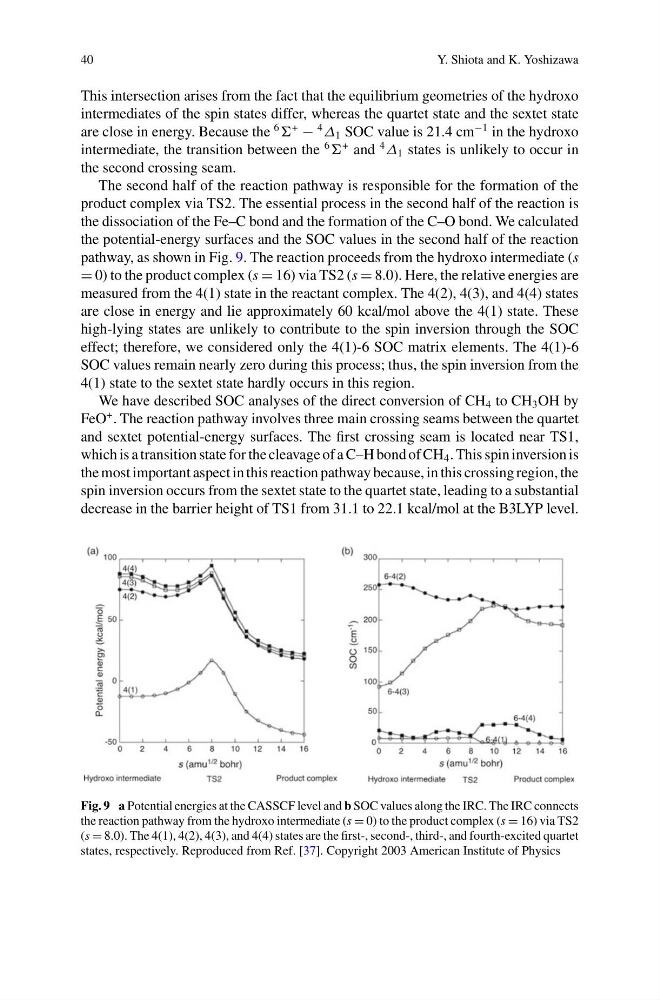
the potential-energy surfaces and the SOC values in the second half of the reaction
pathway, as shown in Fig. 9. The reaction proceeds from the hydroxo intermediate (s
= 0) to the product complex (s = 16) via TS2 (s = 8.0). Here, the relative energies are
measured from the 4(1) state in the reactant complex. The 4(2), 4(3), and 4(4) states
are close in energy and lie approximately 60 kcal/mol above the 4(1) state. These
high-lying states are unlikely to contribute to the spin inversion through the SOC
effect; therefore, we considered only the 4(1)-6 SOC matrix elements. The 4(1)-6
SOC values remain nearly zero during this process; thus, the spin inversion from the
4(1) state to the sextet state hardly occurs in this region.
We have described SOC analyses of the direct conversion of CH 4 to CH 3 OH by
FeO
+ . The reaction pathway involves three main crossing seams between the quartet
and sextet potential-energy surfaces. The first crossing seam is located near TS1,
which is a transition state for the cleavage of a C–H bond of CH 4 . This spin inversion is
the most important aspect in this reaction pathway because, in this crossing region, the
spin inversion occurs from the sextet state to the quartet state, leading to a substantial
decrease in the barrier height of TS1 from 31.1 to 22.1 kcal/mol at the B3LYP level.
Fig. 9 a Potential energies at the CASSCF level and b SOC values along the IRC. The IRC connects
the reaction pathway from the hydroxo intermediate (s = 0) to the product complex (s = 16) via TS2
(s = 8.0). The 4(1), 4(2), 4(3), and 4(4) states are the first-, second-, third-, and fourth-excited quartet
states, respectively. Reproduced from Ref. [37]. Copyright 2003 American Institute of Physics
Y. Shiota and K. Yoshizawa
This intersection arises from the fact that the equilibrium geometries of the hydroxo
intermediates of the spin states differ, whereas the quartet state and the sextet state
are close in energy. Because the
6
+
−
4
Δ 1 SOC value is 21.4 cm
−1 in the hydroxo
intermediate, the transition between the
6
+ and
4
Δ 1 states is unlikely to occur in
the second crossing seam.
The second half of the reaction pathway is responsible for the formation of the
product complex via TS2. The essential process in the second half of the reaction is
the dissociation of the Fe–C bond and the formation of the C–O bond. We calculated
the potential-energy surfaces and the SOC values in the second half of the reaction
pathway, as shown in Fig. 9. The reaction proceeds from the hydroxo intermediate (s
= 0) to the product complex (s = 16) via TS2 (s = 8.0). Here, the relative energies are
measured from the 4(1) state in the reactant complex. The 4(2), 4(3), and 4(4) states
are close in energy and lie approximately 60 kcal/mol above the 4(1) state. These
high-lying states are unlikely to contribute to the spin inversion through the SOC
effect; therefore, we considered only the 4(1)-6 SOC matrix elements. The 4(1)-6
SOC values remain nearly zero during this process; thus, the spin inversion from the
4(1) state to the sextet state hardly occurs in this region.
We have described SOC analyses of the direct conversion of CH 4 to CH 3 OH by
FeO
+ . The reaction pathway involves three main crossing seams between the quartet
and sextet potential-energy surfaces. The first crossing seam is located near TS1,
which is a transition state for the cleavage of a C–H bond of CH 4 . This spin inversion is
the most important aspect in this reaction pathway because, in this crossing region, the
spin inversion occurs from the sextet state to the quartet state, leading to a substantial
decrease in the barrier height of TS1 from 31.1 to 22.1 kcal/mol at the B3LYP level.
Fig. 9 a Potential energies at the CASSCF level and b SOC values along the IRC. The IRC connects
the reaction pathway from the hydroxo intermediate (s = 0) to the product complex (s = 16) via TS2
(s = 8.0). The 4(1), 4(2), 4(3), and 4(4) states are the first-, second-, third-, and fourth-excited quartet
states, respectively. Reproduced from Ref. [37]. Copyright 2003 American Institute of Physics