

30
Y. Shiota and K. Yoshizawa
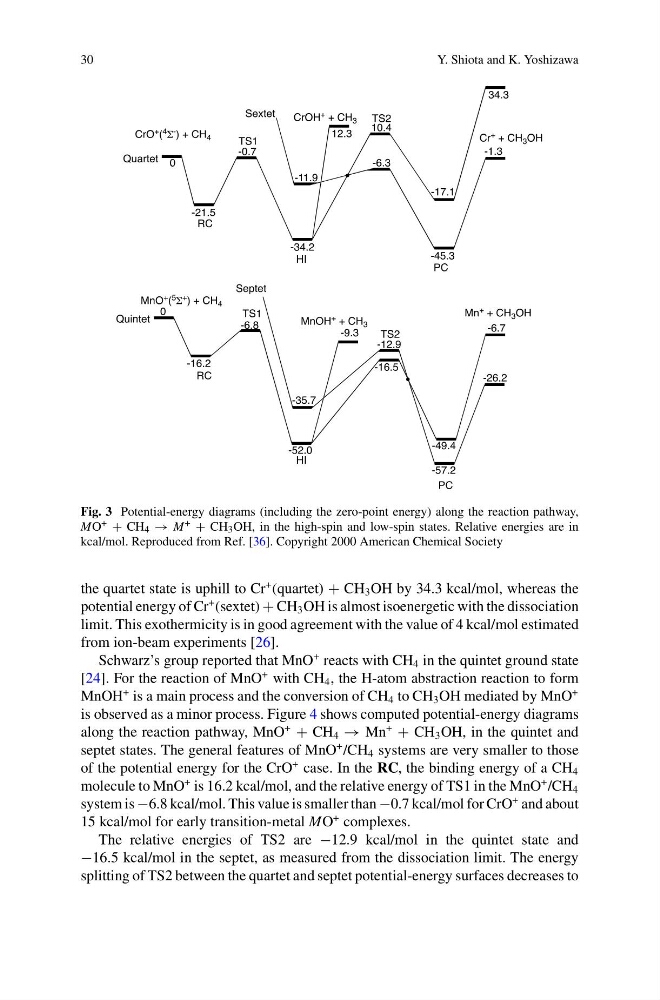
Fig. 3 Potential-energy diagrams (including the zero-point energy) along the reaction pathway,
MO + + CH 4 → M + + CH 3 OH, in the high-spin and low-spin states. Relative energies are in
kcal/mol. Reproduced from Ref. [36]. Copyright 2000 American Chemical Society
the quartet state is uphill to Cr
+ (quartet) + CH 3 OH by 34.3 kcal/mol, whereas the
potential energy of Cr
+ (sextet) + CH 3 OH is almost isoenergetic with the dissociation
limit. This exothermicity is in good agreement with the value of 4 kcal/mol estimated
from ion-beam experiments [26].
Schwarz’s group reported that MnO
+ reacts with CH 4 in the quintet ground state
[24]. For the reaction of MnO
+ with CH 4 , the H-atom abstraction reaction to form
MnOH
+ is a main process and the conversion of CH 4 to CH 3 OH mediated by MnO
+
is observed as a minor process. Figure 4 shows computed potential-energy diagrams
along the reaction pathway, MnO
+
+ CH 4 → Mn
+
+ CH 3 OH, in the quintet and
septet states. The general features of MnO
+ /CH 4 systems are very smaller to those
of the potential energy for the CrO
+ case. In the RC, the binding energy of a CH 4
molecule to MnO
+ is 16.2 kcal/mol, and the relative energy of TS1 in the MnO
+ /CH 4
system is −6.8 kcal/mol. This value is smaller than −0.7 kcal/mol for CrO
+ and about
15 kcal/mol for early transition-metal MO
+ complexes.
The relative energies of TS2 are −12.9 kcal/mol in the quintet state and
−16.5 kcal/mol in the septet, as measured from the dissociation limit. The energy
splitting of TS2 between the quartet and septet potential-energy surfaces decreases to
Y. Shiota and K. Yoshizawa
Fig. 3 Potential-energy diagrams (including the zero-point energy) along the reaction pathway,
MO + + CH 4 → M + + CH 3 OH, in the high-spin and low-spin states. Relative energies are in
kcal/mol. Reproduced from Ref. [36]. Copyright 2000 American Chemical Society
the quartet state is uphill to Cr
+ (quartet) + CH 3 OH by 34.3 kcal/mol, whereas the
potential energy of Cr
+ (sextet) + CH 3 OH is almost isoenergetic with the dissociation
limit. This exothermicity is in good agreement with the value of 4 kcal/mol estimated
from ion-beam experiments [26].
Schwarz’s group reported that MnO
+ reacts with CH 4 in the quintet ground state
[24]. For the reaction of MnO
+ with CH 4 , the H-atom abstraction reaction to form
MnOH
+ is a main process and the conversion of CH 4 to CH 3 OH mediated by MnO
+
is observed as a minor process. Figure 4 shows computed potential-energy diagrams
along the reaction pathway, MnO
+
+ CH 4 → Mn
+
+ CH 3 OH, in the quintet and
septet states. The general features of MnO
+ /CH 4 systems are very smaller to those
of the potential energy for the CrO
+ case. In the RC, the binding energy of a CH 4
molecule to MnO
+ is 16.2 kcal/mol, and the relative energy of TS1 in the MnO
+ /CH 4
system is −6.8 kcal/mol. This value is smaller than −0.7 kcal/mol for CrO
+ and about
15 kcal/mol for early transition-metal MO
+ complexes.
The relative energies of TS2 are −12.9 kcal/mol in the quintet state and
−16.5 kcal/mol in the septet, as measured from the dissociation limit. The energy
splitting of TS2 between the quartet and septet potential-energy surfaces decreases to