

Theoretical Study of the Direct Conversion of Methane …
27
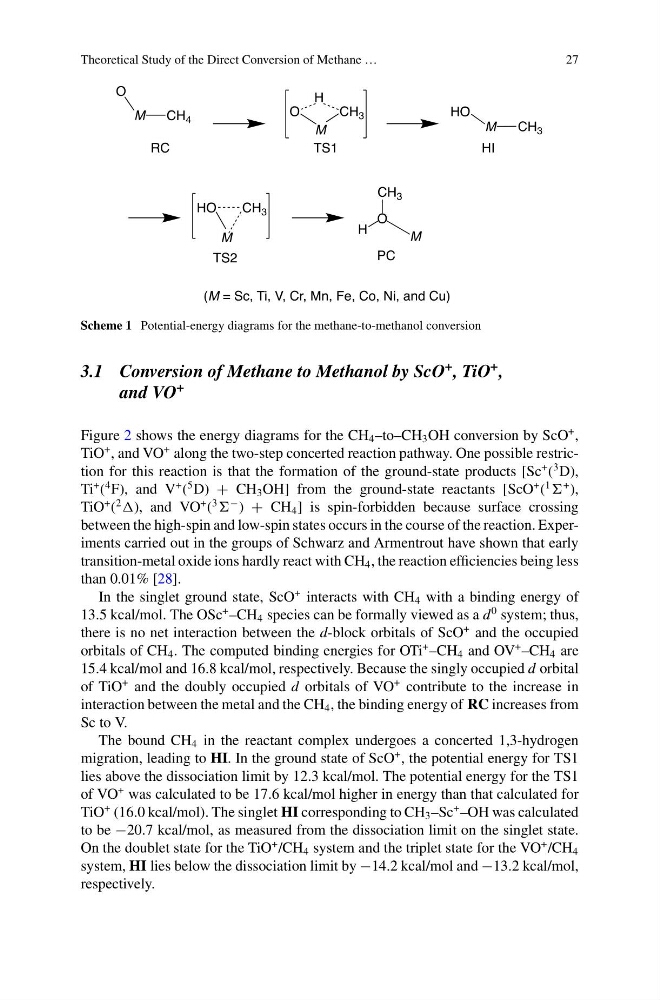
Scheme 1 Potential-energy diagrams for the methane-to-methanol conversion
3.1 Conversion of Methane to Methanol by ScO + , TiO + ,
and VO +
Figure 2 shows the energy diagrams for the CH 4 –to–CH 3 OH conversion by ScO
+ ,
TiO
+ , and VO
+ along the two-step concerted reaction pathway. One possible restriction for this reaction is that the formation of the ground-state products [Sc
+ (
3 D),
Ti
+ (
4 F), and V
+ (
5 D) + CH 3 OH] from the ground-state reactants [ScO
+ (
1
+ ),
TiO
+ (
2
), and VO
+ (
3
− ) + CH 4 ] is spin-forbidden because surface crossing
between the high-spin and low-spin states occurs in the course of the reaction. Experiments carried out in the groups of Schwarz and Armentrout have shown that early
transition-metal oxide ions hardly react with CH 4 , the reaction efficiencies being less
than 0.01% [28].
In the singlet ground state, ScO
+ interacts with CH 4 with a binding energy of
13.5 kcal/mol. The OSc
+ –CH 4 species can be formally viewed as a d
0 system; thus,
there is no net interaction between the d-block orbitals of ScO
+ and the occupied
orbitals of CH 4 . The computed binding energies for OTi
+ –CH 4 and OV
+ –CH 4 are
15.4 kcal/mol and 16.8 kcal/mol, respectively. Because the singly occupied d orbital
of TiO
+ and the doubly occupied d orbitals of VO
+ contribute to the increase in
interaction between the metal and the CH 4 , the binding energy of RC increases from
Sc to V.
The bound CH 4 in the reactant complex undergoes a concerted 1,3-hydrogen
migration, leading to HI. In the ground state of ScO
+ , the potential energy for TS1
lies above the dissociation limit by 12.3 kcal/mol. The potential energy for the TS1
of VO
+ was calculated to be 17.6 kcal/mol higher in energy than that calculated for
TiO
+ (16.0 kcal/mol). The singlet HI corresponding to CH 3 –Sc
+ –OH was calculated
to be −20.7 kcal/mol, as measured from the dissociation limit on the singlet state.
On the doublet state for the TiO
+ /CH 4 system and the triplet state for the VO
+ /CH 4
system, HI lies below the dissociation limit by −14.2 kcal/mol and −13.2 kcal/mol,
respectively.
27
Scheme 1 Potential-energy diagrams for the methane-to-methanol conversion
3.1 Conversion of Methane to Methanol by ScO + , TiO + ,
and VO +
Figure 2 shows the energy diagrams for the CH 4 –to–CH 3 OH conversion by ScO
+ ,
TiO
+ , and VO
+ along the two-step concerted reaction pathway. One possible restriction for this reaction is that the formation of the ground-state products [Sc
+ (
3 D),
Ti
+ (
4 F), and V
+ (
5 D) + CH 3 OH] from the ground-state reactants [ScO
+ (
1
+ ),
TiO
+ (
2
), and VO
+ (
3
− ) + CH 4 ] is spin-forbidden because surface crossing
between the high-spin and low-spin states occurs in the course of the reaction. Experiments carried out in the groups of Schwarz and Armentrout have shown that early
transition-metal oxide ions hardly react with CH 4 , the reaction efficiencies being less
than 0.01% [28].
In the singlet ground state, ScO
+ interacts with CH 4 with a binding energy of
13.5 kcal/mol. The OSc
+ –CH 4 species can be formally viewed as a d
0 system; thus,
there is no net interaction between the d-block orbitals of ScO
+ and the occupied
orbitals of CH 4 . The computed binding energies for OTi
+ –CH 4 and OV
+ –CH 4 are
15.4 kcal/mol and 16.8 kcal/mol, respectively. Because the singly occupied d orbital
of TiO
+ and the doubly occupied d orbitals of VO
+ contribute to the increase in
interaction between the metal and the CH 4 , the binding energy of RC increases from
Sc to V.
The bound CH 4 in the reactant complex undergoes a concerted 1,3-hydrogen
migration, leading to HI. In the ground state of ScO
+ , the potential energy for TS1
lies above the dissociation limit by 12.3 kcal/mol. The potential energy for the TS1
of VO
+ was calculated to be 17.6 kcal/mol higher in energy than that calculated for
TiO
+ (16.0 kcal/mol). The singlet HI corresponding to CH 3 –Sc
+ –OH was calculated
to be −20.7 kcal/mol, as measured from the dissociation limit on the singlet state.
On the doublet state for the TiO
+ /CH 4 system and the triplet state for the VO
+ /CH 4
system, HI lies below the dissociation limit by −14.2 kcal/mol and −13.2 kcal/mol,
respectively.