

Stockholm, joined the two, and they met several times during spring 1739 in the
home of Jonas Alströmer (1685–1761), one of the main figures in the industrial
revolution in Sweden. Alströmer had also been to England, been elected a fellow of
Royal Society and with two of the founding members strongly oriented towards
British traditions, it was natural to use the independent Royal Society as a model
rather than the more state-controlled Académie des Sciences in Paris [1]. It became
von Höpken’s role to write down the by-laws for the new society. Two other men
joined, Carl Wilhelm Cederhielm and Sten Carl Bielke, but they played minor roles.
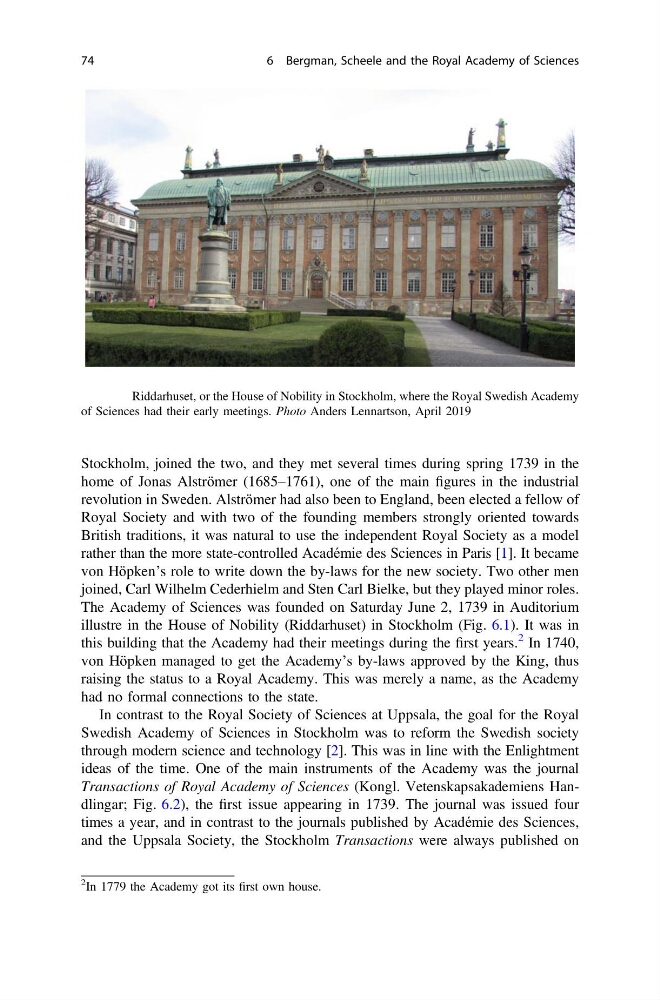
The Academy of Sciences was founded on Saturday June 2, 1739 in Auditorium
illustre in the House of Nobility (Riddarhuset) in Stockholm (Fig. 6.1). It was in
this building that the Academy had their meetings during the first years.
2 In 1740,
von Höpken managed to get the Academy’s by-laws approved by the King, thus
raising the status to a Royal Academy. This was merely a name, as the Academy
had no formal connections to the state.
In contrast to the Royal Society of Sciences at Uppsala, the goal for the Royal
Swedish Academy of Sciences in Stockholm was to reform the Swedish society
through modern science and technology [2]. This was in line with the Enlightment
ideas of the time. One of the main instruments of the Academy was the journal
Transactions of Royal Academy of Sciences (Kongl. Vetenskapsakademiens Handlingar; Fig. 6.2), the first issue appearing in 1739. The journal was issued four
times a year, and in contrast to the journals published by Académie des Sciences,
and the Uppsala Society, the Stockholm Transactions were always published on
Fig. 6.1 Riddarhuset, or the House of Nobility in Stockholm, where the Royal Swedish Academy
of Sciences had their early meetings. Photo Anders Lennartson, April 2019
2
In 1779 the Academy got its first own house.
74
6 Bergman, Scheele and the Royal Academy of Sciences
home of Jonas Alströmer (1685–1761), one of the main figures in the industrial
revolution in Sweden. Alströmer had also been to England, been elected a fellow of
Royal Society and with two of the founding members strongly oriented towards
British traditions, it was natural to use the independent Royal Society as a model
rather than the more state-controlled Académie des Sciences in Paris [1]. It became
von Höpken’s role to write down the by-laws for the new society. Two other men
joined, Carl Wilhelm Cederhielm and Sten Carl Bielke, but they played minor roles.
The Academy of Sciences was founded on Saturday June 2, 1739 in Auditorium
illustre in the House of Nobility (Riddarhuset) in Stockholm (Fig. 6.1). It was in
this building that the Academy had their meetings during the first years.
2 In 1740,
von Höpken managed to get the Academy’s by-laws approved by the King, thus
raising the status to a Royal Academy. This was merely a name, as the Academy
had no formal connections to the state.
In contrast to the Royal Society of Sciences at Uppsala, the goal for the Royal
Swedish Academy of Sciences in Stockholm was to reform the Swedish society
through modern science and technology [2]. This was in line with the Enlightment
ideas of the time. One of the main instruments of the Academy was the journal
Transactions of Royal Academy of Sciences (Kongl. Vetenskapsakademiens Handlingar; Fig. 6.2), the first issue appearing in 1739. The journal was issued four
times a year, and in contrast to the journals published by Académie des Sciences,
and the Uppsala Society, the Stockholm Transactions were always published on
Fig. 6.1 Riddarhuset, or the House of Nobility in Stockholm, where the Royal Swedish Academy
of Sciences had their early meetings. Photo Anders Lennartson, April 2019
2
In 1779 the Academy got its first own house.
74
6 Bergman, Scheele and the Royal Academy of Sciences