

chimneys. Frequently, the traffic interfered with the delicate instruments [6]. Still, it
served as observatory until 1853. Although the tower was removed in 1857, the
building still stands today.
On March 19, 1755, Bergman defended a 16-page thesis titled Dissertatio de
crepusculis (Dissertation on the twilights) under supervision of Mårten Strömer. It
was common practice to defend two theses, one for practice, and one to obtain the
degree. This was the training (pro exercitio) thesis, and since Bergman refers to it as
“my thesis” in his autobiography it is possible that it was written by himself rather
than by Strömer.
Mårten Strömer (Fig. 4.4) was born in Örebro in 1707 and had studied under
Anders Celsius. When Celsius died, aged only 42, in 1744, he was succeeded by
Strömer as professor in astronomy. Strömer was more oriented towards mathematics, and although he was a good teacher, he made no significant original contributions to astronomy. He is most famous for his Swedish translation of the works
of Euclid [6]. In 1757, while Bergman was a student, Strömer left for Karlskrona,
the site of Sweden’s primary naval base, where he helped to establish the new
Naval Academy.
The new Naval Academy was established in 1756, and when Strömer learned of
the plans, he went into action [7]. During his presidency in the Royal Swedish
Academy of Sciences, Bengt Ferner (1724–1802; Fig. 4.5) was inaugurated.
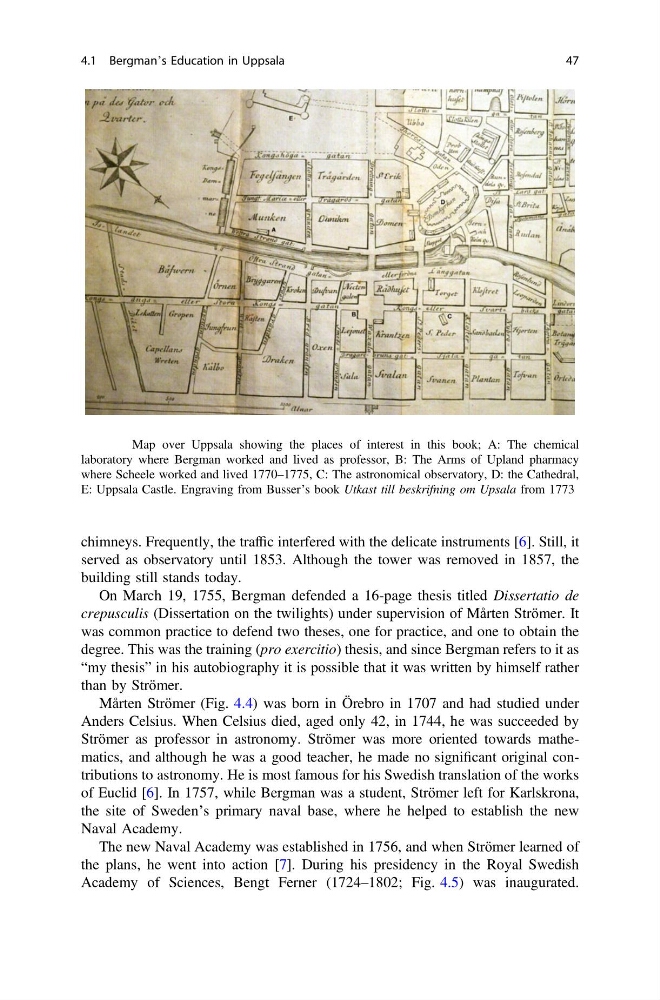
Fig. 4.1 Map over Uppsala showing the places of interest in this book; A: The chemical
laboratory where Bergman worked and lived as professor, B: The Arms of Upland pharmacy
where Scheele worked and lived 1770–1775, C: The astronomical observatory, D: the Cathedral,
E: Uppsala Castle. Engraving from Busser’s book Utkast till beskrifning om Upsala from 1773
4.1 Bergman’s Education in Uppsala
47
served as observatory until 1853. Although the tower was removed in 1857, the
building still stands today.
On March 19, 1755, Bergman defended a 16-page thesis titled Dissertatio de
crepusculis (Dissertation on the twilights) under supervision of Mårten Strömer. It
was common practice to defend two theses, one for practice, and one to obtain the
degree. This was the training (pro exercitio) thesis, and since Bergman refers to it as
“my thesis” in his autobiography it is possible that it was written by himself rather
than by Strömer.
Mårten Strömer (Fig. 4.4) was born in Örebro in 1707 and had studied under
Anders Celsius. When Celsius died, aged only 42, in 1744, he was succeeded by
Strömer as professor in astronomy. Strömer was more oriented towards mathematics, and although he was a good teacher, he made no significant original contributions to astronomy. He is most famous for his Swedish translation of the works
of Euclid [6]. In 1757, while Bergman was a student, Strömer left for Karlskrona,
the site of Sweden’s primary naval base, where he helped to establish the new
Naval Academy.
The new Naval Academy was established in 1756, and when Strömer learned of
the plans, he went into action [7]. During his presidency in the Royal Swedish
Academy of Sciences, Bengt Ferner (1724–1802; Fig. 4.5) was inaugurated.
Fig. 4.1 Map over Uppsala showing the places of interest in this book; A: The chemical
laboratory where Bergman worked and lived as professor, B: The Arms of Upland pharmacy
where Scheele worked and lived 1770–1775, C: The astronomical observatory, D: the Cathedral,
E: Uppsala Castle. Engraving from Busser’s book Utkast till beskrifning om Upsala from 1773
4.1 Bergman’s Education in Uppsala
47