

In the late 1920s, the president of the Swedish Pharmaceutical Society, Stellan
Gullström, was told that in the late nineteenth century, singer Angelica Brüggemann, a grandchild of one of Scheele’s brothers, had possessed a painted medallion
depicting Carl Wilhelm Scheele as a young man [26]. The medallion had last been
seen in the 1880s, some 50 years and one world war earlier, but Gullström did not
hesitate. He sent young pharmacist John Quist to Germany. Quist’s mission was
certainly not easy. Brüggemann was dead since several years, but she had been
survived by a brother, who had died in Berlin under poor circumstances. His widow
had died soon after, but the widower of one of her nieces was found to have the
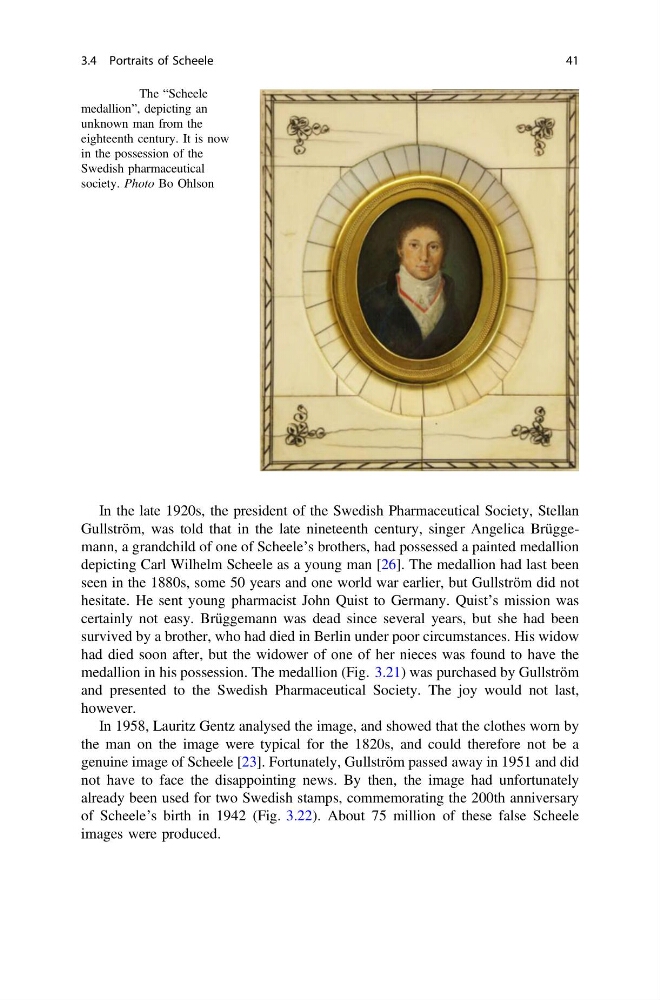
medallion in his possession. The medallion (Fig. 3.21) was purchased by Gullström
and presented to the Swedish Pharmaceutical Society. The joy would not last,
however.
In 1958, Lauritz Gentz analysed the image, and showed that the clothes worn by
the man on the image were typical for the 1820s, and could therefore not be a
genuine image of Scheele [23]. Fortunately, Gullström passed away in 1951 and did
not have to face the disappointing news. By then, the image had unfortunately
already been used for two Swedish stamps, commemorating the 200th anniversary
of Scheele’s birth in 1942 (Fig. 3.22). About 75 million of these false Scheele
images were produced.
Fig. 3.21 The “Scheele
medallion”, depicting an
unknown man from the
eighteenth century. It is now
in the possession of the
Swedish pharmaceutical
society. Photo Bo Ohlson
3.4 Portraits of Scheele
41
Gullström, was told that in the late nineteenth century, singer Angelica Brüggemann, a grandchild of one of Scheele’s brothers, had possessed a painted medallion
depicting Carl Wilhelm Scheele as a young man [26]. The medallion had last been
seen in the 1880s, some 50 years and one world war earlier, but Gullström did not
hesitate. He sent young pharmacist John Quist to Germany. Quist’s mission was
certainly not easy. Brüggemann was dead since several years, but she had been
survived by a brother, who had died in Berlin under poor circumstances. His widow
had died soon after, but the widower of one of her nieces was found to have the
medallion in his possession. The medallion (Fig. 3.21) was purchased by Gullström
and presented to the Swedish Pharmaceutical Society. The joy would not last,
however.
In 1958, Lauritz Gentz analysed the image, and showed that the clothes worn by
the man on the image were typical for the 1820s, and could therefore not be a
genuine image of Scheele [23]. Fortunately, Gullström passed away in 1951 and did
not have to face the disappointing news. By then, the image had unfortunately
already been used for two Swedish stamps, commemorating the 200th anniversary
of Scheele’s birth in 1942 (Fig. 3.22). About 75 million of these false Scheele
images were produced.
Fig. 3.21 The “Scheele
medallion”, depicting an
unknown man from the
eighteenth century. It is now
in the possession of the
Swedish pharmaceutical
society. Photo Bo Ohlson
3.4 Portraits of Scheele
41