

were originally written in German and later translated, but Swedish concepts for a
few of his later papers are preserved in the archive of the Royal Swedish Academy
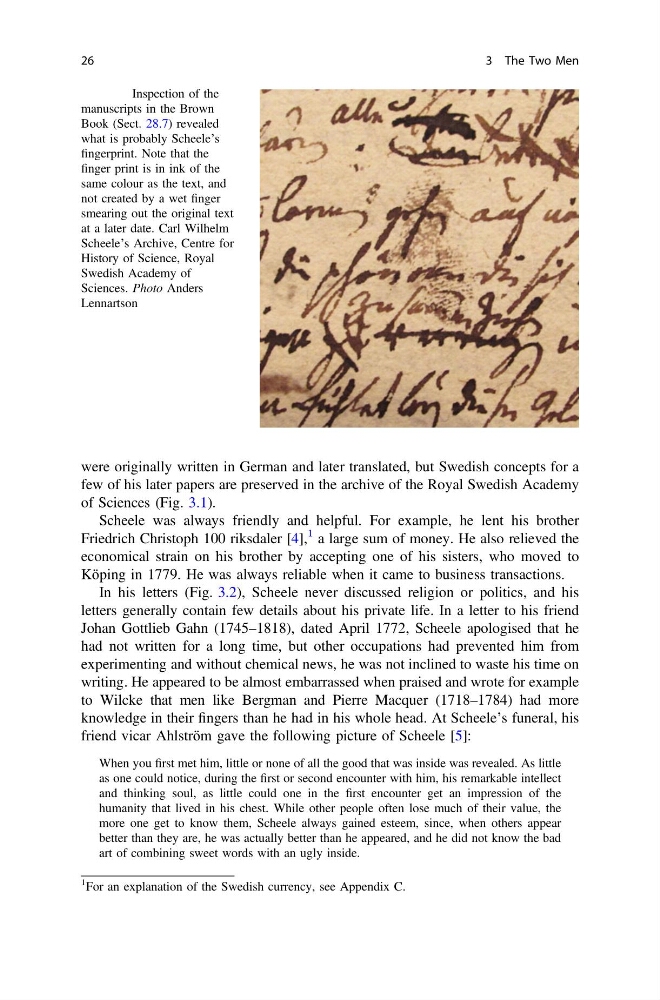
of Sciences (Fig. 3.1).
Scheele was always friendly and helpful. For example, he lent his brother
Friedrich Christoph 100 riksdaler [4],
1 a large sum of money. He also relieved the
economical strain on his brother by accepting one of his sisters, who moved to
Köping in 1779. He was always reliable when it came to business transactions.
In his letters (Fig. 3.2), Scheele never discussed religion or politics, and his
letters generally contain few details about his private life. In a letter to his friend
Johan Gottlieb Gahn (1745–1818), dated April 1772, Scheele apologised that he
had not written for a long time, but other occupations had prevented him from
experimenting and without chemical news, he was not inclined to waste his time on
writing. He appeared to be almost embarrassed when praised and wrote for example
to Wilcke that men like Bergman and Pierre Macquer (1718–1784) had more
knowledge in their fingers than he had in his whole head. At Scheele’s funeral, his
friend vicar Ahlström gave the following picture of Scheele [5]:
When you first met him, little or none of all the good that was inside was revealed. As little
as one could notice, during the first or second encounter with him, his remarkable intellect
and thinking soul, as little could one in the first encounter get an impression of the
humanity that lived in his chest. While other people often lose much of their value, the
more one get to know them, Scheele always gained esteem, since, when others appear
better than they are, he was actually better than he appeared, and he did not know the bad
art of combining sweet words with an ugly inside.
Fig. 3.1 Inspection of the
manuscripts in the Brown
Book (Sect. 28.7) revealed
what is probably Scheele’s
fingerprint. Note that the
finger print is in ink of the
same colour as the text, and
not created by a wet finger
smearing out the original text
at a later date. Carl Wilhelm
Scheele’s Archive, Centre for
History of Science, Royal
Swedish Academy of
Sciences. Photo Anders
Lennartson
1
For an explanation of the Swedish currency, see Appendix C.
26
3 The Two Men
few of his later papers are preserved in the archive of the Royal Swedish Academy
of Sciences (Fig. 3.1).
Scheele was always friendly and helpful. For example, he lent his brother
Friedrich Christoph 100 riksdaler [4],
1 a large sum of money. He also relieved the
economical strain on his brother by accepting one of his sisters, who moved to
Köping in 1779. He was always reliable when it came to business transactions.
In his letters (Fig. 3.2), Scheele never discussed religion or politics, and his
letters generally contain few details about his private life. In a letter to his friend
Johan Gottlieb Gahn (1745–1818), dated April 1772, Scheele apologised that he
had not written for a long time, but other occupations had prevented him from
experimenting and without chemical news, he was not inclined to waste his time on
writing. He appeared to be almost embarrassed when praised and wrote for example
to Wilcke that men like Bergman and Pierre Macquer (1718–1784) had more
knowledge in their fingers than he had in his whole head. At Scheele’s funeral, his
friend vicar Ahlström gave the following picture of Scheele [5]:
When you first met him, little or none of all the good that was inside was revealed. As little
as one could notice, during the first or second encounter with him, his remarkable intellect
and thinking soul, as little could one in the first encounter get an impression of the
humanity that lived in his chest. While other people often lose much of their value, the
more one get to know them, Scheele always gained esteem, since, when others appear
better than they are, he was actually better than he appeared, and he did not know the bad
art of combining sweet words with an ugly inside.
Fig. 3.1 Inspection of the
manuscripts in the Brown
Book (Sect. 28.7) revealed
what is probably Scheele’s
fingerprint. Note that the
finger print is in ink of the
same colour as the text, and
not created by a wet finger
smearing out the original text
at a later date. Carl Wilhelm
Scheele’s Archive, Centre for
History of Science, Royal
Swedish Academy of
Sciences. Photo Anders
Lennartson
1
For an explanation of the Swedish currency, see Appendix C.
26
3 The Two Men