

Scheele and Bergman have minerals named after them. The mineral (CaWO 4 ) from
which Scheele isolated tungstic acid and which was known in Sweden as tungsten,
meaning “heavy stone” in the eighteenth century, is now called scheelite, and
Bergman got two uranium minerals, torbernite (Cu(UO 2 ) 2 (PO 4 ) 2 ∙ 12 H 2 O) and
metatorbernite (Cu(UO 2 ) 2 (PO 4 ) 2 ∙ 8 H 2 O) named after him.
Some may argue that the lives of individual scientists are of little or no interest:
if one scientist fails to make a discovery, someone else will soon make the same
discovery. Perhaps one should distinguish between scientists who are only linked to
a single great discovery, and those who are still of interest if their greatest discovery
is ignored. Take, for instance, Dmitri Mendeleev; if it were not for his contribution
to the invention of the periodic table, he would only be a minor figure in the history
of chemistry. Given the parallel work on the periodic law by Lothar Meyer and
others, the periodic table would actually have developed along a similar line
without Mendeleev’s contribution. If we, on the other hand, suppose that Albert
Einstein had not formulated the theory of special relativity, his other work would
still have made him one of the most influential scientists of the twentieth century.
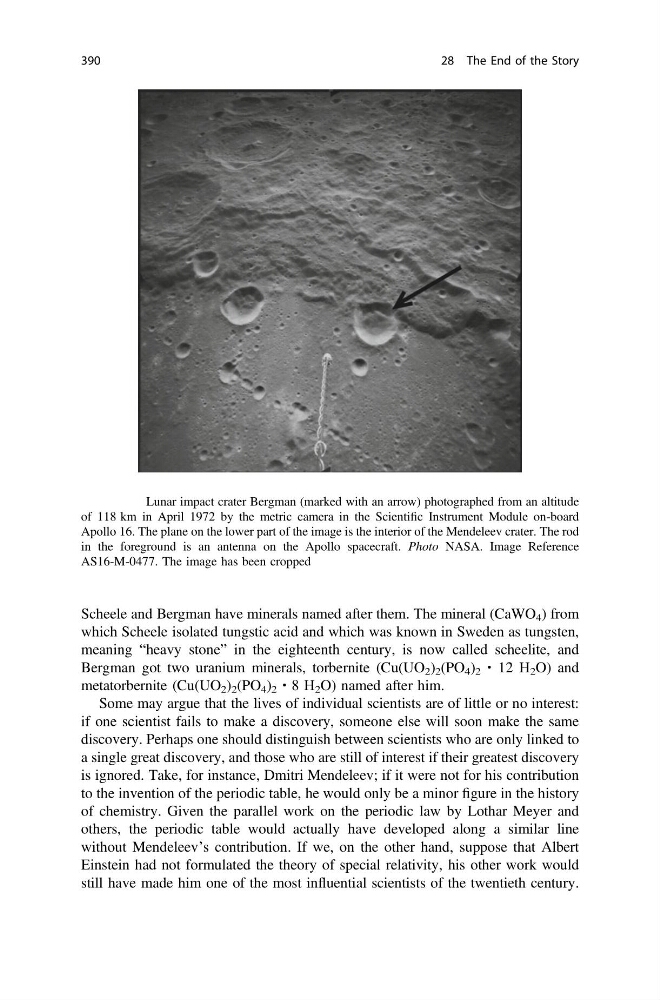
Fig. 28.10 Lunar impact crater Bergman (marked with an arrow) photographed from an altitude
of 118 km in April 1972 by the metric camera in the Scientific Instrument Module on-board
Apollo 16. The plane on the lower part of the image is the interior of the Mendeleev crater. The rod
in the foreground is an antenna on the Apollo spacecraft. Photo NASA. Image Reference
AS16-M-0477. The image has been cropped
390
28 The End of the Story
which Scheele isolated tungstic acid and which was known in Sweden as tungsten,
meaning “heavy stone” in the eighteenth century, is now called scheelite, and
Bergman got two uranium minerals, torbernite (Cu(UO 2 ) 2 (PO 4 ) 2 ∙ 12 H 2 O) and
metatorbernite (Cu(UO 2 ) 2 (PO 4 ) 2 ∙ 8 H 2 O) named after him.
Some may argue that the lives of individual scientists are of little or no interest:
if one scientist fails to make a discovery, someone else will soon make the same
discovery. Perhaps one should distinguish between scientists who are only linked to
a single great discovery, and those who are still of interest if their greatest discovery
is ignored. Take, for instance, Dmitri Mendeleev; if it were not for his contribution
to the invention of the periodic table, he would only be a minor figure in the history
of chemistry. Given the parallel work on the periodic law by Lothar Meyer and
others, the periodic table would actually have developed along a similar line
without Mendeleev’s contribution. If we, on the other hand, suppose that Albert
Einstein had not formulated the theory of special relativity, his other work would
still have made him one of the most influential scientists of the twentieth century.
Fig. 28.10 Lunar impact crater Bergman (marked with an arrow) photographed from an altitude
of 118 km in April 1972 by the metric camera in the Scientific Instrument Module on-board
Apollo 16. The plane on the lower part of the image is the interior of the Mendeleev crater. The rod
in the foreground is an antenna on the Apollo spacecraft. Photo NASA. Image Reference
AS16-M-0477. The image has been cropped
390
28 The End of the Story