

28.7 Scheele’s Manuscripts
It was immediately realised that there could be notes on important unpublished
discoveries among Scheele’s papers. Physician Birger Martin Hall who arrived at
Scheele’s home a few hours after his death spent two hours collecting all papers,
notes and letters he could find and in the presence of Mrs. Scheele and her father, he
tied a string around the documents and was assured that they would not be thrown
away or handed over to anyone without his permission. The widow was soon
contacted by Wilcke in Stockholm, who offered economical compensation in
exchange for the papers, which ever since have been stored in the archive of the
Royal Swedish Academy of Sciences. Wilcke’s intension was to use the papers for
his memorial lecture over Scheele in the Academy, but upon his death 10 years
later, the lecture was still not finished. It was finally completed in 1799 by physicist
Carl Gustaf Sjöstén (1767–1817), acting Secretary of the Academy. The lecture was
subsequently printed in 1801. In the introduction, Sjöstén, who unlike Wilcke did
not know Scheele personally, wrote that he had only changed the beginning and end
of the lecture, but Boklund found several alterations when he compared the printed
lecture with Wilckes manuscript, where the text appears in several versions [46].
For example, Sjöstén claimed that Scheele’s papers were close to useless, while
Boklund’s conclusion was that they were never thoroughly examined.
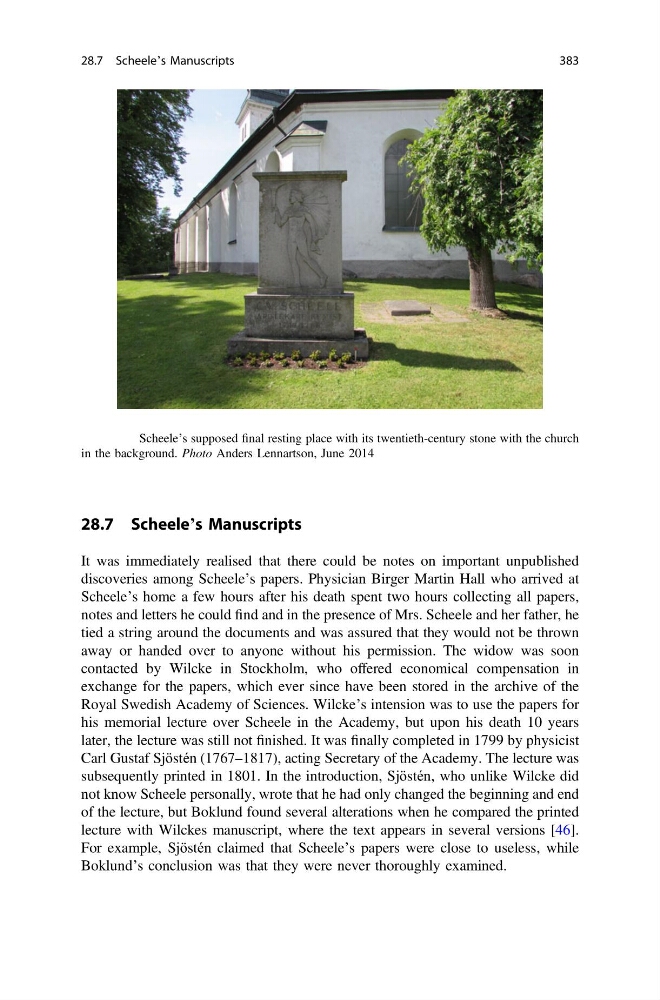
Fig. 28.3 Scheele’s supposed final resting place with its twentieth-century stone with the church
in the background. Photo Anders Lennartson, June 2014
28.7 Scheele’s Manuscripts
383
It was immediately realised that there could be notes on important unpublished
discoveries among Scheele’s papers. Physician Birger Martin Hall who arrived at
Scheele’s home a few hours after his death spent two hours collecting all papers,
notes and letters he could find and in the presence of Mrs. Scheele and her father, he
tied a string around the documents and was assured that they would not be thrown
away or handed over to anyone without his permission. The widow was soon
contacted by Wilcke in Stockholm, who offered economical compensation in
exchange for the papers, which ever since have been stored in the archive of the
Royal Swedish Academy of Sciences. Wilcke’s intension was to use the papers for
his memorial lecture over Scheele in the Academy, but upon his death 10 years
later, the lecture was still not finished. It was finally completed in 1799 by physicist
Carl Gustaf Sjöstén (1767–1817), acting Secretary of the Academy. The lecture was
subsequently printed in 1801. In the introduction, Sjöstén, who unlike Wilcke did
not know Scheele personally, wrote that he had only changed the beginning and end
of the lecture, but Boklund found several alterations when he compared the printed
lecture with Wilckes manuscript, where the text appears in several versions [46].
For example, Sjöstén claimed that Scheele’s papers were close to useless, while
Boklund’s conclusion was that they were never thoroughly examined.
Fig. 28.3 Scheele’s supposed final resting place with its twentieth-century stone with the church
in the background. Photo Anders Lennartson, June 2014
28.7 Scheele’s Manuscripts
383