

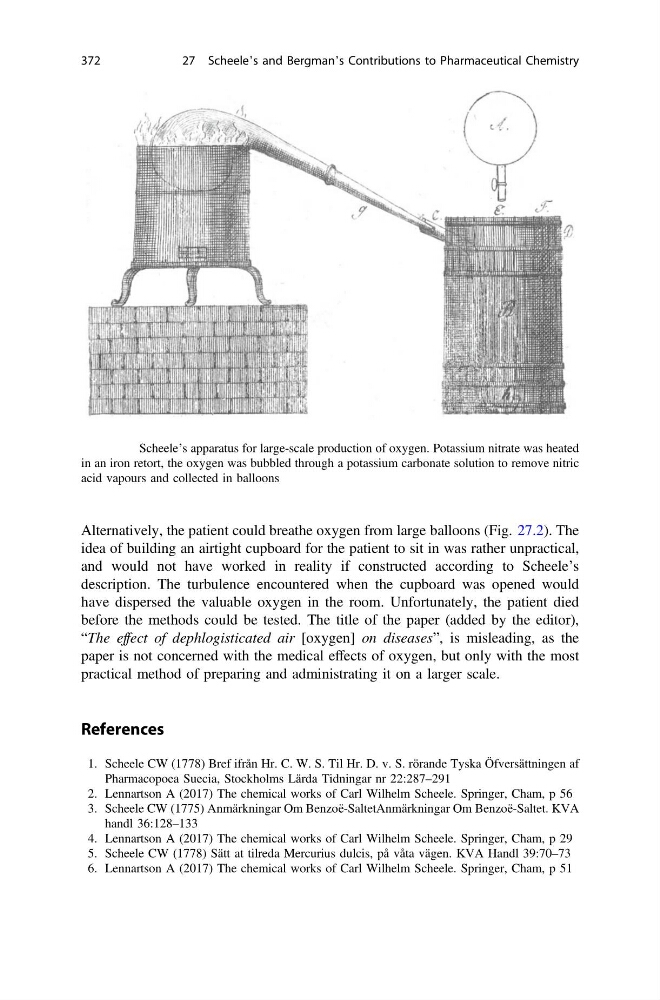
Alternatively, the patient could breathe oxygen from large balloons (Fig. 27.2). The
idea of building an airtight cupboard for the patient to sit in was rather unpractical,
and would not have worked in reality if constructed according to Scheele’s
description. The turbulence encountered when the cupboard was opened would
have dispersed the valuable oxygen in the room. Unfortunately, the patient died
before the methods could be tested. The title of the paper (added by the editor),
“The effect of dephlogisticated air [oxygen] on diseases”, is misleading, as the
paper is not concerned with the medical effects of oxygen, but only with the most
practical method of preparing and administrating it on a larger scale.
References
1. Scheele CW (1778) Bref ifrån Hr. C. W. S. Til Hr. D. v. S. rörande Tyska Öfversättningen af
Pharmacopoea Suecia, Stockholms Lärda Tidningar nr 22:287–291
2. Lennartson A (2017) The chemical works of Carl Wilhelm Scheele. Springer, Cham, p 56
3. Scheele CW (1775) Anmärkningar Om Benzoë-SaltetAnmärkningar Om Benzoë-Saltet. KVA
handl 36:128–133
4. Lennartson A (2017) The chemical works of Carl Wilhelm Scheele. Springer, Cham, p 29
5. Scheele CW (1778) Sätt at tilreda Mercurius dulcis, på våta vägen. KVA Handl 39:70–73
6. Lennartson A (2017) The chemical works of Carl Wilhelm Scheele. Springer, Cham, p 51
Fig. 27.2 Scheele’s apparatus for large-scale production of oxygen. Potassium nitrate was heated
in an iron retort, the oxygen was bubbled through a potassium carbonate solution to remove nitric
acid vapours and collected in balloons
372
27 Scheele’s and Bergman’s Contributions to Pharmaceutical Chemistry
idea of building an airtight cupboard for the patient to sit in was rather unpractical,
and would not have worked in reality if constructed according to Scheele’s
description. The turbulence encountered when the cupboard was opened would
have dispersed the valuable oxygen in the room. Unfortunately, the patient died
before the methods could be tested. The title of the paper (added by the editor),
“The effect of dephlogisticated air [oxygen] on diseases”, is misleading, as the
paper is not concerned with the medical effects of oxygen, but only with the most
practical method of preparing and administrating it on a larger scale.
References
1. Scheele CW (1778) Bref ifrån Hr. C. W. S. Til Hr. D. v. S. rörande Tyska Öfversättningen af
Pharmacopoea Suecia, Stockholms Lärda Tidningar nr 22:287–291
2. Lennartson A (2017) The chemical works of Carl Wilhelm Scheele. Springer, Cham, p 56
3. Scheele CW (1775) Anmärkningar Om Benzoë-SaltetAnmärkningar Om Benzoë-Saltet. KVA
handl 36:128–133
4. Lennartson A (2017) The chemical works of Carl Wilhelm Scheele. Springer, Cham, p 29
5. Scheele CW (1778) Sätt at tilreda Mercurius dulcis, på våta vägen. KVA Handl 39:70–73
6. Lennartson A (2017) The chemical works of Carl Wilhelm Scheele. Springer, Cham, p 51
Fig. 27.2 Scheele’s apparatus for large-scale production of oxygen. Potassium nitrate was heated
in an iron retort, the oxygen was bubbled through a potassium carbonate solution to remove nitric
acid vapours and collected in balloons
372
27 Scheele’s and Bergman’s Contributions to Pharmaceutical Chemistry