

27.1 Benzoic Acid
In 1775, Scheele published an improved method of preparing benzoic acid
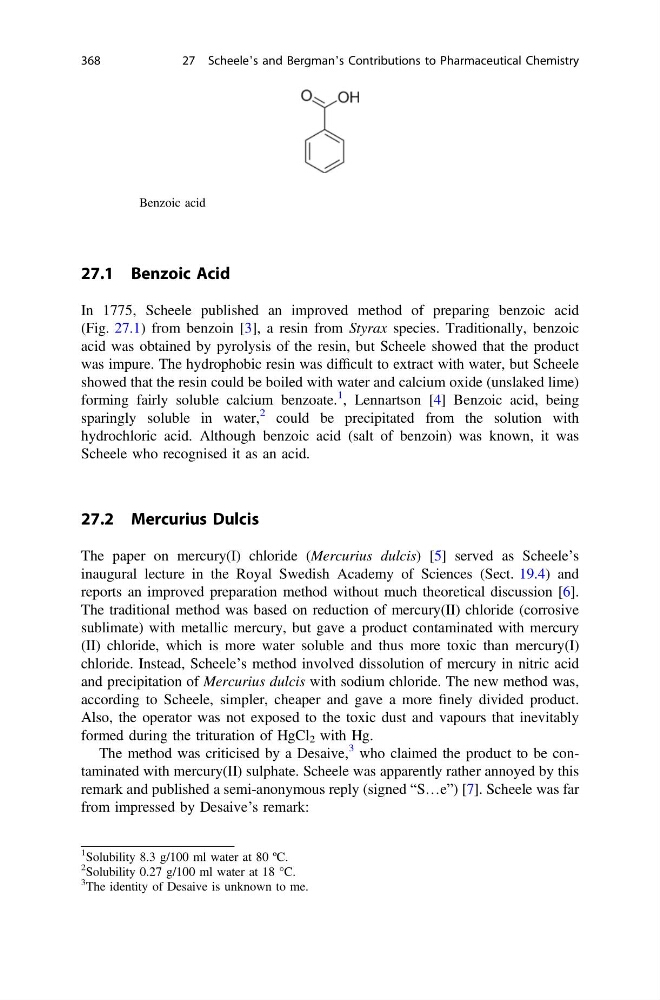
(Fig. 27.1) from benzoin [3], a resin from Styrax species. Traditionally, benzoic
acid was obtained by pyrolysis of the resin, but Scheele showed that the product
was impure. The hydrophobic resin was difficult to extract with water, but Scheele
showed that the resin could be boiled with water and calcium oxide (unslaked lime)
forming fairly soluble calcium benzoate.
1 , Lennartson [4] Benzoic acid, being
sparingly soluble in water,
2 could be precipitated from the solution with
hydrochloric acid. Although benzoic acid (salt of benzoin) was known, it was
Scheele who recognised it as an acid.
27.2 Mercurius Dulcis
The paper on mercury(I) chloride (Mercurius dulcis) [5] served as Scheele’s
inaugural lecture in the Royal Swedish Academy of Sciences (Sect. 19.4) and
reports an improved preparation method without much theoretical discussion [6].
The traditional method was based on reduction of mercury(II) chloride (corrosive
sublimate) with metallic mercury, but gave a product contaminated with mercury
(II) chloride, which is more water soluble and thus more toxic than mercury(I)
chloride. Instead, Scheele’s method involved dissolution of mercury in nitric acid
and precipitation of Mercurius dulcis with sodium chloride. The new method was,
according to Scheele, simpler, cheaper and gave a more finely divided product.
Also, the operator was not exposed to the toxic dust and vapours that inevitably
formed during the trituration of HgCl 2 with Hg.
The method was criticised by a Desaive,
3 who claimed the product to be contaminated with mercury(II) sulphate. Scheele was apparently rather annoyed by this
remark and published a semi-anonymous reply (signed “S…e”) [7]. Scheele was far
from impressed by Desaive’s remark:
Fig. 27.1 Benzoic acid
1
Solubility 8.3 g/100 ml water at 80 ºC.
2
Solubility 0.27 g/100 ml water at 18 °C.
3
The identity of Desaive is unknown to me.
368
27 Scheele’s and Bergman’s Contributions to Pharmaceutical Chemistry
In 1775, Scheele published an improved method of preparing benzoic acid
(Fig. 27.1) from benzoin [3], a resin from Styrax species. Traditionally, benzoic
acid was obtained by pyrolysis of the resin, but Scheele showed that the product
was impure. The hydrophobic resin was difficult to extract with water, but Scheele
showed that the resin could be boiled with water and calcium oxide (unslaked lime)
forming fairly soluble calcium benzoate.
1 , Lennartson [4] Benzoic acid, being
sparingly soluble in water,
2 could be precipitated from the solution with
hydrochloric acid. Although benzoic acid (salt of benzoin) was known, it was
Scheele who recognised it as an acid.
27.2 Mercurius Dulcis
The paper on mercury(I) chloride (Mercurius dulcis) [5] served as Scheele’s
inaugural lecture in the Royal Swedish Academy of Sciences (Sect. 19.4) and
reports an improved preparation method without much theoretical discussion [6].
The traditional method was based on reduction of mercury(II) chloride (corrosive
sublimate) with metallic mercury, but gave a product contaminated with mercury
(II) chloride, which is more water soluble and thus more toxic than mercury(I)
chloride. Instead, Scheele’s method involved dissolution of mercury in nitric acid
and precipitation of Mercurius dulcis with sodium chloride. The new method was,
according to Scheele, simpler, cheaper and gave a more finely divided product.
Also, the operator was not exposed to the toxic dust and vapours that inevitably
formed during the trituration of HgCl 2 with Hg.
The method was criticised by a Desaive,
3 who claimed the product to be contaminated with mercury(II) sulphate. Scheele was apparently rather annoyed by this
remark and published a semi-anonymous reply (signed “S…e”) [7]. Scheele was far
from impressed by Desaive’s remark:
Fig. 27.1 Benzoic acid
1
Solubility 8.3 g/100 ml water at 80 ºC.
2
Solubility 0.27 g/100 ml water at 18 °C.
3
The identity of Desaive is unknown to me.
368
27 Scheele’s and Bergman’s Contributions to Pharmaceutical Chemistry