

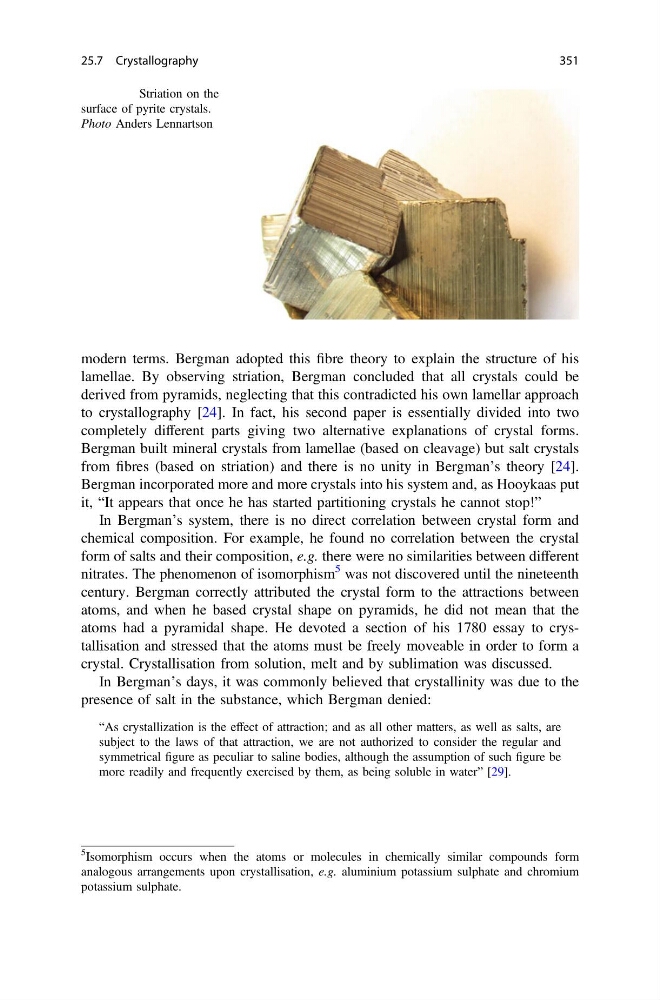
modern terms. Bergman adopted this fibre theory to explain the structure of his
lamellae. By observing striation, Bergman concluded that all crystals could be
derived from pyramids, neglecting that this contradicted his own lamellar approach
to crystallography [24]. In fact, his second paper is essentially divided into two
completely different parts giving two alternative explanations of crystal forms.
Bergman built mineral crystals from lamellae (based on cleavage) but salt crystals
from fibres (based on striation) and there is no unity in Bergman’s theory [24].
Bergman incorporated more and more crystals into his system and, as Hooykaas put
it, “It appears that once he has started partitioning crystals he cannot stop!”
In Bergman’s system, there is no direct correlation between crystal form and
chemical composition. For example, he found no correlation between the crystal
form of salts and their composition, e.g. there were no similarities between different
nitrates. The phenomenon of isomorphism
5 was not discovered until the nineteenth
century. Bergman correctly attributed the crystal form to the attractions between
atoms, and when he based crystal shape on pyramids, he did not mean that the
atoms had a pyramidal shape. He devoted a section of his 1780 essay to crystallisation and stressed that the atoms must be freely moveable in order to form a
crystal. Crystallisation from solution, melt and by sublimation was discussed.
In Bergman’s days, it was commonly believed that crystallinity was due to the
presence of salt in the substance, which Bergman denied:
“As crystallization is the effect of attraction; and as all other matters, as well as salts, are
subject to the laws of that attraction, we are not authorized to consider the regular and
symmetrical figure as peculiar to saline bodies, although the assumption of such figure be
more readily and frequently exercised by them, as being soluble in water” [29].
Fig. 25.2 Striation on the
surface of pyrite crystals.
Photo Anders Lennartson
5
Isomorphism occurs when the atoms or molecules in chemically similar compounds form
analogous arrangements upon crystallisation, e.g. aluminium potassium sulphate and chromium
potassium sulphate.
25.7 Crystallography
351
lamellae. By observing striation, Bergman concluded that all crystals could be
derived from pyramids, neglecting that this contradicted his own lamellar approach
to crystallography [24]. In fact, his second paper is essentially divided into two
completely different parts giving two alternative explanations of crystal forms.
Bergman built mineral crystals from lamellae (based on cleavage) but salt crystals
from fibres (based on striation) and there is no unity in Bergman’s theory [24].
Bergman incorporated more and more crystals into his system and, as Hooykaas put
it, “It appears that once he has started partitioning crystals he cannot stop!”
In Bergman’s system, there is no direct correlation between crystal form and
chemical composition. For example, he found no correlation between the crystal
form of salts and their composition, e.g. there were no similarities between different
nitrates. The phenomenon of isomorphism
5 was not discovered until the nineteenth
century. Bergman correctly attributed the crystal form to the attractions between
atoms, and when he based crystal shape on pyramids, he did not mean that the
atoms had a pyramidal shape. He devoted a section of his 1780 essay to crystallisation and stressed that the atoms must be freely moveable in order to form a
crystal. Crystallisation from solution, melt and by sublimation was discussed.
In Bergman’s days, it was commonly believed that crystallinity was due to the
presence of salt in the substance, which Bergman denied:
“As crystallization is the effect of attraction; and as all other matters, as well as salts, are
subject to the laws of that attraction, we are not authorized to consider the regular and
symmetrical figure as peculiar to saline bodies, although the assumption of such figure be
more readily and frequently exercised by them, as being soluble in water” [29].
Fig. 25.2 Striation on the
surface of pyrite crystals.
Photo Anders Lennartson
5
Isomorphism occurs when the atoms or molecules in chemically similar compounds form
analogous arrangements upon crystallisation, e.g. aluminium potassium sulphate and chromium
potassium sulphate.
25.7 Crystallography
351