

25.7 Crystallography
Crystals have been studied since antiquity, but with no real progress until the
re-emergence of atomic theory in the seventeenth century. Various schemes were
proposed for an explanation of the crystal form based on atomic theory: British
scientist Robert Hooke (1635–1703) regarded crystals as built up by spherical
atoms, while Christiaan Huygens (1629–1695) preferred ellipsoidal atoms; Giovanni Battista Guglielmini (1763–1817) and Antoni van Leeuwenhoek (1632–
1723) held that crystals were built up by polyhedral atoms.
Usually, the French mineralogist René Just Haüy (1743–1822) is credited as the
father of crystallography, but Dutch historian of Science, Reijer Hooykaas, who
studied the crystallographic works of Bergman and Haüy in great detail, has pointed
out that Haüy based his early theories on Bergman’s work [24].
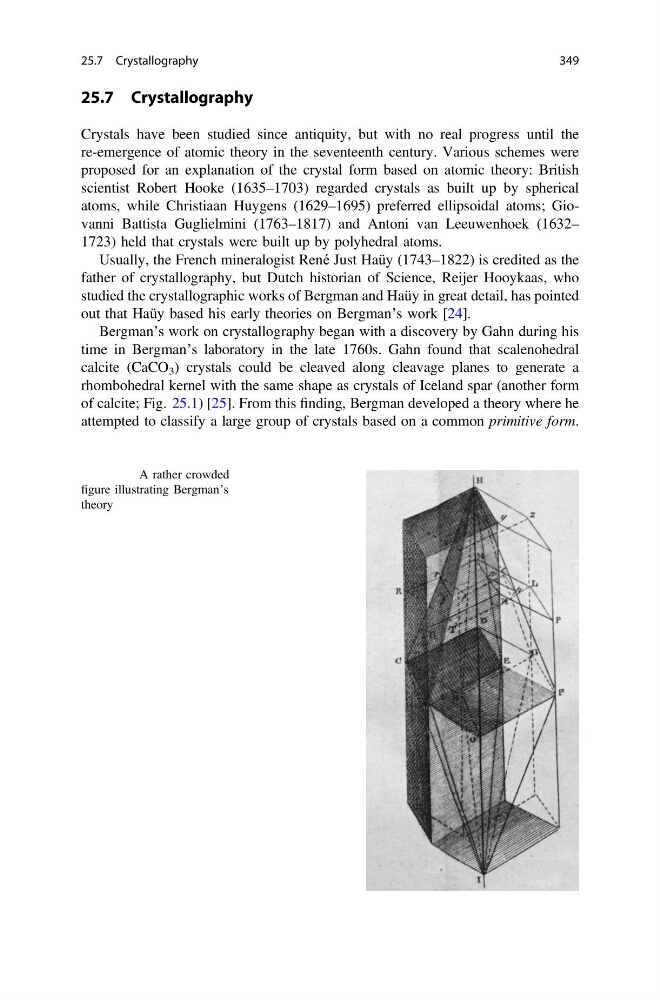
Bergman’s work on crystallography began with a discovery by Gahn during his
time in Bergman’s laboratory in the late 1760s. Gahn found that scalenohedral
calcite (CaCO 3 ) crystals could be cleaved along cleavage planes to generate a
rhombohedral kernel with the same shape as crystals of Iceland spar (another form
of calcite; Fig. 25.1) [25]. From this finding, Bergman developed a theory where he
attempted to classify a large group of crystals based on a common primitive form.
Fig. 25.1 A rather crowded
figure illustrating Bergman’s
theory
25.7 Crystallography
349
Crystals have been studied since antiquity, but with no real progress until the
re-emergence of atomic theory in the seventeenth century. Various schemes were
proposed for an explanation of the crystal form based on atomic theory: British
scientist Robert Hooke (1635–1703) regarded crystals as built up by spherical
atoms, while Christiaan Huygens (1629–1695) preferred ellipsoidal atoms; Giovanni Battista Guglielmini (1763–1817) and Antoni van Leeuwenhoek (1632–
1723) held that crystals were built up by polyhedral atoms.
Usually, the French mineralogist René Just Haüy (1743–1822) is credited as the
father of crystallography, but Dutch historian of Science, Reijer Hooykaas, who
studied the crystallographic works of Bergman and Haüy in great detail, has pointed
out that Haüy based his early theories on Bergman’s work [24].
Bergman’s work on crystallography began with a discovery by Gahn during his
time in Bergman’s laboratory in the late 1760s. Gahn found that scalenohedral
calcite (CaCO 3 ) crystals could be cleaved along cleavage planes to generate a
rhombohedral kernel with the same shape as crystals of Iceland spar (another form
of calcite; Fig. 25.1) [25]. From this finding, Bergman developed a theory where he
attempted to classify a large group of crystals based on a common primitive form.
Fig. 25.1 A rather crowded
figure illustrating Bergman’s
theory
25.7 Crystallography
349