

oxalate ions, and calcium oxalate is much less soluble in water than calcium sulphate
(0.00067 and 0.24 per 100 ml of water, respectively). The breakthrough came around
1784, when Scheele used the lead salt rather than the calcium salt, and as lead(II)
sulphate is virtually insoluble in water, he was able to isolate Acid acetosellæ (oxalic
acid; C 2 H 2 O 4 ) by the action of sulphuric acid on lead oxalate [3]:
KHC 2 O 4 ðaqÞ þ Pb OOCCH 3
ð
Þ 2 ðaqÞ ! PbC 2 O 4 ðsÞ þ KOOCCH 3 ðaqÞ þ CH 3 COOHðaqÞ
PbC 2 O 4 ðsÞ þ H 2 SO 4 ðaqÞ ! H 2 C 2 O 4 ðaqÞ þ PbSO 4 ðsÞ
Using the same method, he managed to isolate the acid from earth of rhubarb
(calcium oxalate), an insoluble earthy material found in the roots of medical rhubarb, which was used as a laxative and imported in large quantities from China.
Around 1771, Scheele had noted that earth of rhubarb behaved similarly to calcium
citrate on heating, and he therefore initially assumed that earth of rhubarb contained
citric acid. Scheele now found, probably to his surprise, that the two acids from
wood sorrel and rhubarb were identical.
Scheele also discovered that Acid acetosellæ was identical to acid of sugar, a
substance he had obtained in 1772 by treating sugar with nitric acid (sugar is
oxidised by nitric acid to oxalic acid). Scheele did not publish his discovery of acid
of sugar, which was instead included in a thesis of one of Bergman’s students (and
eventually his successor as professor in chemistry in Uppsala) Johan Afzelius in
1776 [4]. It has been disputed whether Scheele agreed on this publication, and of
the experiments in the thesis, it is not known which were performed by Scheele,
Bergman, or Afzelius. Typically, when Scheele had discovered a new acid, he
would try to prepare as many salts of the new acid as possible, and it is hard to
imagine that acid of sugar would have been an exception. In the thesis, attempts to
Fig. 24.1 Oxalic acid
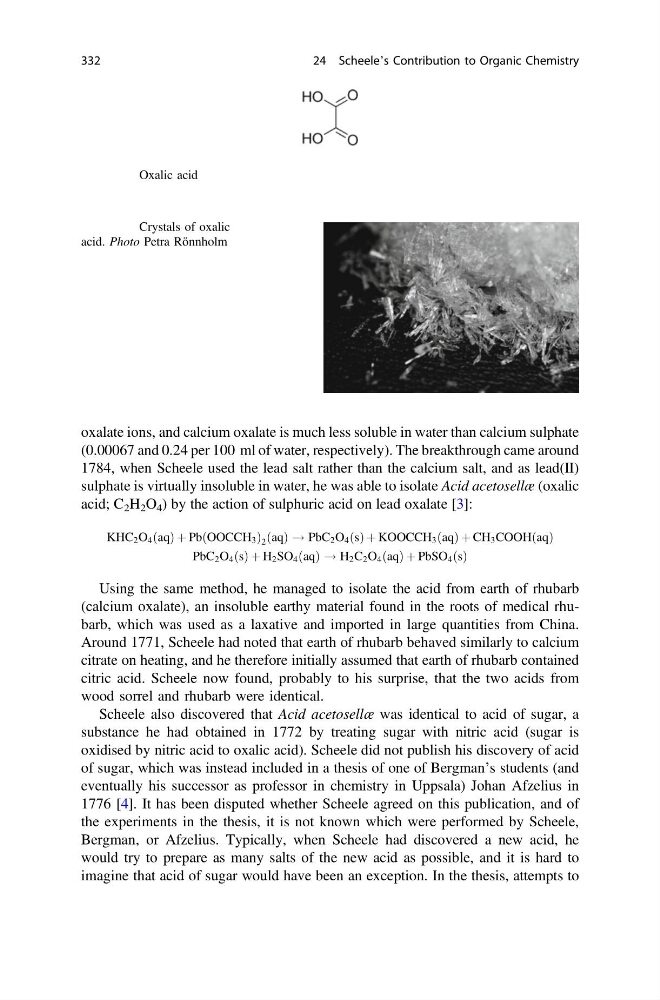
Fig. 24.2 Crystals of oxalic
acid. Photo Petra Rönnholm
332
24 Scheele’s Contribution to Organic Chemistry
(0.00067 and 0.24 per 100 ml of water, respectively). The breakthrough came around
1784, when Scheele used the lead salt rather than the calcium salt, and as lead(II)
sulphate is virtually insoluble in water, he was able to isolate Acid acetosellæ (oxalic
acid; C 2 H 2 O 4 ) by the action of sulphuric acid on lead oxalate [3]:
KHC 2 O 4 ðaqÞ þ Pb OOCCH 3
ð
Þ 2 ðaqÞ ! PbC 2 O 4 ðsÞ þ KOOCCH 3 ðaqÞ þ CH 3 COOHðaqÞ
PbC 2 O 4 ðsÞ þ H 2 SO 4 ðaqÞ ! H 2 C 2 O 4 ðaqÞ þ PbSO 4 ðsÞ
Using the same method, he managed to isolate the acid from earth of rhubarb
(calcium oxalate), an insoluble earthy material found in the roots of medical rhubarb, which was used as a laxative and imported in large quantities from China.
Around 1771, Scheele had noted that earth of rhubarb behaved similarly to calcium
citrate on heating, and he therefore initially assumed that earth of rhubarb contained
citric acid. Scheele now found, probably to his surprise, that the two acids from
wood sorrel and rhubarb were identical.
Scheele also discovered that Acid acetosellæ was identical to acid of sugar, a
substance he had obtained in 1772 by treating sugar with nitric acid (sugar is
oxidised by nitric acid to oxalic acid). Scheele did not publish his discovery of acid
of sugar, which was instead included in a thesis of one of Bergman’s students (and
eventually his successor as professor in chemistry in Uppsala) Johan Afzelius in
1776 [4]. It has been disputed whether Scheele agreed on this publication, and of
the experiments in the thesis, it is not known which were performed by Scheele,
Bergman, or Afzelius. Typically, when Scheele had discovered a new acid, he
would try to prepare as many salts of the new acid as possible, and it is hard to
imagine that acid of sugar would have been an exception. In the thesis, attempts to
Fig. 24.1 Oxalic acid
Fig. 24.2 Crystals of oxalic
acid. Photo Petra Rönnholm
332
24 Scheele’s Contribution to Organic Chemistry