

23.3 Water Analysis
From the early years of his chemical career, Bergman had been interested in water
analysis (Chap. 17). This section will merely describe the analytical methods
developed by Bergman, rather than his results. In 1775, he wrote an extensive paper
on mineral waters [25], more precisely bitter water from Seidschutz (old spelling:
Seydschutz) in Bohemia, Selzer water (from Selters in Hessen), Spa water (from
Spa in Belgium) and Pyrmont water (from Bad Pyrmont in Niedersachsen). The
challenge and the importance that Bergman attributed to the subject is indicated in
the opening paragraph of the paper: “To test waters, and to discover the quantity
and nature of the foreign substances, which hide therein, is one of the most
important, and at the same time more difficult, problems in chemistry” [25].
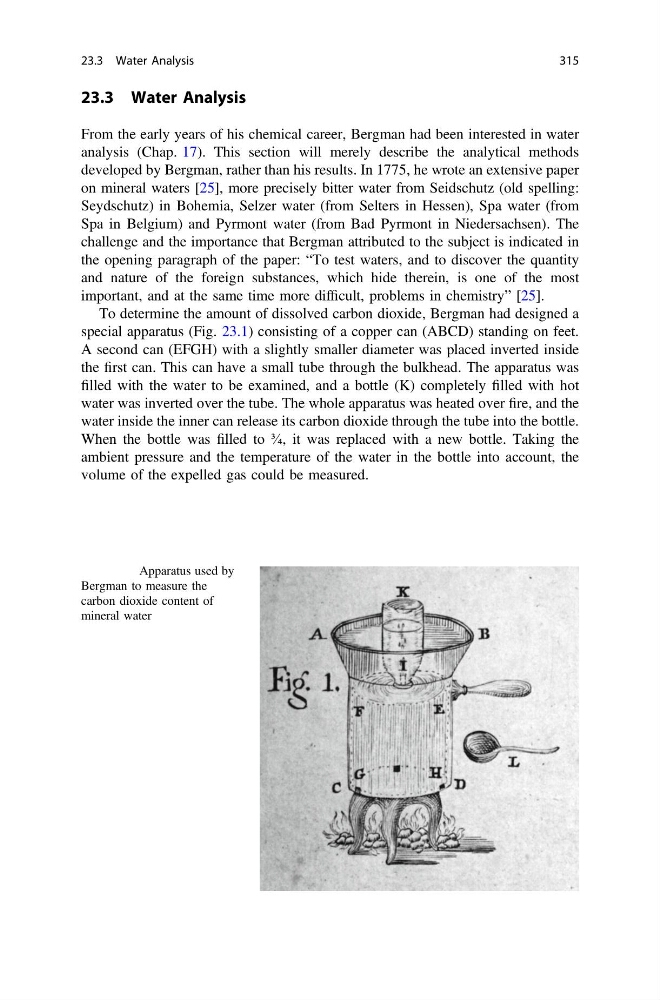
To determine the amount of dissolved carbon dioxide, Bergman had designed a
special apparatus (Fig. 23.1) consisting of a copper can (ABCD) standing on feet.
A second can (EFGH) with a slightly smaller diameter was placed inverted inside
the first can. This can have a small tube through the bulkhead. The apparatus was
filled with the water to be examined, and a bottle (K) completely filled with hot
water was inverted over the tube. The whole apparatus was heated over fire, and the
water inside the inner can release its carbon dioxide through the tube into the bottle.
When the bottle was filled to ¾, it was replaced with a new bottle. Taking the
ambient pressure and the temperature of the water in the bottle into account, the
volume of the expelled gas could be measured.
Fig. 23.1 Apparatus used by
Bergman to measure the
carbon dioxide content of
mineral water
23.3 Water Analysis
315
From the early years of his chemical career, Bergman had been interested in water
analysis (Chap. 17). This section will merely describe the analytical methods
developed by Bergman, rather than his results. In 1775, he wrote an extensive paper
on mineral waters [25], more precisely bitter water from Seidschutz (old spelling:
Seydschutz) in Bohemia, Selzer water (from Selters in Hessen), Spa water (from
Spa in Belgium) and Pyrmont water (from Bad Pyrmont in Niedersachsen). The
challenge and the importance that Bergman attributed to the subject is indicated in
the opening paragraph of the paper: “To test waters, and to discover the quantity
and nature of the foreign substances, which hide therein, is one of the most
important, and at the same time more difficult, problems in chemistry” [25].
To determine the amount of dissolved carbon dioxide, Bergman had designed a
special apparatus (Fig. 23.1) consisting of a copper can (ABCD) standing on feet.
A second can (EFGH) with a slightly smaller diameter was placed inverted inside
the first can. This can have a small tube through the bulkhead. The apparatus was
filled with the water to be examined, and a bottle (K) completely filled with hot
water was inverted over the tube. The whole apparatus was heated over fire, and the
water inside the inner can release its carbon dioxide through the tube into the bottle.
When the bottle was filled to ¾, it was replaced with a new bottle. Taking the
ambient pressure and the temperature of the water in the bottle into account, the
volume of the expelled gas could be measured.
Fig. 23.1 Apparatus used by
Bergman to measure the
carbon dioxide content of
mineral water
23.3 Water Analysis
315