

amount of phlogiston in different metals [34]. The dissertation has been translated
(in part) to English by Schufle [35]. Bergman’s method was to determine the
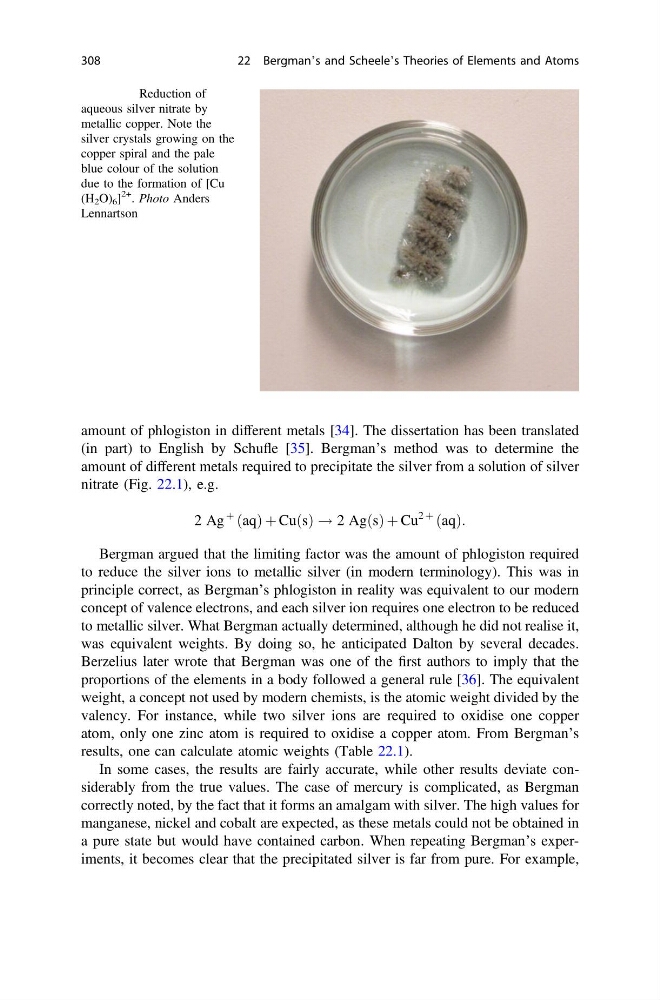
amount of different metals required to precipitate the silver from a solution of silver
nitrate (Fig. 22.1), e.g.
2 Ag
þ
ðaqÞ þ CuðsÞ ! 2 AgðsÞ þ Cu
2 þ
ðaqÞ:
Bergman argued that the limiting factor was the amount of phlogiston required
to reduce the silver ions to metallic silver (in modern terminology). This was in
principle correct, as Bergman’s phlogiston in reality was equivalent to our modern
concept of valence electrons, and each silver ion requires one electron to be reduced
to metallic silver. What Bergman actually determined, although he did not realise it,
was equivalent weights. By doing so, he anticipated Dalton by several decades.
Berzelius later wrote that Bergman was one of the first authors to imply that the
proportions of the elements in a body followed a general rule [36]. The equivalent
weight, a concept not used by modern chemists, is the atomic weight divided by the
valency. For instance, while two silver ions are required to oxidise one copper
atom, only one zinc atom is required to oxidise a copper atom. From Bergman’s
results, one can calculate atomic weights (Table 22.1).
In some cases, the results are fairly accurate, while other results deviate considerably from the true values. The case of mercury is complicated, as Bergman
correctly noted, by the fact that it forms an amalgam with silver. The high values for
manganese, nickel and cobalt are expected, as these metals could not be obtained in
a pure state but would have contained carbon. When repeating Bergman’s experiments, it becomes clear that the precipitated silver is far from pure. For example,
Fig. 22.1 Reduction of
aqueous silver nitrate by
metallic copper. Note the
silver crystals growing on the
copper spiral and the pale
blue colour of the solution
due to the formation of [Cu
(H 2 O) 6 ]
2+ . Photo Anders
Lennartson
308
22 Bergman’s and Scheele’s Theories of Elements and Atoms
(in part) to English by Schufle [35]. Bergman’s method was to determine the
amount of different metals required to precipitate the silver from a solution of silver
nitrate (Fig. 22.1), e.g.
2 Ag
þ
ðaqÞ þ CuðsÞ ! 2 AgðsÞ þ Cu
2 þ
ðaqÞ:
Bergman argued that the limiting factor was the amount of phlogiston required
to reduce the silver ions to metallic silver (in modern terminology). This was in
principle correct, as Bergman’s phlogiston in reality was equivalent to our modern
concept of valence electrons, and each silver ion requires one electron to be reduced
to metallic silver. What Bergman actually determined, although he did not realise it,
was equivalent weights. By doing so, he anticipated Dalton by several decades.
Berzelius later wrote that Bergman was one of the first authors to imply that the
proportions of the elements in a body followed a general rule [36]. The equivalent
weight, a concept not used by modern chemists, is the atomic weight divided by the
valency. For instance, while two silver ions are required to oxidise one copper
atom, only one zinc atom is required to oxidise a copper atom. From Bergman’s
results, one can calculate atomic weights (Table 22.1).
In some cases, the results are fairly accurate, while other results deviate considerably from the true values. The case of mercury is complicated, as Bergman
correctly noted, by the fact that it forms an amalgam with silver. The high values for
manganese, nickel and cobalt are expected, as these metals could not be obtained in
a pure state but would have contained carbon. When repeating Bergman’s experiments, it becomes clear that the precipitated silver is far from pure. For example,
Fig. 22.1 Reduction of
aqueous silver nitrate by
metallic copper. Note the
silver crystals growing on the
copper spiral and the pale
blue colour of the solution
due to the formation of [Cu
(H 2 O) 6 ]
2+ . Photo Anders
Lennartson
308
22 Bergman’s and Scheele’s Theories of Elements and Atoms