

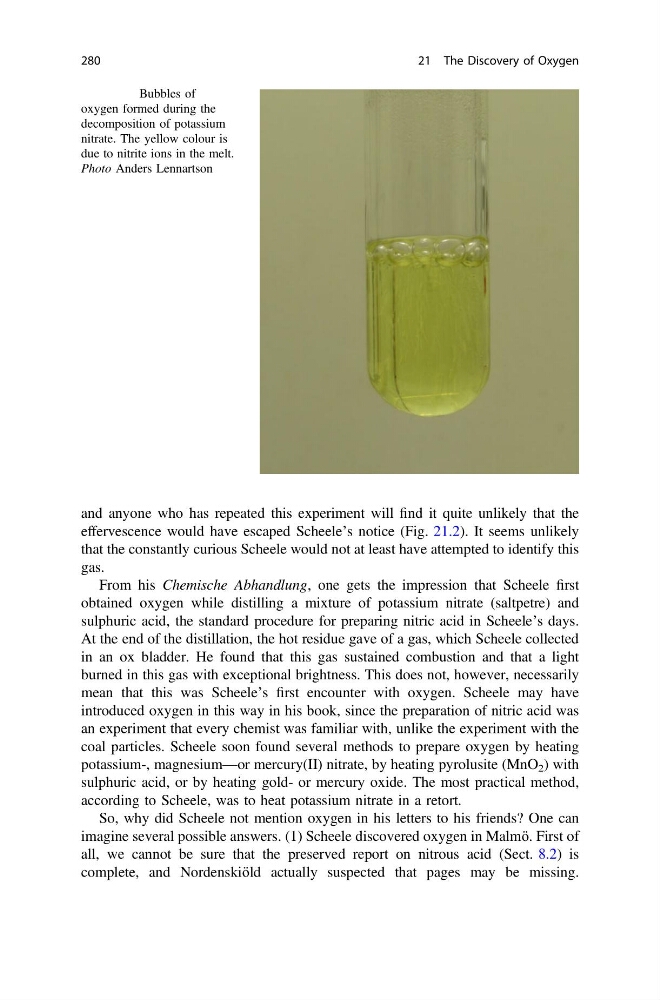
and anyone who has repeated this experiment will find it quite unlikely that the
effervescence would have escaped Scheele’s notice (Fig. 21.2). It seems unlikely
that the constantly curious Scheele would not at least have attempted to identify this
gas.
From his Chemische Abhandlung, one gets the impression that Scheele first
obtained oxygen while distilling a mixture of potassium nitrate (saltpetre) and
sulphuric acid, the standard procedure for preparing nitric acid in Scheele’s days.
At the end of the distillation, the hot residue gave of a gas, which Scheele collected
in an ox bladder. He found that this gas sustained combustion and that a light
burned in this gas with exceptional brightness. This does not, however, necessarily
mean that this was Scheele’s first encounter with oxygen. Scheele may have
introduced oxygen in this way in his book, since the preparation of nitric acid was
an experiment that every chemist was familiar with, unlike the experiment with the
coal particles. Scheele soon found several methods to prepare oxygen by heating
potassium-, magnesium—or mercury(II) nitrate, by heating pyrolusite (MnO 2 ) with
sulphuric acid, or by heating gold- or mercury oxide. The most practical method,
according to Scheele, was to heat potassium nitrate in a retort.
So, why did Scheele not mention oxygen in his letters to his friends? One can
imagine several possible answers. (1) Scheele discovered oxygen in Malmö. First of
all, we cannot be sure that the preserved report on nitrous acid (Sect. 8.2) is
complete, and Nordenskiöld actually suspected that pages may be missing.
Fig. 21.2 Bubbles of
oxygen formed during the
decomposition of potassium
nitrate. The yellow colour is
due to nitrite ions in the melt.
Photo Anders Lennartson
280
21 The Discovery of Oxygen
effervescence would have escaped Scheele’s notice (Fig. 21.2). It seems unlikely
that the constantly curious Scheele would not at least have attempted to identify this
gas.
From his Chemische Abhandlung, one gets the impression that Scheele first
obtained oxygen while distilling a mixture of potassium nitrate (saltpetre) and
sulphuric acid, the standard procedure for preparing nitric acid in Scheele’s days.
At the end of the distillation, the hot residue gave of a gas, which Scheele collected
in an ox bladder. He found that this gas sustained combustion and that a light
burned in this gas with exceptional brightness. This does not, however, necessarily
mean that this was Scheele’s first encounter with oxygen. Scheele may have
introduced oxygen in this way in his book, since the preparation of nitric acid was
an experiment that every chemist was familiar with, unlike the experiment with the
coal particles. Scheele soon found several methods to prepare oxygen by heating
potassium-, magnesium—or mercury(II) nitrate, by heating pyrolusite (MnO 2 ) with
sulphuric acid, or by heating gold- or mercury oxide. The most practical method,
according to Scheele, was to heat potassium nitrate in a retort.
So, why did Scheele not mention oxygen in his letters to his friends? One can
imagine several possible answers. (1) Scheele discovered oxygen in Malmö. First of
all, we cannot be sure that the preserved report on nitrous acid (Sect. 8.2) is
complete, and Nordenskiöld actually suspected that pages may be missing.
Fig. 21.2 Bubbles of
oxygen formed during the
decomposition of potassium
nitrate. The yellow colour is
due to nitrite ions in the melt.
Photo Anders Lennartson
280
21 The Discovery of Oxygen