

discovery of oxygen. Oseen argues that oxygen did not fit into Bergman’s chemical
system, and that Scheele was unable to form his own opinion until after he left
Uppsala and Bergman’s influence on him weakened [3]. If so, this transition in
Scheele’s thoughts must have been very sudden, as Scheele left Uppsala in July,
and had finished his manuscript by the end of December.
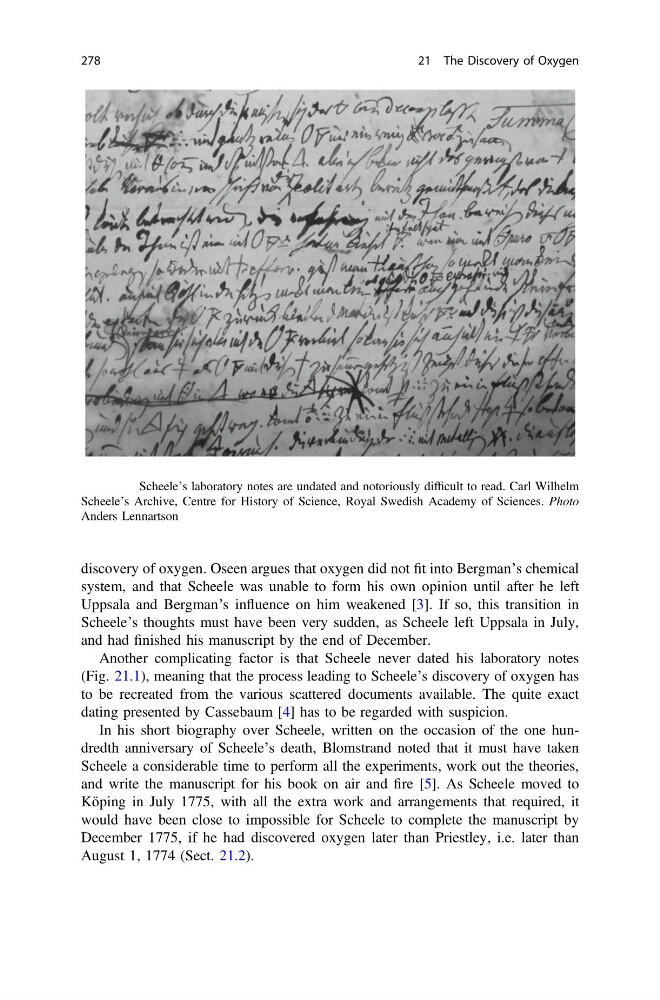
Another complicating factor is that Scheele never dated his laboratory notes
(Fig. 21.1), meaning that the process leading to Scheele’s discovery of oxygen has
to be recreated from the various scattered documents available. The quite exact
dating presented by Cassebaum [4] has to be regarded with suspicion.
In his short biography over Scheele, written on the occasion of the one hundredth anniversary of Scheele’s death, Blomstrand noted that it must have taken
Scheele a considerable time to perform all the experiments, work out the theories,
and write the manuscript for his book on air and fire [5]. As Scheele moved to
Köping in July 1775, with all the extra work and arrangements that required, it
would have been close to impossible for Scheele to complete the manuscript by
December 1775, if he had discovered oxygen later than Priestley, i.e. later than
August 1, 1774 (Sect. 21.2).
Fig. 21.1 Scheele’s laboratory notes are undated and notoriously difficult to read. Carl Wilhelm
Scheele’s Archive, Centre for History of Science, Royal Swedish Academy of Sciences. Photo
Anders Lennartson
278
21 The Discovery of Oxygen
system, and that Scheele was unable to form his own opinion until after he left
Uppsala and Bergman’s influence on him weakened [3]. If so, this transition in
Scheele’s thoughts must have been very sudden, as Scheele left Uppsala in July,
and had finished his manuscript by the end of December.
Another complicating factor is that Scheele never dated his laboratory notes
(Fig. 21.1), meaning that the process leading to Scheele’s discovery of oxygen has
to be recreated from the various scattered documents available. The quite exact
dating presented by Cassebaum [4] has to be regarded with suspicion.
In his short biography over Scheele, written on the occasion of the one hundredth anniversary of Scheele’s death, Blomstrand noted that it must have taken
Scheele a considerable time to perform all the experiments, work out the theories,
and write the manuscript for his book on air and fire [5]. As Scheele moved to
Köping in July 1775, with all the extra work and arrangements that required, it
would have been close to impossible for Scheele to complete the manuscript by
December 1775, if he had discovered oxygen later than Priestley, i.e. later than
August 1, 1774 (Sect. 21.2).
Fig. 21.1 Scheele’s laboratory notes are undated and notoriously difficult to read. Carl Wilhelm
Scheele’s Archive, Centre for History of Science, Royal Swedish Academy of Sciences. Photo
Anders Lennartson
278
21 The Discovery of Oxygen