

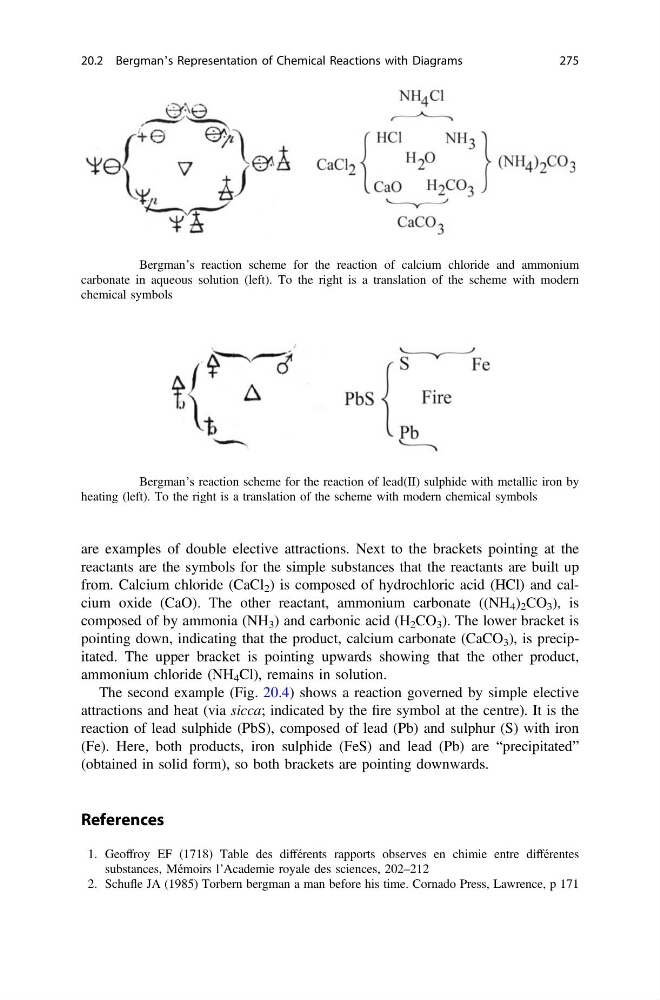
are examples of double elective attractions. Next to the brackets pointing at the
reactants are the symbols for the simple substances that the reactants are built up
from. Calcium chloride (CaCl 2 ) is composed of hydrochloric acid (HCl) and calcium oxide (CaO). The other reactant, ammonium carbonate ((NH 4 ) 2 CO 3 ), is
composed of by ammonia (NH 3 ) and carbonic acid (H 2 CO 3 ). The lower bracket is
pointing down, indicating that the product, calcium carbonate (CaCO 3 ), is precipitated. The upper bracket is pointing upwards showing that the other product,
ammonium chloride (NH 4 Cl), remains in solution.
The second example (Fig. 20.4) shows a reaction governed by simple elective
attractions and heat (via sicca; indicated by the fire symbol at the centre). It is the
reaction of lead sulphide (PbS), composed of lead (Pb) and sulphur (S) with iron
(Fe). Here, both products, iron sulphide (FeS) and lead (Pb) are “precipitated”
(obtained in solid form), so both brackets are pointing downwards.
References
1. Geoffroy EF (1718) Table des différents rapports observes en chimie entre différentes
substances, Mémoirs l’Academie royale des sciences, 202–212
2. Schufle JA (1985) Torbern bergman a man before his time. Cornado Press, Lawrence, p 171
Fig. 20.3 Bergman’s reaction scheme for the reaction of calcium chloride and ammonium
carbonate in aqueous solution (left). To the right is a translation of the scheme with modern
chemical symbols
Fig. 20.4 Bergman’s reaction scheme for the reaction of lead(II) sulphide with metallic iron by
heating (left). To the right is a translation of the scheme with modern chemical symbols
20.2 Bergman’s Representation of Chemical Reactions with Diagrams
275
reactants are the symbols for the simple substances that the reactants are built up
from. Calcium chloride (CaCl 2 ) is composed of hydrochloric acid (HCl) and calcium oxide (CaO). The other reactant, ammonium carbonate ((NH 4 ) 2 CO 3 ), is
composed of by ammonia (NH 3 ) and carbonic acid (H 2 CO 3 ). The lower bracket is
pointing down, indicating that the product, calcium carbonate (CaCO 3 ), is precipitated. The upper bracket is pointing upwards showing that the other product,
ammonium chloride (NH 4 Cl), remains in solution.
The second example (Fig. 20.4) shows a reaction governed by simple elective
attractions and heat (via sicca; indicated by the fire symbol at the centre). It is the
reaction of lead sulphide (PbS), composed of lead (Pb) and sulphur (S) with iron
(Fe). Here, both products, iron sulphide (FeS) and lead (Pb) are “precipitated”
(obtained in solid form), so both brackets are pointing downwards.
References
1. Geoffroy EF (1718) Table des différents rapports observes en chimie entre différentes
substances, Mémoirs l’Academie royale des sciences, 202–212
2. Schufle JA (1985) Torbern bergman a man before his time. Cornado Press, Lawrence, p 171
Fig. 20.3 Bergman’s reaction scheme for the reaction of calcium chloride and ammonium
carbonate in aqueous solution (left). To the right is a translation of the scheme with modern
chemical symbols
Fig. 20.4 Bergman’s reaction scheme for the reaction of lead(II) sulphide with metallic iron by
heating (left). To the right is a translation of the scheme with modern chemical symbols
20.2 Bergman’s Representation of Chemical Reactions with Diagrams
275