

attractonibus electivis [3] printed in 1776 and had 50 columns. Later editions of
The Chemical Lectures of H.T. Scheffer did not incorporate this updated table, but
the original copper plate was reused. Bergman’s paper on elective attractions gained
much attention, and a second expanded and updated version (179 pages; 59 columns in the table) was included in the third volume of his collected works in 1783
[4]. Not only did Bergman include more substance in his updated tables, he also
modified the order the substances appeared and in the last version he included
another important modification. Rather than listing the metals in the acid columns,
as he had done in his original table, he listed the metal oxides (metal calces). This
was correct, since the metals appear as cations in oxidised states in salts. The idea
for this change may have been inspired by a letter from Scheele, written in May
1777. It was the 1783 version that was translated to English [5], while an English
translation of the original 1775 paper did not appear until 1968 [6]. French and
Italian translations followed, but none in German or Swedish [7]. Bergman’s work
on elective attractions attracted much attention, mainly positive but gave also rise to
some criticism [8]. Bergman considered his work on elective attractions as his most
important contribution to science, and it is not a coincidence that he holds a scroll
with an attraction table in his hand on the 1778 oil painting by Pasch (Fig. 3.4).
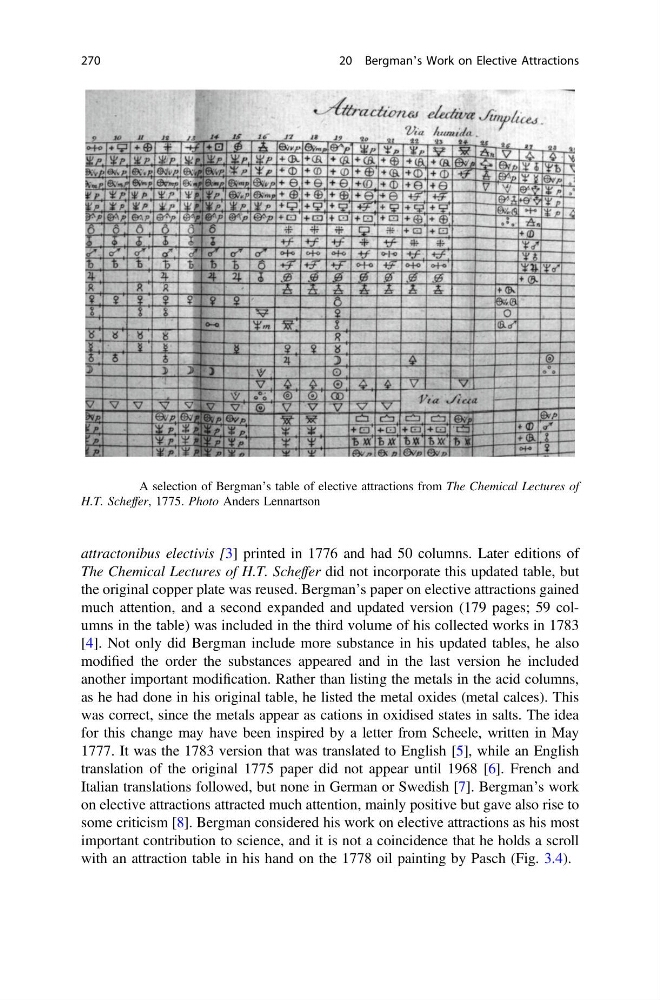
Fig. 20.2 A selection of Bergman’s table of elective attractions from The Chemical Lectures of
H.T. Scheffer, 1775. Photo Anders Lennartson
270
20 Bergman’s Work on Elective Attractions
The Chemical Lectures of H.T. Scheffer did not incorporate this updated table, but
the original copper plate was reused. Bergman’s paper on elective attractions gained
much attention, and a second expanded and updated version (179 pages; 59 columns in the table) was included in the third volume of his collected works in 1783
[4]. Not only did Bergman include more substance in his updated tables, he also
modified the order the substances appeared and in the last version he included
another important modification. Rather than listing the metals in the acid columns,
as he had done in his original table, he listed the metal oxides (metal calces). This
was correct, since the metals appear as cations in oxidised states in salts. The idea
for this change may have been inspired by a letter from Scheele, written in May
1777. It was the 1783 version that was translated to English [5], while an English
translation of the original 1775 paper did not appear until 1968 [6]. French and
Italian translations followed, but none in German or Swedish [7]. Bergman’s work
on elective attractions attracted much attention, mainly positive but gave also rise to
some criticism [8]. Bergman considered his work on elective attractions as his most
important contribution to science, and it is not a coincidence that he holds a scroll
with an attraction table in his hand on the 1778 oil painting by Pasch (Fig. 3.4).
Fig. 20.2 A selection of Bergman’s table of elective attractions from The Chemical Lectures of
H.T. Scheffer, 1775. Photo Anders Lennartson
270
20 Bergman’s Work on Elective Attractions