

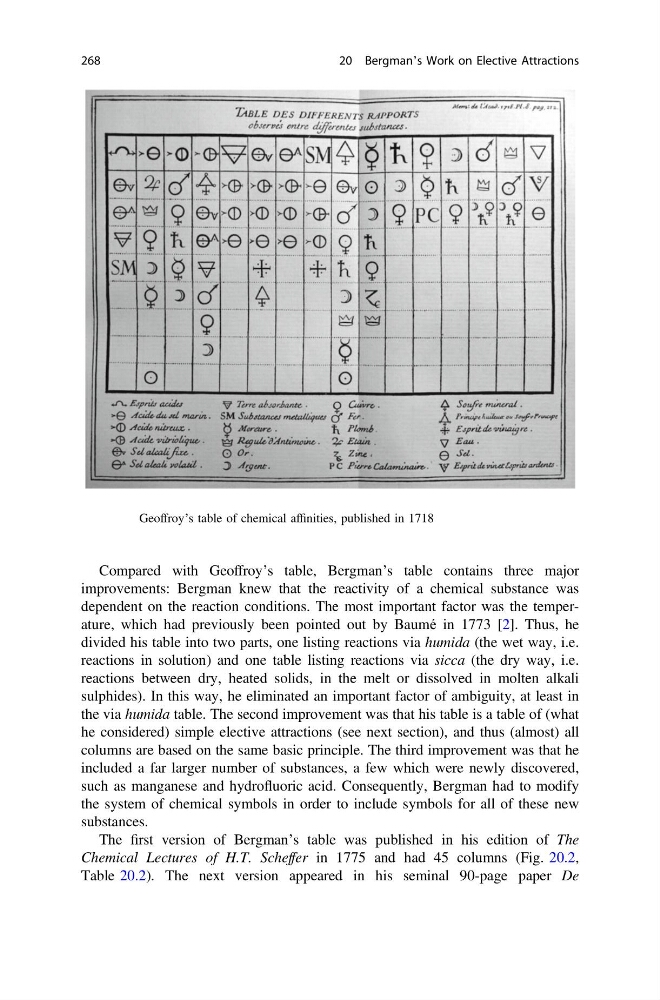
Compared with Geoffroy’s table, Bergman’s table contains three major
improvements: Bergman knew that the reactivity of a chemical substance was
dependent on the reaction conditions. The most important factor was the temperature, which had previously been pointed out by Baumé in 1773 [2]. Thus, he
divided his table into two parts, one listing reactions via humida (the wet way, i.e.
reactions in solution) and one table listing reactions via sicca (the dry way, i.e.
reactions between dry, heated solids, in the melt or dissolved in molten alkali
sulphides). In this way, he eliminated an important factor of ambiguity, at least in
the via humida table. The second improvement was that his table is a table of (what
he considered) simple elective attractions (see next section), and thus (almost) all
columns are based on the same basic principle. The third improvement was that he
included a far larger number of substances, a few which were newly discovered,
such as manganese and hydrofluoric acid. Consequently, Bergman had to modify
the system of chemical symbols in order to include symbols for all of these new
substances.
The first version of Bergman’s table was published in his edition of The
Chemical Lectures of H.T. Scheffer in 1775 and had 45 columns (Fig. 20.2,
Table 20.2). The next version appeared in his seminal 90-page paper De
Fig. 20.1 Geoffroy’s table of chemical affinities, published in 1718
268
20 Bergman’s Work on Elective Attractions
improvements: Bergman knew that the reactivity of a chemical substance was
dependent on the reaction conditions. The most important factor was the temperature, which had previously been pointed out by Baumé in 1773 [2]. Thus, he
divided his table into two parts, one listing reactions via humida (the wet way, i.e.
reactions in solution) and one table listing reactions via sicca (the dry way, i.e.
reactions between dry, heated solids, in the melt or dissolved in molten alkali
sulphides). In this way, he eliminated an important factor of ambiguity, at least in
the via humida table. The second improvement was that his table is a table of (what
he considered) simple elective attractions (see next section), and thus (almost) all
columns are based on the same basic principle. The third improvement was that he
included a far larger number of substances, a few which were newly discovered,
such as manganese and hydrofluoric acid. Consequently, Bergman had to modify
the system of chemical symbols in order to include symbols for all of these new
substances.
The first version of Bergman’s table was published in his edition of The
Chemical Lectures of H.T. Scheffer in 1775 and had 45 columns (Fig. 20.2,
Table 20.2). The next version appeared in his seminal 90-page paper De
Fig. 20.1 Geoffroy’s table of chemical affinities, published in 1718
268
20 Bergman’s Work on Elective Attractions