

the caustic quicklime on calcination, and the exothermic reaction with water to form
slaked lime was believed to be due to water expelling the fire from quicklime. By
adding slaked lime to a solution of sodium carbonate (soda) or potassium carbonate
(potash), insoluble calcium carbonate precipitated, leaving strongly basic alkali
hydroxides (caustic alkalis) in solution:
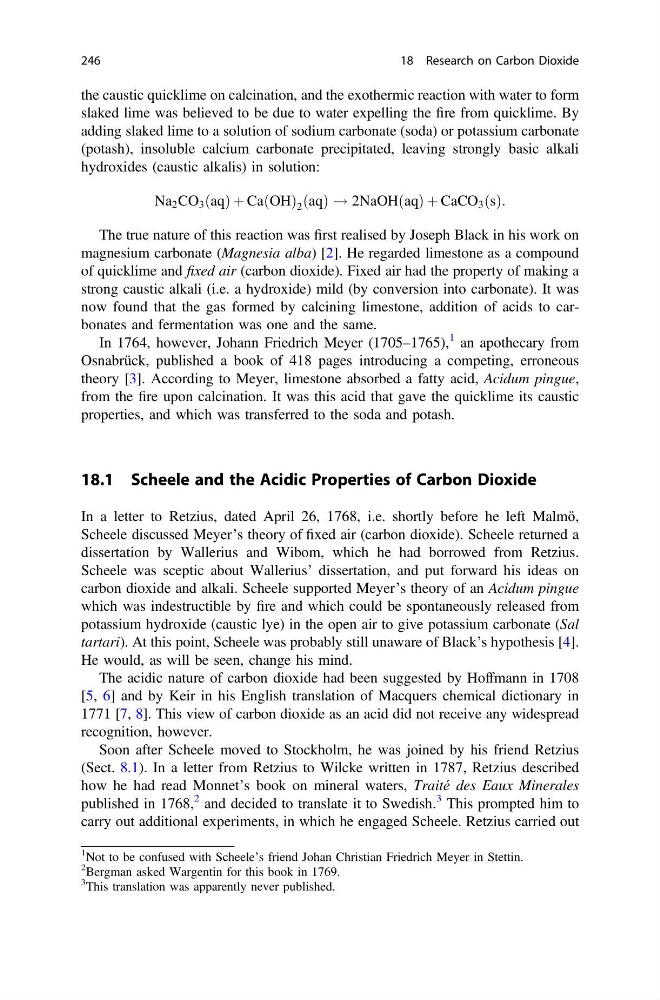
Na 2 CO 3 ðaqÞ þ CaðOHÞ 2 ðaqÞ ! 2NaOHðaqÞ þ CaCO 3 ðsÞ:
The true nature of this reaction was first realised by Joseph Black in his work on
magnesium carbonate (Magnesia alba) [2]. He regarded limestone as a compound
of quicklime and fixed air (carbon dioxide). Fixed air had the property of making a
strong caustic alkali (i.e. a hydroxide) mild (by conversion into carbonate). It was
now found that the gas formed by calcining limestone, addition of acids to carbonates and fermentation was one and the same.
In 1764, however, Johann Friedrich Meyer (1705–1765),
1 an apothecary from
Osnabrück, published a book of 418 pages introducing a competing, erroneous
theory [3]. According to Meyer, limestone absorbed a fatty acid, Acidum pingue,
from the fire upon calcination. It was this acid that gave the quicklime its caustic
properties, and which was transferred to the soda and potash.
18.1 Scheele and the Acidic Properties of Carbon Dioxide
In a letter to Retzius, dated April 26, 1768, i.e. shortly before he left Malmö,
Scheele discussed Meyer’s theory of fixed air (carbon dioxide). Scheele returned a
dissertation by Wallerius and Wibom, which he had borrowed from Retzius.
Scheele was sceptic about Wallerius’ dissertation, and put forward his ideas on
carbon dioxide and alkali. Scheele supported Meyer’s theory of an Acidum pingue
which was indestructible by fire and which could be spontaneously released from
potassium hydroxide (caustic lye) in the open air to give potassium carbonate (Sal
tartari). At this point, Scheele was probably still unaware of Black’s hypothesis [4].
He would, as will be seen, change his mind.
The acidic nature of carbon dioxide had been suggested by Hoffmann in 1708
[5, 6] and by Keir in his English translation of Macquers chemical dictionary in
1771 [7, 8]. This view of carbon dioxide as an acid did not receive any widespread
recognition, however.
Soon after Scheele moved to Stockholm, he was joined by his friend Retzius
(Sect. 8.1). In a letter from Retzius to Wilcke written in 1787, Retzius described
how he had read Monnet’s book on mineral waters, Traité des Eaux Minerales
published in 1768,
2 and decided to translate it to Swedish.
3 This prompted him to
carry out additional experiments, in which he engaged Scheele. Retzius carried out
1
Not to be confused with Scheele’s friend Johan Christian Friedrich Meyer in Stettin.
2
Bergman asked Wargentin for this book in 1769.
3
This translation was apparently never published.
246
18 Research on Carbon Dioxide
slaked lime was believed to be due to water expelling the fire from quicklime. By
adding slaked lime to a solution of sodium carbonate (soda) or potassium carbonate
(potash), insoluble calcium carbonate precipitated, leaving strongly basic alkali
hydroxides (caustic alkalis) in solution:
Na 2 CO 3 ðaqÞ þ CaðOHÞ 2 ðaqÞ ! 2NaOHðaqÞ þ CaCO 3 ðsÞ:
The true nature of this reaction was first realised by Joseph Black in his work on
magnesium carbonate (Magnesia alba) [2]. He regarded limestone as a compound
of quicklime and fixed air (carbon dioxide). Fixed air had the property of making a
strong caustic alkali (i.e. a hydroxide) mild (by conversion into carbonate). It was
now found that the gas formed by calcining limestone, addition of acids to carbonates and fermentation was one and the same.
In 1764, however, Johann Friedrich Meyer (1705–1765),
1 an apothecary from
Osnabrück, published a book of 418 pages introducing a competing, erroneous
theory [3]. According to Meyer, limestone absorbed a fatty acid, Acidum pingue,
from the fire upon calcination. It was this acid that gave the quicklime its caustic
properties, and which was transferred to the soda and potash.
18.1 Scheele and the Acidic Properties of Carbon Dioxide
In a letter to Retzius, dated April 26, 1768, i.e. shortly before he left Malmö,
Scheele discussed Meyer’s theory of fixed air (carbon dioxide). Scheele returned a
dissertation by Wallerius and Wibom, which he had borrowed from Retzius.
Scheele was sceptic about Wallerius’ dissertation, and put forward his ideas on
carbon dioxide and alkali. Scheele supported Meyer’s theory of an Acidum pingue
which was indestructible by fire and which could be spontaneously released from
potassium hydroxide (caustic lye) in the open air to give potassium carbonate (Sal
tartari). At this point, Scheele was probably still unaware of Black’s hypothesis [4].
He would, as will be seen, change his mind.
The acidic nature of carbon dioxide had been suggested by Hoffmann in 1708
[5, 6] and by Keir in his English translation of Macquers chemical dictionary in
1771 [7, 8]. This view of carbon dioxide as an acid did not receive any widespread
recognition, however.
Soon after Scheele moved to Stockholm, he was joined by his friend Retzius
(Sect. 8.1). In a letter from Retzius to Wilcke written in 1787, Retzius described
how he had read Monnet’s book on mineral waters, Traité des Eaux Minerales
published in 1768,
2 and decided to translate it to Swedish.
3 This prompted him to
carry out additional experiments, in which he engaged Scheele. Retzius carried out
1
Not to be confused with Scheele’s friend Johan Christian Friedrich Meyer in Stettin.
2
Bergman asked Wargentin for this book in 1769.
3
This translation was apparently never published.
246
18 Research on Carbon Dioxide