

was a more thorough blow-pipe analysis. Although Bergman had little experimental
information in addition to Scheele’s findings, Bergman’s tungsten paper is still of
considerable interest. Here Bergman, for the first time, expresses the opinion that
molybdic and tungstic acid could be reduced to metals. He had found that
molybdenum and tungsten compounds gave precipitates with hexacyanoferrate (lye
of blood) and gave colour to ammonium sodium phosphate (microcosmic salt) and
sodium tetraborate (borax) during blow-pipe analyses, properties that he had
hitherto only observed for metal compounds. He would soon be proven to be
correct. Bergman also expressed the idea that all metal calces consisted of metallic
acids and phlogiston (Sect. 22.4).
In June 1782, Scheele was visited by the Spanish chemist Juan José d’Elhuyar
(1754–1796), who had been working in Bergman’s laboratory for half a year. In
Scheele’s laboratory, they learned of Scheele’s tungstic acid. Back in Spain, Juan
José and his brother Fausto (1755–1833) investigated a mineral known as wolfram
(now known as wolframite, (Fe,Mn)WO 4 ). It had been thought to be a tin ore, but
all attempts to extract tin failed, and it was known to interfere with the smelting of
genuine tin ores, and was referred to as Spuma lupi, [40] meaning “wolf foam”. In
German, this term was translated to Wolf Rahm or Wolfram and Wallerius called
this material Volfram [41]. The eccentric British chemist and alchemist Peter
Woulfe (1727–1803) had speculated about the possibility of a new metal in this
mineral in 1779, but his ideas received no recognition. From this mineral, the
d’Elhuyar brother isolated a substance which they found to be identical to Scheele’s
tungstic acid:
This [—] made us suspect immediately that the matter, from which this colour proceeded,
might be that particular product which Scheele, a Swedish chymist, has lately met with in a
stone called Tungsten, or heavy stone [42]
The two Spanish chemists followed Bergman’s suggestion, and reduced tungstic
acid to obtain tungsten in the metallic state:
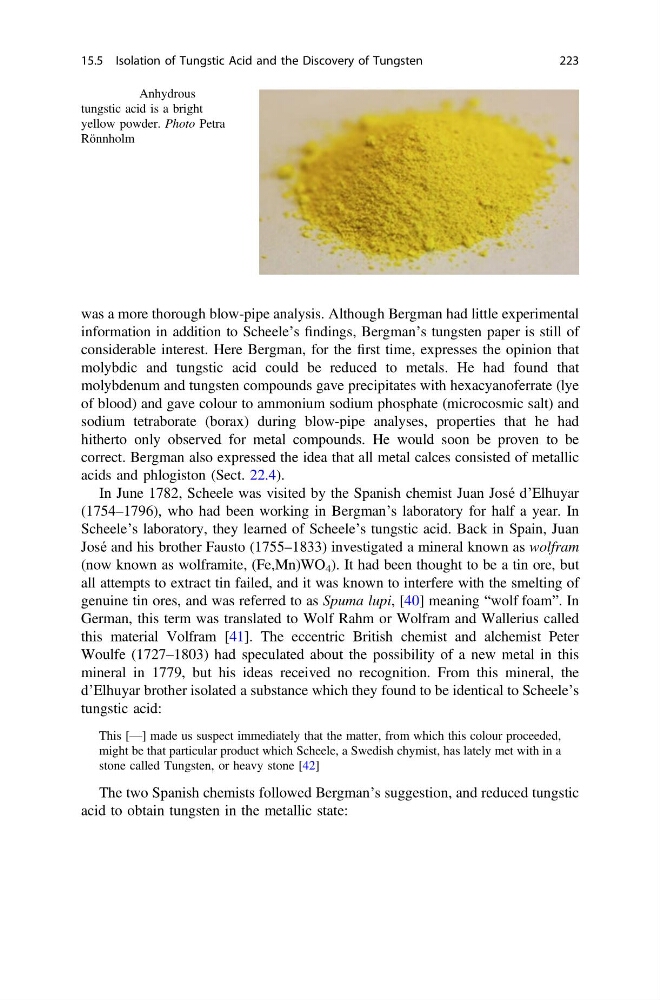
Fig. 15.6 Anhydrous
tungstic acid is a bright
yellow powder. Photo Petra
Rönnholm
15.5 Isolation of Tungstic Acid and the Discovery of Tungsten
223
information in addition to Scheele’s findings, Bergman’s tungsten paper is still of
considerable interest. Here Bergman, for the first time, expresses the opinion that
molybdic and tungstic acid could be reduced to metals. He had found that
molybdenum and tungsten compounds gave precipitates with hexacyanoferrate (lye
of blood) and gave colour to ammonium sodium phosphate (microcosmic salt) and
sodium tetraborate (borax) during blow-pipe analyses, properties that he had
hitherto only observed for metal compounds. He would soon be proven to be
correct. Bergman also expressed the idea that all metal calces consisted of metallic
acids and phlogiston (Sect. 22.4).
In June 1782, Scheele was visited by the Spanish chemist Juan José d’Elhuyar
(1754–1796), who had been working in Bergman’s laboratory for half a year. In
Scheele’s laboratory, they learned of Scheele’s tungstic acid. Back in Spain, Juan
José and his brother Fausto (1755–1833) investigated a mineral known as wolfram
(now known as wolframite, (Fe,Mn)WO 4 ). It had been thought to be a tin ore, but
all attempts to extract tin failed, and it was known to interfere with the smelting of
genuine tin ores, and was referred to as Spuma lupi, [40] meaning “wolf foam”. In
German, this term was translated to Wolf Rahm or Wolfram and Wallerius called
this material Volfram [41]. The eccentric British chemist and alchemist Peter
Woulfe (1727–1803) had speculated about the possibility of a new metal in this
mineral in 1779, but his ideas received no recognition. From this mineral, the
d’Elhuyar brother isolated a substance which they found to be identical to Scheele’s
tungstic acid:
This [—] made us suspect immediately that the matter, from which this colour proceeded,
might be that particular product which Scheele, a Swedish chymist, has lately met with in a
stone called Tungsten, or heavy stone [42]
The two Spanish chemists followed Bergman’s suggestion, and reduced tungstic
acid to obtain tungsten in the metallic state:
Fig. 15.6 Anhydrous
tungstic acid is a bright
yellow powder. Photo Petra
Rönnholm
15.5 Isolation of Tungstic Acid and the Discovery of Tungsten
223