

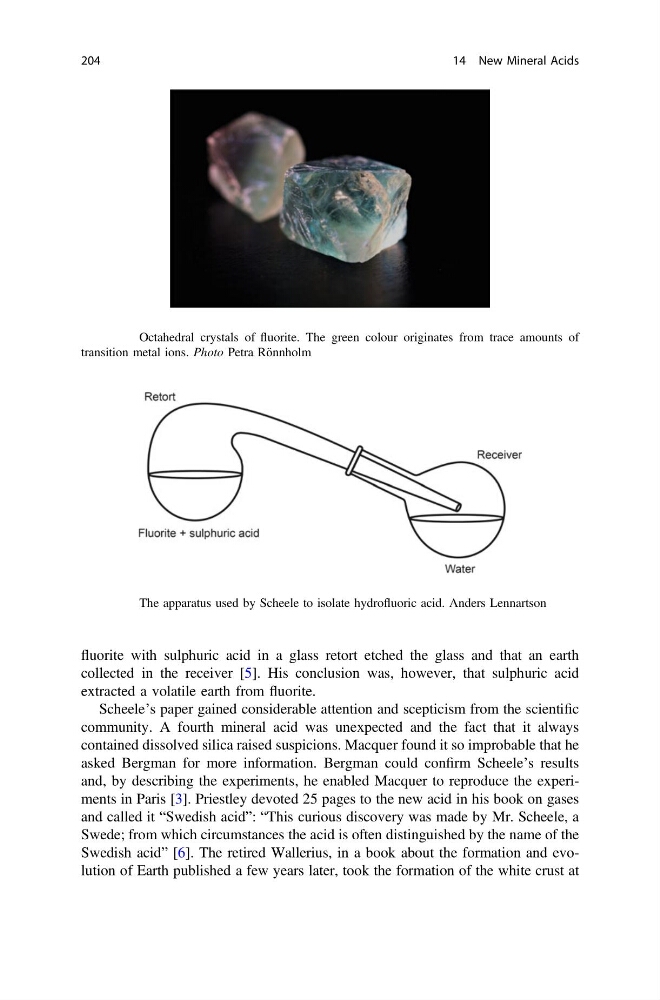
fluorite with sulphuric acid in a glass retort etched the glass and that an earth
collected in the receiver [5]. His conclusion was, however, that sulphuric acid
extracted a volatile earth from fluorite.
Scheele’s paper gained considerable attention and scepticism from the scientific
community. A fourth mineral acid was unexpected and the fact that it always
contained dissolved silica raised suspicions. Macquer found it so improbable that he
asked Bergman for more information. Bergman could confirm Scheele’s results
and, by describing the experiments, he enabled Macquer to reproduce the experiments in Paris [3]. Priestley devoted 25 pages to the new acid in his book on gases
and called it “Swedish acid”: “This curious discovery was made by Mr. Scheele, a
Swede; from which circumstances the acid is often distinguished by the name of the
Swedish acid” [6]. The retired Wallerius, in a book about the formation and evolution of Earth published a few years later, took the formation of the white crust at
Fig. 14.1 Octahedral crystals of fluorite. The green colour originates from trace amounts of
transition metal ions. Photo Petra Rönnholm
Fig. 14.2 The apparatus used by Scheele to isolate hydrofluoric acid. Anders Lennartson
204
14 New Mineral Acids
collected in the receiver [5]. His conclusion was, however, that sulphuric acid
extracted a volatile earth from fluorite.
Scheele’s paper gained considerable attention and scepticism from the scientific
community. A fourth mineral acid was unexpected and the fact that it always
contained dissolved silica raised suspicions. Macquer found it so improbable that he
asked Bergman for more information. Bergman could confirm Scheele’s results
and, by describing the experiments, he enabled Macquer to reproduce the experiments in Paris [3]. Priestley devoted 25 pages to the new acid in his book on gases
and called it “Swedish acid”: “This curious discovery was made by Mr. Scheele, a
Swede; from which circumstances the acid is often distinguished by the name of the
Swedish acid” [6]. The retired Wallerius, in a book about the formation and evolution of Earth published a few years later, took the formation of the white crust at
Fig. 14.1 Octahedral crystals of fluorite. The green colour originates from trace amounts of
transition metal ions. Photo Petra Rönnholm
Fig. 14.2 The apparatus used by Scheele to isolate hydrofluoric acid. Anders Lennartson
204
14 New Mineral Acids