

1762, where he initially intended to study botany under Linnaeus. However, his
interest soon shifted towards physics and chemistry, and he attended Bergman’s
lectures in chemistry in the autumn of 1768. Thought Gahn was one of Bergman’s
favourite students, he took his exam, not in chemistry, but in mining. His thesis [5]
was on the subject “promotion of good economy at iron works” and was supervised
by Pehr Niclas Christiernin. The thesis, 46 pages long, contains no discussions on
chemistry or metallurgy, but contains many sound opinions on technical matters.
While certainly a useful text in the mining districts, it is uncertain how many iron
workers actually read Gahn’s dissertation. In the introduction, Gahn,
1 if he was the
true author, stresses that it is not primarily the supply of natural resources that
makes a country rich, but the diligence and ability of the citizens to make proper use
of the resources.
After graduating, Gahn moved to Falun, the location of one of the world’s
largest copper mines. Gahn planned either to make a foreign trip or to join Sven
Rinman at the Garphyttan alum works in order to widen his knowledge, but was
more or less forced into a collaboration with Samuel Gustaf Hermelin (1744–1820),
a young mineralogist and cartographer. Hermelin, an acquaintance of Bergman, had
been appointed by the Board of Mines to investigate the low quality of the Falun
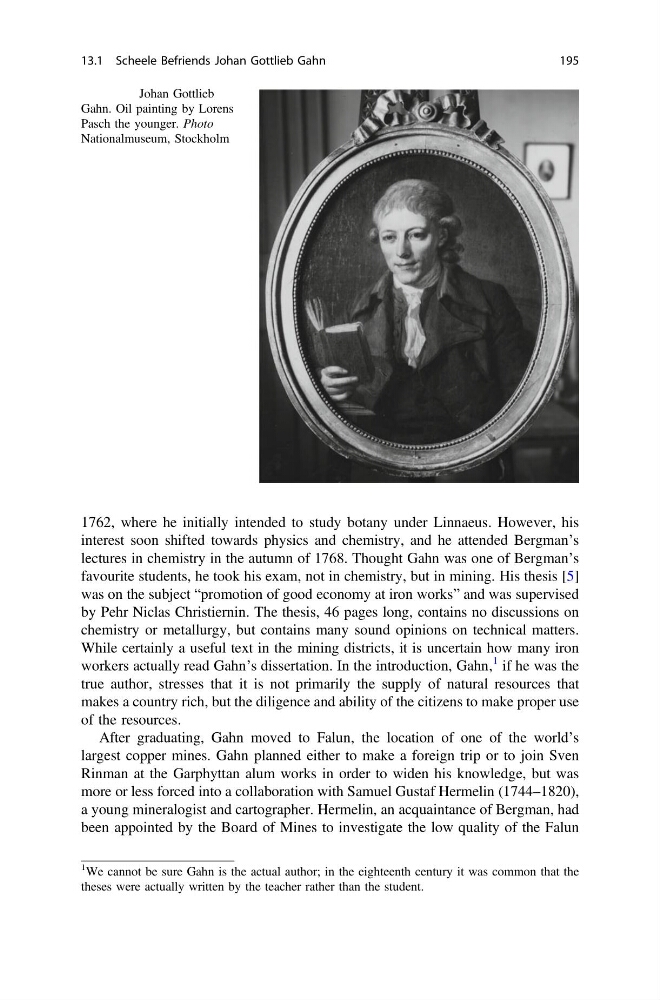
Fig. 13.3 Johan Gottlieb
Gahn. Oil painting by Lorens
Pasch the younger. Photo
Nationalmuseum, Stockholm
1
We cannot be sure Gahn is the actual author; in the eighteenth century it was common that the
theses were actually written by the teacher rather than the student.
13.1 Scheele Befriends Johan Gottlieb Gahn
195
interest soon shifted towards physics and chemistry, and he attended Bergman’s
lectures in chemistry in the autumn of 1768. Thought Gahn was one of Bergman’s
favourite students, he took his exam, not in chemistry, but in mining. His thesis [5]
was on the subject “promotion of good economy at iron works” and was supervised
by Pehr Niclas Christiernin. The thesis, 46 pages long, contains no discussions on
chemistry or metallurgy, but contains many sound opinions on technical matters.
While certainly a useful text in the mining districts, it is uncertain how many iron
workers actually read Gahn’s dissertation. In the introduction, Gahn,
1 if he was the
true author, stresses that it is not primarily the supply of natural resources that
makes a country rich, but the diligence and ability of the citizens to make proper use
of the resources.
After graduating, Gahn moved to Falun, the location of one of the world’s
largest copper mines. Gahn planned either to make a foreign trip or to join Sven
Rinman at the Garphyttan alum works in order to widen his knowledge, but was
more or less forced into a collaboration with Samuel Gustaf Hermelin (1744–1820),
a young mineralogist and cartographer. Hermelin, an acquaintance of Bergman, had
been appointed by the Board of Mines to investigate the low quality of the Falun
Fig. 13.3 Johan Gottlieb
Gahn. Oil painting by Lorens
Pasch the younger. Photo
Nationalmuseum, Stockholm
1
We cannot be sure Gahn is the actual author; in the eighteenth century it was common that the
theses were actually written by the teacher rather than the student.
13.1 Scheele Befriends Johan Gottlieb Gahn
195