

closed jar over concentrated sulphuric acid and the blue colour was therefore not
dependent on heat. We now know that the blue colour is due to the reversible
dehydration of pink CoCl 2 Á6H 2 O to blue CoCl 2 . When discussing the solubility of
metallic copper in ammonia, it was Scheele who had found that this was only
possible after loss of phlogiston (i.e. by oxidation) [13]. In several cases, the book
introduces concepts that Bergman was developing and that would be more formally
announced in latter publications, such as his work on quantitative analysis
(Sect. 23.2), chemical affinity (Chap. 20) and nomenclature (Chap. 26).
Bergman divided the original text into six main parts, each part further divided
into chapters, thus using the same format he had used in his Physical Description of
the Earth, the second edition of which appeared the year before The Chemical
Lectures of H.T. Scheffer.The first part deals with salts. Salts were water-soluble
substances with taste, and Bergman added that salts generally need less than 200
times their weight of water to dissolve (he later changed this definition to 500 times
[14]). Scheffer divided salts into two classes, but Bergman’s system of classification
of salts was more elaborate. His scheme for classification is visually similar to the
schemes in Linnaeus’ Systema Naturae, which probably served as Bergman’s
inspiration. Bergman’s definition of salts was much wider than the modern definition: it would not only include substances that we refer to as salts, but also
included acids, bases and even sugar. The two main classes of salts were called
“true salts” (egentlige salter) and “analogical salts” (analogiske salter). The true
salts were divided into three subclasses: acids, alkalis and neutral salts. The neutral
salts were composed of an acid and an alkali, and correspond to the sodium,
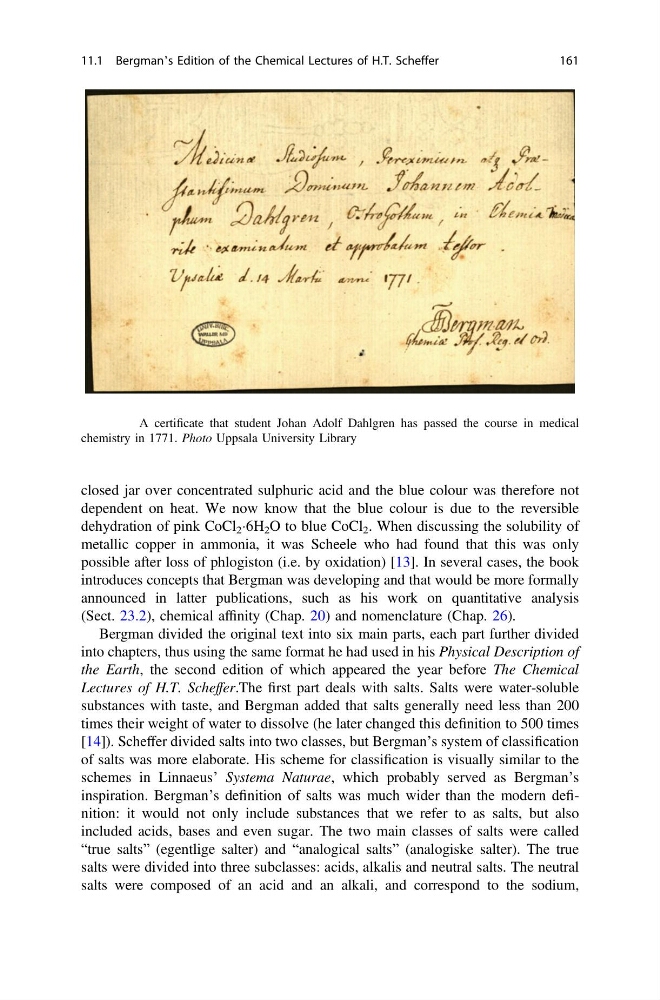
Fig. 11.1 A certificate that student Johan Adolf Dahlgren has passed the course in medical
chemistry in 1771. Photo Uppsala University Library
11.1 Bergman’s Edition of the Chemical Lectures of H.T. Scheffer
161
dependent on heat. We now know that the blue colour is due to the reversible
dehydration of pink CoCl 2 Á6H 2 O to blue CoCl 2 . When discussing the solubility of
metallic copper in ammonia, it was Scheele who had found that this was only
possible after loss of phlogiston (i.e. by oxidation) [13]. In several cases, the book
introduces concepts that Bergman was developing and that would be more formally
announced in latter publications, such as his work on quantitative analysis
(Sect. 23.2), chemical affinity (Chap. 20) and nomenclature (Chap. 26).
Bergman divided the original text into six main parts, each part further divided
into chapters, thus using the same format he had used in his Physical Description of
the Earth, the second edition of which appeared the year before The Chemical
Lectures of H.T. Scheffer.The first part deals with salts. Salts were water-soluble
substances with taste, and Bergman added that salts generally need less than 200
times their weight of water to dissolve (he later changed this definition to 500 times
[14]). Scheffer divided salts into two classes, but Bergman’s system of classification
of salts was more elaborate. His scheme for classification is visually similar to the
schemes in Linnaeus’ Systema Naturae, which probably served as Bergman’s
inspiration. Bergman’s definition of salts was much wider than the modern definition: it would not only include substances that we refer to as salts, but also
included acids, bases and even sugar. The two main classes of salts were called
“true salts” (egentlige salter) and “analogical salts” (analogiske salter). The true
salts were divided into three subclasses: acids, alkalis and neutral salts. The neutral
salts were composed of an acid and an alkali, and correspond to the sodium,
Fig. 11.1 A certificate that student Johan Adolf Dahlgren has passed the course in medical
chemistry in 1771. Photo Uppsala University Library
11.1 Bergman’s Edition of the Chemical Lectures of H.T. Scheffer
161