

burned enough for the surface to melt in order for the tiles to be waterproof. Also,
clay contains sulphates which are reduced to gaseous sulphur dioxide on burning.
With insufficient heating, Bergman noted that the sulphate remaining tended to be
leached away by water as alum, leaving pores in the material. Bergman’s samples
had been exposed to the open air for 3 years when he published his paper, and while
the improperly burnt specimens were almost entirely destroyed, the properly burnt
specimens were unaffected. The paper also includes a discussion on the chemical
analysis of clays. Bergman identified calcium carbonate (lime) by its effervescence
with nitric acid. The lime was reprecipitated from the acidic solution with “stinking
spiritus”, a sulphide solution. Later in his career, he did not precipitate metals as
sulphides, which is common in modern procedures. By repeated washing with
water, clay was separated from sand.
In this paper, as in the case of the work on alum refining, Bergman addressed a
practical problem and showed that he could offer a simple solution based on
chemistry. This was the kind of paper that the people who had helped him to the
professorship wanted to see. As will be seen, however, as his position became more
secure and his chemical knowledge increased, his work would become less applied.
Bergman complained that many people had little or no interest in things that could
not be used as food or for clothes [92].
There are probably no surviving artifacts from Bergman’s early career, but the
museum of Uppsala University, Museum Gustavianum, has some of Bergman’s
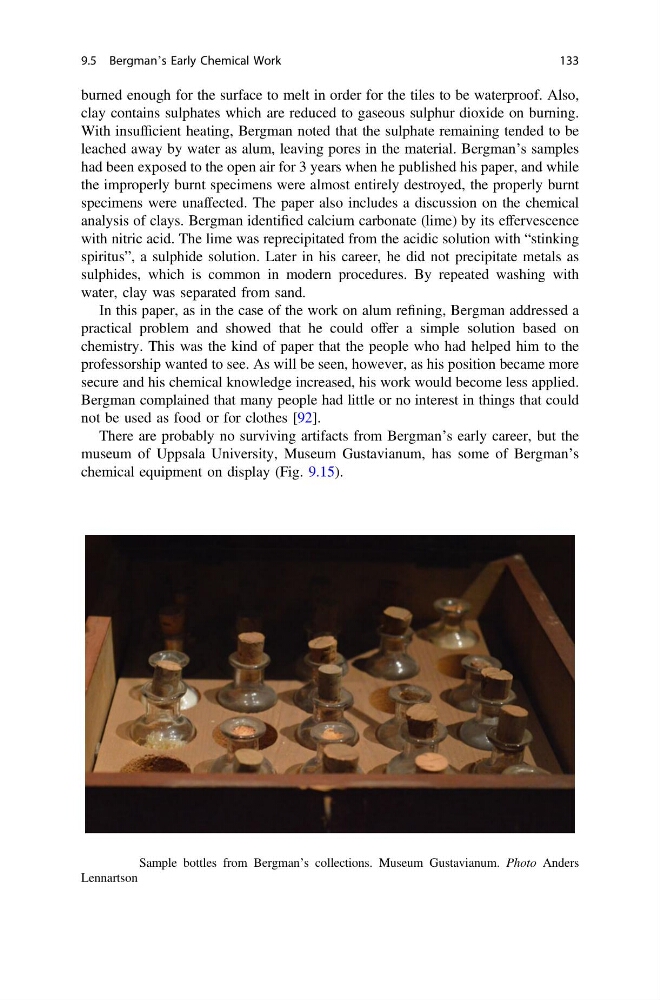
chemical equipment on display (Fig. 9.15).
Fig. 9.15 Sample bottles from Bergman’s collections. Museum Gustavianum. Photo Anders
Lennartson
9.5 Bergman’s Early Chemical Work
133
clay contains sulphates which are reduced to gaseous sulphur dioxide on burning.
With insufficient heating, Bergman noted that the sulphate remaining tended to be
leached away by water as alum, leaving pores in the material. Bergman’s samples
had been exposed to the open air for 3 years when he published his paper, and while
the improperly burnt specimens were almost entirely destroyed, the properly burnt
specimens were unaffected. The paper also includes a discussion on the chemical
analysis of clays. Bergman identified calcium carbonate (lime) by its effervescence
with nitric acid. The lime was reprecipitated from the acidic solution with “stinking
spiritus”, a sulphide solution. Later in his career, he did not precipitate metals as
sulphides, which is common in modern procedures. By repeated washing with
water, clay was separated from sand.
In this paper, as in the case of the work on alum refining, Bergman addressed a
practical problem and showed that he could offer a simple solution based on
chemistry. This was the kind of paper that the people who had helped him to the
professorship wanted to see. As will be seen, however, as his position became more
secure and his chemical knowledge increased, his work would become less applied.
Bergman complained that many people had little or no interest in things that could
not be used as food or for clothes [92].
There are probably no surviving artifacts from Bergman’s early career, but the
museum of Uppsala University, Museum Gustavianum, has some of Bergman’s
chemical equipment on display (Fig. 9.15).
Fig. 9.15 Sample bottles from Bergman’s collections. Museum Gustavianum. Photo Anders
Lennartson
9.5 Bergman’s Early Chemical Work
133