

organise his mineral collection. Linnaeus also engaged politician Carl Johan Gyllenborg, son of Linnaeus’ deceased patron Carl Gyllenborg. Unfortunately for
Tidström, the Hat party, to which Tessin and Gyllenborg belonged, had just lost
power to the Cap party (Chap. 1), and Tessin and Gyllenborg had lost some of their
former power.
Through his membership in the Cosmographic Society (Sect. 7.1) and the Royal
Swedish Academy of Sciences, Bergman was well acquainted with Wargentin and
it should be recalled that Bergman was elected a member of the Academy on the
recommendation by Wargentin. None of the other applicants were members of the
Academy. As a physicist, Wargentin could fully appreciate Bergman’s talent, and
could probably see merit in a more physical and mathematical approach to
chemistry rather than the purely descriptive approach of Wallerius.
Wallerius’ former teacher, professor Rosén von Rosenstein, also supported
Bergman, and according to a preserved letter to Wargentin, he attempted to get the
Queen’s support for Bergman. The Queen had a genuine interest in science, and
although the royal couple had no political power, it was strategically important.
While Wallerius’ connections to the Board of Mines were rather weak, Bergman,
with his connections to the Royal Swedish Academy of Sciences and Wargentin,
approached two of its more influential members, Tilas and von Swab, and sent them
copies of his Physical Description of the Earth and his dissertation on alum. Tilas
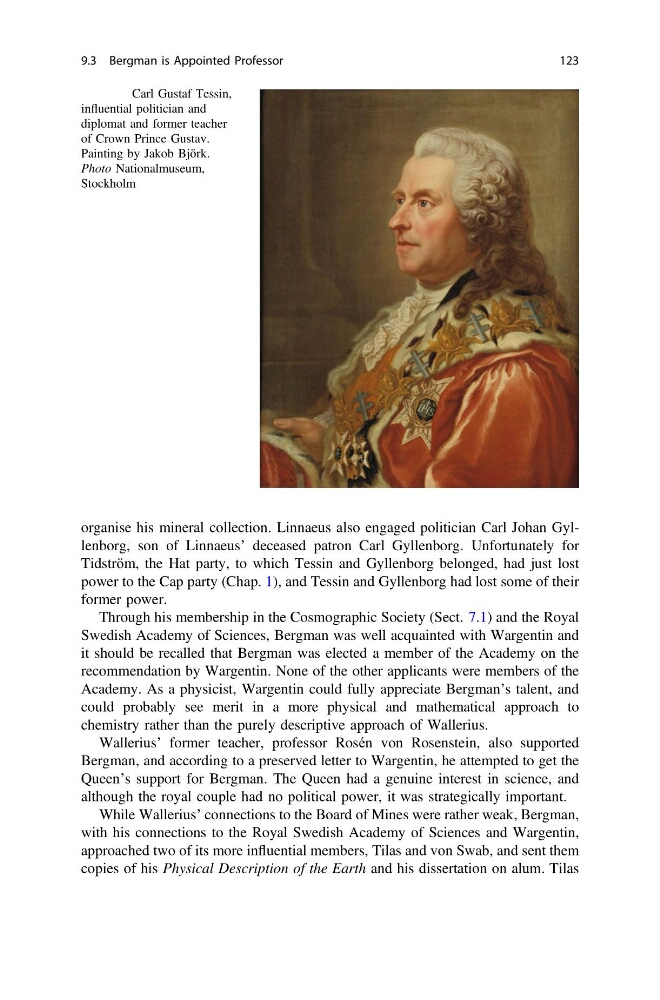
Fig. 9.7 Carl Gustaf Tessin,
influential politician and
diplomat and former teacher
of Crown Prince Gustav.
Painting by Jakob Björk.
Photo Nationalmuseum,
Stockholm
9.3 Bergman is Appointed Professor
123
Tidström, the Hat party, to which Tessin and Gyllenborg belonged, had just lost
power to the Cap party (Chap. 1), and Tessin and Gyllenborg had lost some of their
former power.
Through his membership in the Cosmographic Society (Sect. 7.1) and the Royal
Swedish Academy of Sciences, Bergman was well acquainted with Wargentin and
it should be recalled that Bergman was elected a member of the Academy on the
recommendation by Wargentin. None of the other applicants were members of the
Academy. As a physicist, Wargentin could fully appreciate Bergman’s talent, and
could probably see merit in a more physical and mathematical approach to
chemistry rather than the purely descriptive approach of Wallerius.
Wallerius’ former teacher, professor Rosén von Rosenstein, also supported
Bergman, and according to a preserved letter to Wargentin, he attempted to get the
Queen’s support for Bergman. The Queen had a genuine interest in science, and
although the royal couple had no political power, it was strategically important.
While Wallerius’ connections to the Board of Mines were rather weak, Bergman,
with his connections to the Royal Swedish Academy of Sciences and Wargentin,
approached two of its more influential members, Tilas and von Swab, and sent them
copies of his Physical Description of the Earth and his dissertation on alum. Tilas
Fig. 9.7 Carl Gustaf Tessin,
influential politician and
diplomat and former teacher
of Crown Prince Gustav.
Painting by Jakob Björk.
Photo Nationalmuseum,
Stockholm
9.3 Bergman is Appointed Professor
123