

The most important point is not that Scheele had isolated nitrous acid, but that he
had found phenomena that were incompatible with the traditional phlogiston theory
the way it was taught by Stahl and the way that Scheele had learned it from the
books in Bauch’s shop [8]. Not only had he found that potassium nitrate and silver
nitrate could (in his view) extract phlogiston from heat, he also made another
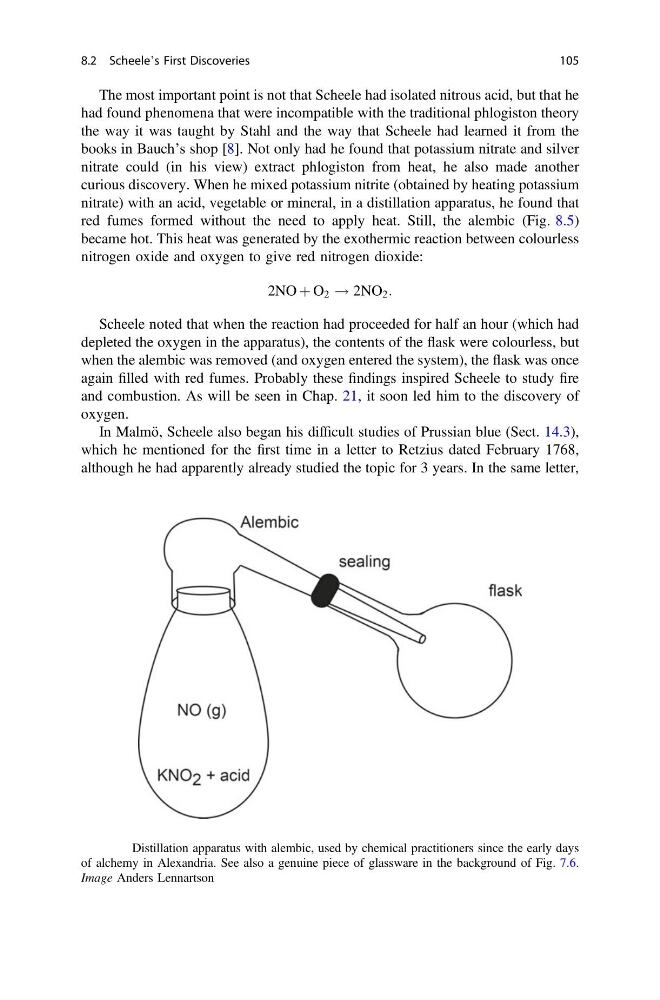
curious discovery. When he mixed potassium nitrite (obtained by heating potassium
nitrate) with an acid, vegetable or mineral, in a distillation apparatus, he found that
red fumes formed without the need to apply heat. Still, the alembic (Fig. 8.5)
became hot. This heat was generated by the exothermic reaction between colourless
nitrogen oxide and oxygen to give red nitrogen dioxide:
2NO þ O 2 ! 2NO 2 :
Scheele noted that when the reaction had proceeded for half an hour (which had
depleted the oxygen in the apparatus), the contents of the flask were colourless, but
when the alembic was removed (and oxygen entered the system), the flask was once
again filled with red fumes. Probably these findings inspired Scheele to study fire
and combustion. As will be seen in Chap. 21, it soon led him to the discovery of
oxygen.
In Malmö, Scheele also began his difficult studies of Prussian blue (Sect. 14.3),
which he mentioned for the first time in a letter to Retzius dated February 1768,
although he had apparently already studied the topic for 3 years. In the same letter,
Fig. 8.5 Distillation apparatus with alembic, used by chemical practitioners since the early days
of alchemy in Alexandria. See also a genuine piece of glassware in the background of Fig. 7.6.
Image Anders Lennartson
8.2 Scheele’s First Discoveries
105
had found phenomena that were incompatible with the traditional phlogiston theory
the way it was taught by Stahl and the way that Scheele had learned it from the
books in Bauch’s shop [8]. Not only had he found that potassium nitrate and silver
nitrate could (in his view) extract phlogiston from heat, he also made another
curious discovery. When he mixed potassium nitrite (obtained by heating potassium
nitrate) with an acid, vegetable or mineral, in a distillation apparatus, he found that
red fumes formed without the need to apply heat. Still, the alembic (Fig. 8.5)
became hot. This heat was generated by the exothermic reaction between colourless
nitrogen oxide and oxygen to give red nitrogen dioxide:
2NO þ O 2 ! 2NO 2 :
Scheele noted that when the reaction had proceeded for half an hour (which had
depleted the oxygen in the apparatus), the contents of the flask were colourless, but
when the alembic was removed (and oxygen entered the system), the flask was once
again filled with red fumes. Probably these findings inspired Scheele to study fire
and combustion. As will be seen in Chap. 21, it soon led him to the discovery of
oxygen.
In Malmö, Scheele also began his difficult studies of Prussian blue (Sect. 14.3),
which he mentioned for the first time in a letter to Retzius dated February 1768,
although he had apparently already studied the topic for 3 years. In the same letter,
Fig. 8.5 Distillation apparatus with alembic, used by chemical practitioners since the early days
of alchemy in Alexandria. See also a genuine piece of glassware in the background of Fig. 7.6.
Image Anders Lennartson
8.2 Scheele’s First Discoveries
105