

A A ∞ - and L ∞ -Algebras
83
and therefore L cl [c ] defines also an L ∞ -algebra. Thus, E(c ) is an L ∞ -morphism.
There is a subtlety if the new background does not satisfy the field equations. The
initial L ∞ -algebra is determined by the vertices (l cl ) n where there is no vertex for
n = 0, i.e., (l cl ) 0 = 0. A non-vanishing (l cl ) 0 would correspond to a term in the
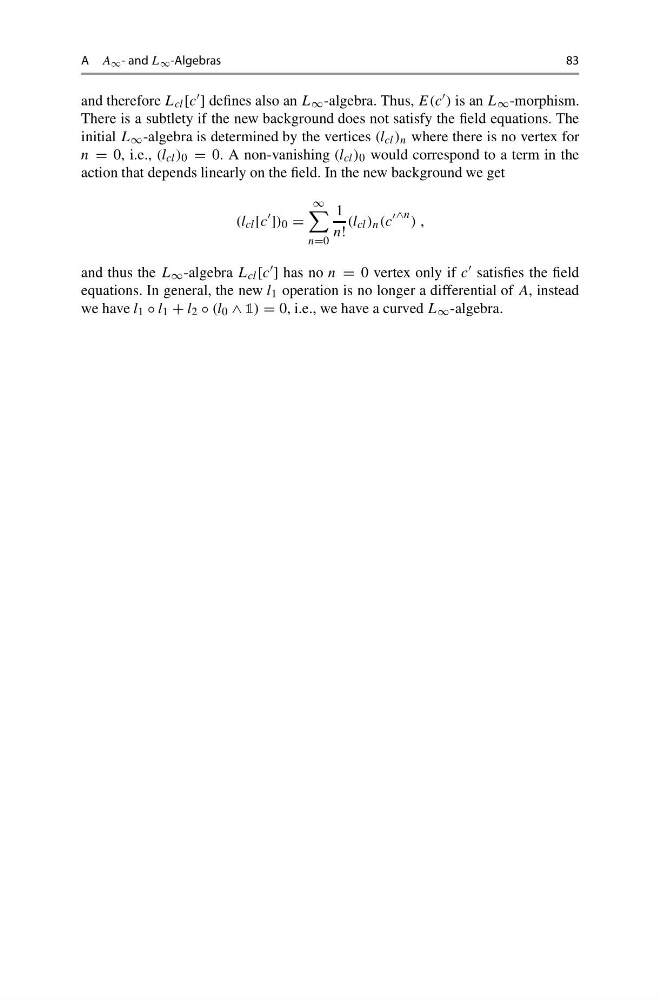
action that depends linearly on the field. In the new background we get
(l cl [c
]) 0 =
∞
n=0
1
n!
(l cl ) n (c
∧n ) ,
and thus the L ∞ -algebra L cl [c ] has no n = 0 vertex only if c satisfies the field
equations. In general, the new l 1 operation is no longer a differential of A, instead
we have l 1 ◦ l 1 + l 2 ◦ (l 0 ∧ 1) = 0, i.e., we have a curved L ∞ -algebra.
83
and therefore L cl [c ] defines also an L ∞ -algebra. Thus, E(c ) is an L ∞ -morphism.
There is a subtlety if the new background does not satisfy the field equations. The
initial L ∞ -algebra is determined by the vertices (l cl ) n where there is no vertex for
n = 0, i.e., (l cl ) 0 = 0. A non-vanishing (l cl ) 0 would correspond to a term in the
action that depends linearly on the field. In the new background we get
(l cl [c
]) 0 =
∞
n=0
1
n!
(l cl ) n (c
∧n ) ,
and thus the L ∞ -algebra L cl [c ] has no n = 0 vertex only if c satisfies the field
equations. In general, the new l 1 operation is no longer a differential of A, instead
we have l 1 ◦ l 1 + l 2 ◦ (l 0 ∧ 1) = 0, i.e., we have a curved L ∞ -algebra.