

5.2 Quantum Open-Closed Homotopy Algebra
69
where L c ∈ coder(T V c , ¯
h) is defined in Eq. (3.32) and L o ∈ Coder(SA o , ¯
h)
is defined in Eq. (5.3). We use the abbreviation A o = Hom
cycl (T V o , C). More
precisely, we have an IBL ∞ -morphism F ∈ Morph(V c , A o , ¯
h), that is,
F ◦ L c = L o ◦ F
and
|F| = 0.
(5.5)
The morphism F is determined by a map f through (see Eq. (B.11) and (B.12))
F =
∞
n=0
1
n!
f
∧n
◦ Δ n ,
where
f =
∞
b=1
∞
g=0
¯
h
g+b−1 f
b,g ,
and
f
b,g
: T V c → A
∧b
o .
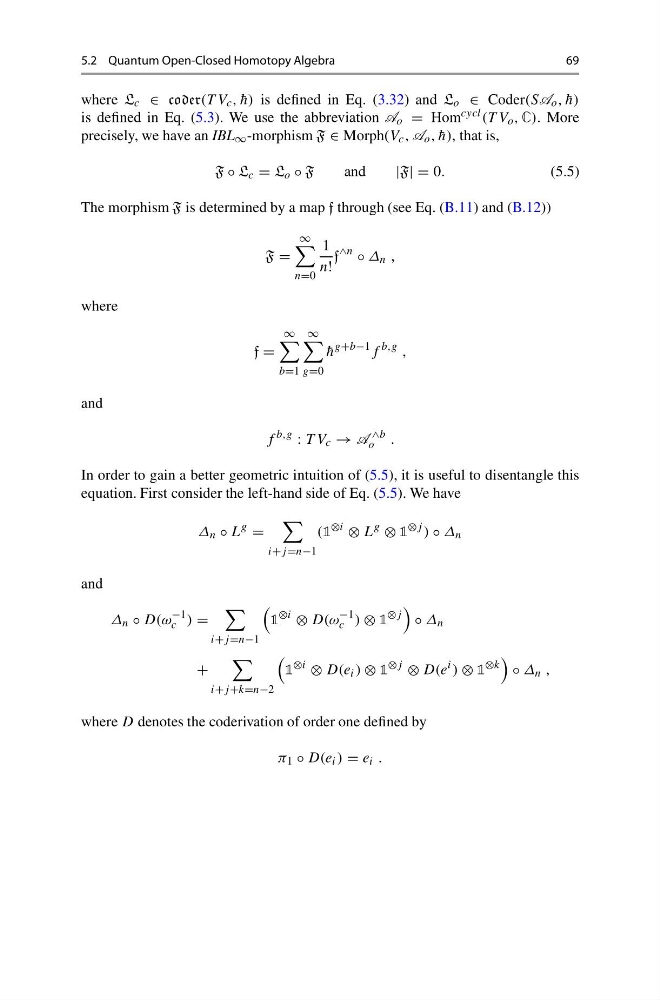
In order to gain a better geometric intuition of (5.5), it is useful to disentangle this
equation. First consider the left-hand side of Eq. (5.5). We have
Δ n ◦ L
g
=
i+j =n−1
(1
⊗i
⊗ L
g
⊗ 1
⊗j ) ◦ Δ n
and
Δ n ◦ D(ω
−1
c ) =
i+j =n−1
1
⊗i
⊗ D(ω
−1
c ) ⊗ 1
⊗j
◦ Δ n
+
i+j +k=n−2
1
⊗i
⊗ D(e i ) ⊗ 1
⊗j
⊗ D(e
i ) ⊗ 1
⊗k
◦ Δ n ,
where D denotes the coderivation of order one defined by
π 1 ◦ D(e i ) = e i .
69
where L c ∈ coder(T V c , ¯
h) is defined in Eq. (3.32) and L o ∈ Coder(SA o , ¯
h)
is defined in Eq. (5.3). We use the abbreviation A o = Hom
cycl (T V o , C). More
precisely, we have an IBL ∞ -morphism F ∈ Morph(V c , A o , ¯
h), that is,
F ◦ L c = L o ◦ F
and
|F| = 0.
(5.5)
The morphism F is determined by a map f through (see Eq. (B.11) and (B.12))
F =
∞
n=0
1
n!
f
∧n
◦ Δ n ,
where
f =
∞
b=1
∞
g=0
¯
h
g+b−1 f
b,g ,
and
f
b,g
: T V c → A
∧b
o .
In order to gain a better geometric intuition of (5.5), it is useful to disentangle this
equation. First consider the left-hand side of Eq. (5.5). We have
Δ n ◦ L
g
=
i+j =n−1
(1
⊗i
⊗ L
g
⊗ 1
⊗j ) ◦ Δ n
and
Δ n ◦ D(ω
−1
c ) =
i+j =n−1
1
⊗i
⊗ D(ω
−1
c ) ⊗ 1
⊗j
◦ Δ n
+
i+j +k=n−2
1
⊗i
⊗ D(e i ) ⊗ 1
⊗j
⊗ D(e
i ) ⊗ 1
⊗k
◦ Δ n ,
where D denotes the coderivation of order one defined by
π 1 ◦ D(e i ) = e i .