

48
3 String Theory
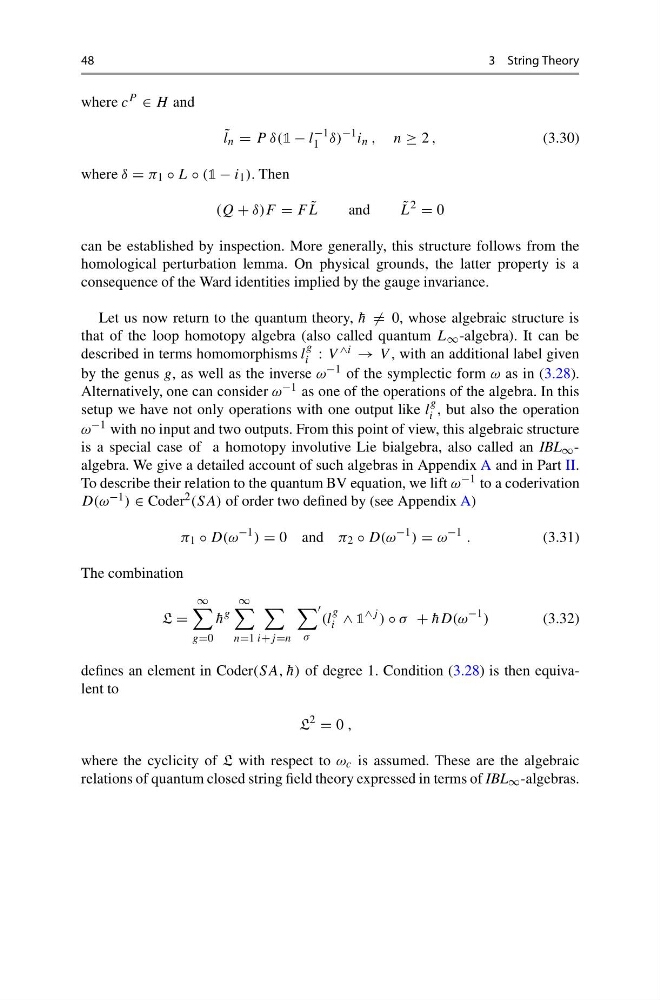
where c P ∈ H and
˜
l n = P δ(1 − l
−1
1 δ)
−1 i n , n ≥ 2 ,
(3.30)
where δ = π 1 ◦ L ◦ (1 − i 1 ). Then
(Q + δ)F = F ˜
L
and
˜
L
2
= 0
can be established by inspection. More generally, this structure follows from the
homological perturbation lemma. On physical grounds, the latter property is a
consequence of the Ward identities implied by the gauge invariance.
Let us now return to the quantum theory, ¯
h = 0, whose algebraic structure is
that of the loop homotopy algebra (also called quantum L ∞ -algebra). It can be
described in terms homomorphisms l
g
i : V ∧i → V , with an additional label given
by the genus g, as well as the inverse ω −1 of the symplectic form ω as in (3.28).
Alternatively, one can consider ω −1 as one of the operations of the algebra. In this
setup we have not only operations with one output like l
g
i , but also the operation
ω −1 with no input and two outputs. From this point of view, this algebraic structure
is a special case of a homotopy involutive Lie bialgebra, also called an IBL ∞ -
algebra. We give a detailed account of such algebras in Appendix A and in Part II.
To describe their relation to the quantum BV equation, we lift ω −1 to a coderivation
D(ω −1 ) ∈ Coder 2 (SA) of order two defined by (see Appendix A)
π 1 ◦ D(ω
−1 ) = 0 and π 2 ◦ D(ω
−1 ) = ω
−1 .
(3.31)
The combination
L =
∞
g=0
¯
h
g
∞
n=1
i+j =n
σ
(l
g
i ∧ 1
∧j ) ◦ σ + ¯
hD(ω
−1 )
(3.32)
defines an element in Coder(SA, ¯
h) of degree 1. Condition (3.28) is then equivalent to
L
2
= 0 ,
where the cyclicity of L with respect to ω c is assumed. These are the algebraic
relations of quantum closed string field theory expressed in terms of IBL ∞ -algebras.
3 String Theory
where c P ∈ H and
˜
l n = P δ(1 − l
−1
1 δ)
−1 i n , n ≥ 2 ,
(3.30)
where δ = π 1 ◦ L ◦ (1 − i 1 ). Then
(Q + δ)F = F ˜
L
and
˜
L
2
= 0
can be established by inspection. More generally, this structure follows from the
homological perturbation lemma. On physical grounds, the latter property is a
consequence of the Ward identities implied by the gauge invariance.
Let us now return to the quantum theory, ¯
h = 0, whose algebraic structure is
that of the loop homotopy algebra (also called quantum L ∞ -algebra). It can be
described in terms homomorphisms l
g
i : V ∧i → V , with an additional label given
by the genus g, as well as the inverse ω −1 of the symplectic form ω as in (3.28).
Alternatively, one can consider ω −1 as one of the operations of the algebra. In this
setup we have not only operations with one output like l
g
i , but also the operation
ω −1 with no input and two outputs. From this point of view, this algebraic structure
is a special case of a homotopy involutive Lie bialgebra, also called an IBL ∞ -
algebra. We give a detailed account of such algebras in Appendix A and in Part II.
To describe their relation to the quantum BV equation, we lift ω −1 to a coderivation
D(ω −1 ) ∈ Coder 2 (SA) of order two defined by (see Appendix A)
π 1 ◦ D(ω
−1 ) = 0 and π 2 ◦ D(ω
−1 ) = ω
−1 .
(3.31)
The combination
L =
∞
g=0
¯
h
g
∞
n=1
i+j =n
σ
(l
g
i ∧ 1
∧j ) ◦ σ + ¯
hD(ω
−1 )
(3.32)
defines an element in Coder(SA, ¯
h) of degree 1. Condition (3.28) is then equivalent to
L
2
= 0 ,
where the cyclicity of L with respect to ω c is assumed. These are the algebraic
relations of quantum closed string field theory expressed in terms of IBL ∞ -algebras.