

3.3 Decomposition of the Moduli Space
39
where g denotes the genus of the geometric vertex and we introduced the expansion
parameter ¯
h to keep track of the loop order. It turns out that the operations ∂, Δ, and
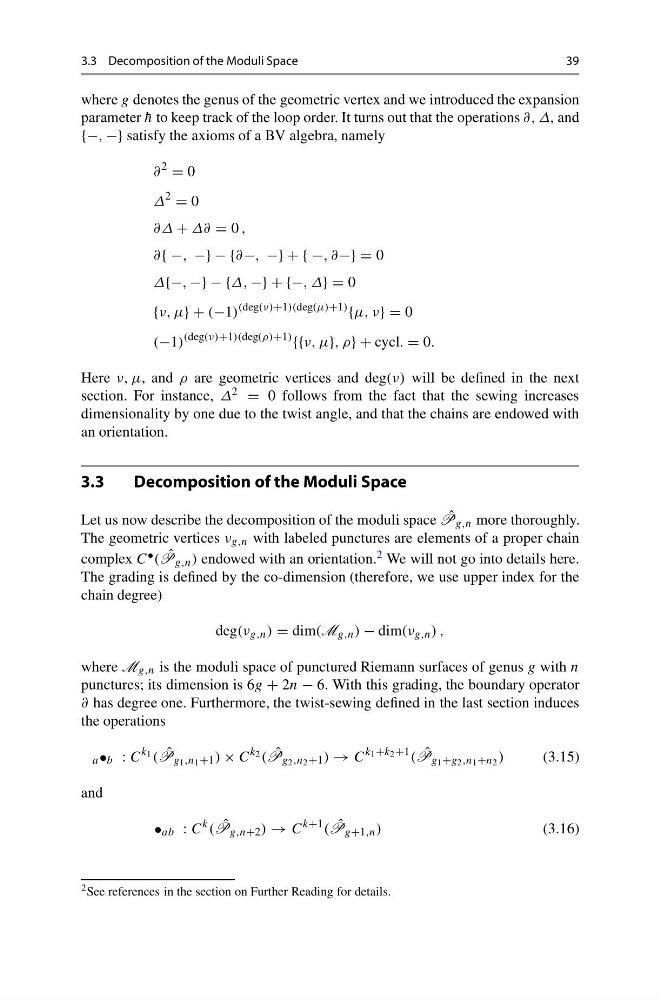
{−, −} satisfy the axioms of a BV algebra, namely
∂
2
= 0
Δ
2
= 0
∂Δ + Δ∂ = 0 ,
∂{ −, −} − {∂−, −} + { −, ∂−} = 0
Δ{−, −} − {Δ, −} + {−, Δ} = 0
{ν, μ} + (−1)
(deg(ν)+1)(deg(μ)+1)
{μ, ν} = 0
(−1)
(deg(ν)+1)(deg(ρ)+1)
{{ν, μ}, ρ} + cycl. = 0.
Here ν, μ, and ρ are geometric vertices and deg(ν) will be defined in the next
section. For instance, Δ 2 = 0 follows from the fact that the sewing increases
dimensionality by one due to the twist angle, and that the chains are endowed with
an orientation.
3.3
Decomposition of the Moduli Space
Let us now describe the decomposition of the moduli space ˆ
P g,n more thoroughly.
The geometric vertices ν g,n with labeled punctures are elements of a proper chain
complex C • ( ˆ
P g,n ) endowed with an orientation. 2 We will not go into details here.
The grading is defined by the co-dimension (therefore, we use upper index for the
chain degree)
deg(ν g,n ) = dim(M g,n ) − dim(ν g,n ) ,
where M g,n is the moduli space of punctured Riemann surfaces of genus g with n
punctures; its dimension is 6g + 2n − 6. With this grading, the boundary operator
∂ has degree one. Furthermore, the twist-sewing defined in the last section induces
the operations
a • b : C
k 1 ( ˆ
P g 1 ,n 1 +1 ) × C
k 2 ( ˆ
P g 2 ,n 2 +1 ) → C
k 1 +k 2 +1 ( ˆ
P g 1 +g 2 ,n 1 +n 2 )
(3.15)
and
• ab : C
k ( ˆ
P g,n+2 ) → C
k+1 ( ˆ
P g+1,n )
(3.16)
2 See references in the section on Further Reading for details.
39
where g denotes the genus of the geometric vertex and we introduced the expansion
parameter ¯
h to keep track of the loop order. It turns out that the operations ∂, Δ, and
{−, −} satisfy the axioms of a BV algebra, namely
∂
2
= 0
Δ
2
= 0
∂Δ + Δ∂ = 0 ,
∂{ −, −} − {∂−, −} + { −, ∂−} = 0
Δ{−, −} − {Δ, −} + {−, Δ} = 0
{ν, μ} + (−1)
(deg(ν)+1)(deg(μ)+1)
{μ, ν} = 0
(−1)
(deg(ν)+1)(deg(ρ)+1)
{{ν, μ}, ρ} + cycl. = 0.
Here ν, μ, and ρ are geometric vertices and deg(ν) will be defined in the next
section. For instance, Δ 2 = 0 follows from the fact that the sewing increases
dimensionality by one due to the twist angle, and that the chains are endowed with
an orientation.
3.3
Decomposition of the Moduli Space
Let us now describe the decomposition of the moduli space ˆ
P g,n more thoroughly.
The geometric vertices ν g,n with labeled punctures are elements of a proper chain
complex C • ( ˆ
P g,n ) endowed with an orientation. 2 We will not go into details here.
The grading is defined by the co-dimension (therefore, we use upper index for the
chain degree)
deg(ν g,n ) = dim(M g,n ) − dim(ν g,n ) ,
where M g,n is the moduli space of punctured Riemann surfaces of genus g with n
punctures; its dimension is 6g + 2n − 6. With this grading, the boundary operator
∂ has degree one. Furthermore, the twist-sewing defined in the last section induces
the operations
a • b : C
k 1 ( ˆ
P g 1 ,n 1 +1 ) × C
k 2 ( ˆ
P g 2 ,n 2 +1 ) → C
k 1 +k 2 +1 ( ˆ
P g 1 +g 2 ,n 1 +n 2 )
(3.15)
and
• ab : C
k ( ˆ
P g,n+2 ) → C
k+1 ( ˆ
P g+1,n )
(3.16)
2 See references in the section on Further Reading for details.