

3.2 Interactions
37
will not affect us here, so we only refer the reader to the original literature listed at
the end of this chapter for further details on this issue. To the quadratic order, we
have the invariance under
δ Λ ψ = QΛ + l 2 (ψ, Λ) + · · · ,
because ∂ν 3 = 0 implies
[Q, l 2 ](a, b) = Ql 2 (a, b) + l 2 (Qa, b) + (−1)
deg(a) l 2 (a, Qb) = 0 .
(3.12)
So far this looks as a Lie algebra type symmetry. However, since l 3 does not
commute with Q as is evident from (3.11) due to the correspondence between
the geometric vertex ν 4 and the operation l 3 , and the boundary operator δ and the
BRST operator Q, respectively, δ Λ ψ will receive corrections. Indeed, we will see
in Sect. 3.5 that (3.11) implies
[Q, l 3 ] +
1
2
[l 2 , l 2 ] = 0 ,
(3.13)
where
[Q, l 3 ](a, b, c) =Ql 3 (a, b, c) + l 2 (Qa, b, c) + (−1)
deg(a) l 3 (a, Qb, c)
+ (−1)
deg(a)+deg(b) l 3 (a, b, Qc)
and
[l 2 , l 2 ](a, b, c) = l 2 (l 2 (a, b), c) + (−1)
deg(c)(deg(a)+deg(b)) l 2 (l 2 (c, a), b)
+ (−1)
deg(a)(deg(b)+deg(c)) l 2 (l 2 (b, c), a) .
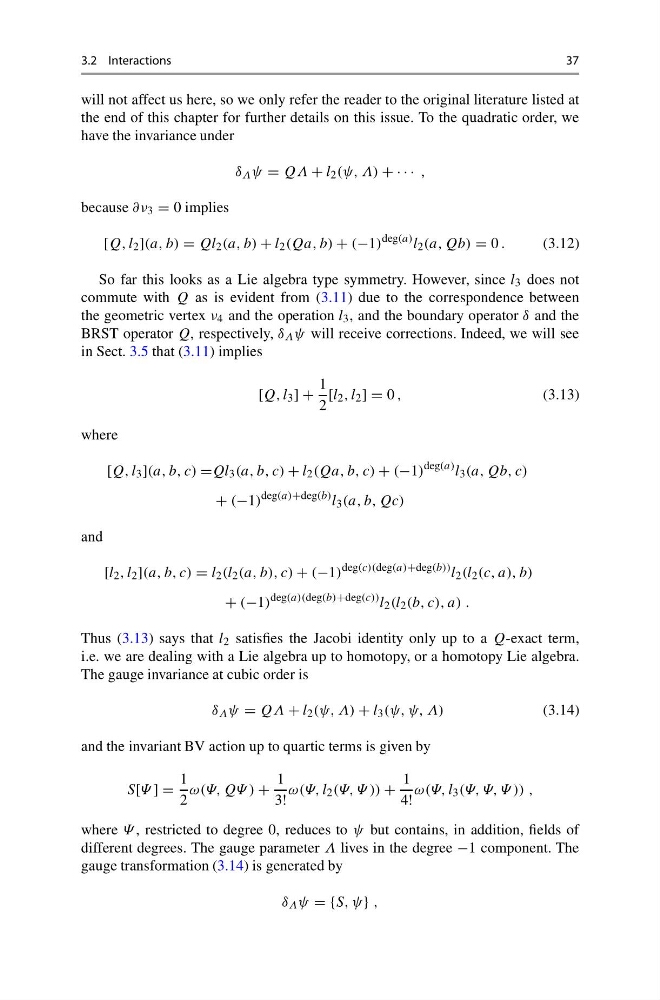
Thus (3.13) says that l 2 satisfies the Jacobi identity only up to a Q-exact term,
i.e. we are dealing with a Lie algebra up to homotopy, or a homotopy Lie algebra.
The gauge invariance at cubic order is
δ Λ ψ = QΛ + l 2 (ψ, Λ) + l 3 (ψ, ψ, Λ)
(3.14)
and the invariant BV action up to quartic terms is given by
S[Ψ ] =
1
2
ω(Ψ, QΨ ) +
1
3!
ω(Ψ, l 2 (Ψ, Ψ )) +
1
4!
ω(Ψ, l 3 (Ψ, Ψ, Ψ )) ,
where Ψ , restricted to degree 0, reduces to ψ but contains, in addition, fields of
different degrees. The gauge parameter Λ lives in the degree −1 component. The
gauge transformation (3.14) is generated by
δ Λ ψ = {S, ψ} ,
37
will not affect us here, so we only refer the reader to the original literature listed at
the end of this chapter for further details on this issue. To the quadratic order, we
have the invariance under
δ Λ ψ = QΛ + l 2 (ψ, Λ) + · · · ,
because ∂ν 3 = 0 implies
[Q, l 2 ](a, b) = Ql 2 (a, b) + l 2 (Qa, b) + (−1)
deg(a) l 2 (a, Qb) = 0 .
(3.12)
So far this looks as a Lie algebra type symmetry. However, since l 3 does not
commute with Q as is evident from (3.11) due to the correspondence between
the geometric vertex ν 4 and the operation l 3 , and the boundary operator δ and the
BRST operator Q, respectively, δ Λ ψ will receive corrections. Indeed, we will see
in Sect. 3.5 that (3.11) implies
[Q, l 3 ] +
1
2
[l 2 , l 2 ] = 0 ,
(3.13)
where
[Q, l 3 ](a, b, c) =Ql 3 (a, b, c) + l 2 (Qa, b, c) + (−1)
deg(a) l 3 (a, Qb, c)
+ (−1)
deg(a)+deg(b) l 3 (a, b, Qc)
and
[l 2 , l 2 ](a, b, c) = l 2 (l 2 (a, b), c) + (−1)
deg(c)(deg(a)+deg(b)) l 2 (l 2 (c, a), b)
+ (−1)
deg(a)(deg(b)+deg(c)) l 2 (l 2 (b, c), a) .
Thus (3.13) says that l 2 satisfies the Jacobi identity only up to a Q-exact term,
i.e. we are dealing with a Lie algebra up to homotopy, or a homotopy Lie algebra.
The gauge invariance at cubic order is
δ Λ ψ = QΛ + l 2 (ψ, Λ) + l 3 (ψ, ψ, Λ)
(3.14)
and the invariant BV action up to quartic terms is given by
S[Ψ ] =
1
2
ω(Ψ, QΨ ) +
1
3!
ω(Ψ, l 2 (Ψ, Ψ )) +
1
4!
ω(Ψ, l 3 (Ψ, Ψ, Ψ )) ,
where Ψ , restricted to degree 0, reduces to ψ but contains, in addition, fields of
different degrees. The gauge parameter Λ lives in the degree −1 component. The
gauge transformation (3.14) is generated by
δ Λ ψ = {S, ψ} ,