

3.2 Interactions
33
which sends an element of the cohomology to its representative. We will call i the
inclusion map. We also have the projection
π : V → H .
Obviously, the map P := i ◦ π : V → V satisfies P 2 = P and the image V P of P
is isomorphic to H . This means that V P represents the physical states. Moreover P
is a chain map, i.e. P Q = QP = 0 and it induces the identity map on cohomology.
This implies that P is homotopic to 1, i.e. there is a map Q −1 : V → V such that
P − 1 = Q
−1 Q + QQ
−1 .
Note that P 2 = P implies (Q −1 ) 2 = 0. Physically we can identify Q −1 as the
propagator corresponding to the chosen gauge. We demand Q −1 P = P Q −1 = 0,
which means that we set the propagator to be zero on the space of physical states.
The subspace V U corresponding to the projection map P U = −Q −1 Q represents
the nonphysical states, i.e. the states not annihilated by Q, and the subspace V T
represents the space of trivial states, i.e. Q-exact states. To summarize, choosing a
gauge in SFT determines a harmonious Hodge decomposition (compatible with the
odd symplectic form), which decomposes the state space into physical, nonphysical,
and trivial states. In Siegel gauge b
+
0 ψ = 0 we have
Q
−1
=
b
+
0
L
+
0
(1 − P ) .
3.2
Interactions
In order to work out the higher order corrections to the string action (3.9), we could
proceed, as for the point particle in Chap. 2, by considering the propagation of
a string in the background field corresponding to some external state ψ. In this way
one obtains a prescription for calculating scattering matrix elements. However, from
the point of view of string field theory, it is easier to just consider the geometrical
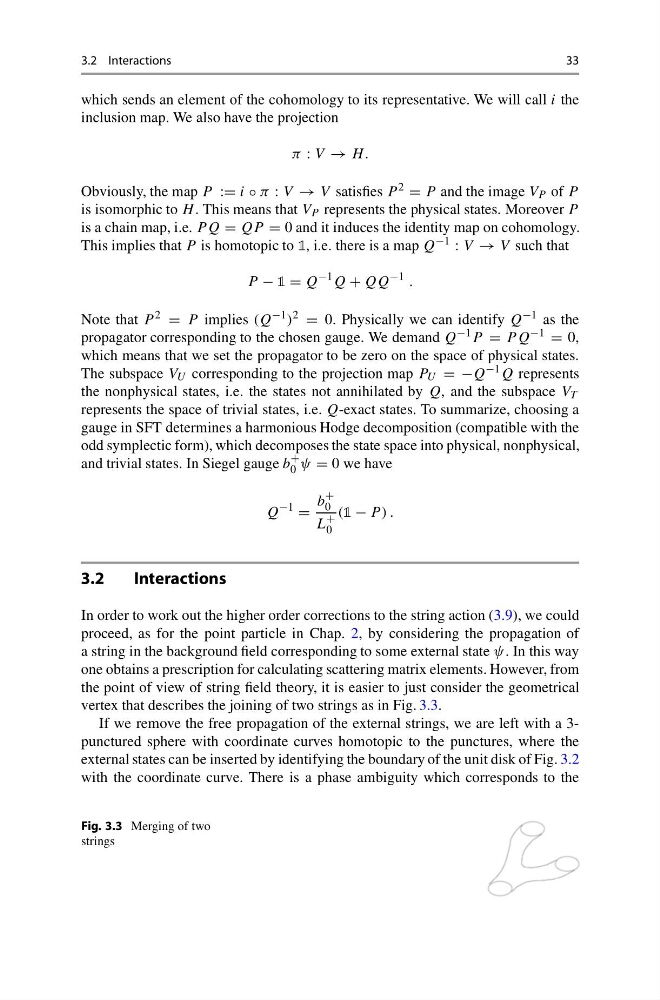
vertex that describes the joining of two strings as in Fig. 3.3.
If we remove the free propagation of the external strings, we are left with a 3punctured sphere with coordinate curves homotopic to the punctures, where the
external states can be inserted by identifying the boundary of the unit disk of Fig. 3.2
with the coordinate curve. There is a phase ambiguity which corresponds to the
Fig. 3.3 Merging of two
strings
33
which sends an element of the cohomology to its representative. We will call i the
inclusion map. We also have the projection
π : V → H .
Obviously, the map P := i ◦ π : V → V satisfies P 2 = P and the image V P of P
is isomorphic to H . This means that V P represents the physical states. Moreover P
is a chain map, i.e. P Q = QP = 0 and it induces the identity map on cohomology.
This implies that P is homotopic to 1, i.e. there is a map Q −1 : V → V such that
P − 1 = Q
−1 Q + QQ
−1 .
Note that P 2 = P implies (Q −1 ) 2 = 0. Physically we can identify Q −1 as the
propagator corresponding to the chosen gauge. We demand Q −1 P = P Q −1 = 0,
which means that we set the propagator to be zero on the space of physical states.
The subspace V U corresponding to the projection map P U = −Q −1 Q represents
the nonphysical states, i.e. the states not annihilated by Q, and the subspace V T
represents the space of trivial states, i.e. Q-exact states. To summarize, choosing a
gauge in SFT determines a harmonious Hodge decomposition (compatible with the
odd symplectic form), which decomposes the state space into physical, nonphysical,
and trivial states. In Siegel gauge b
+
0 ψ = 0 we have
Q
−1
=
b
+
0
L
+
0
(1 − P ) .
3.2
Interactions
In order to work out the higher order corrections to the string action (3.9), we could
proceed, as for the point particle in Chap. 2, by considering the propagation of
a string in the background field corresponding to some external state ψ. In this way
one obtains a prescription for calculating scattering matrix elements. However, from
the point of view of string field theory, it is easier to just consider the geometrical
vertex that describes the joining of two strings as in Fig. 3.3.
If we remove the free propagation of the external strings, we are left with a 3punctured sphere with coordinate curves homotopic to the punctures, where the
external states can be inserted by identifying the boundary of the unit disk of Fig. 3.2
with the coordinate curve. There is a phase ambiguity which corresponds to the
Fig. 3.3 Merging of two
strings