

2.3 Summary, Comments, and Remarks Towards Part II
23
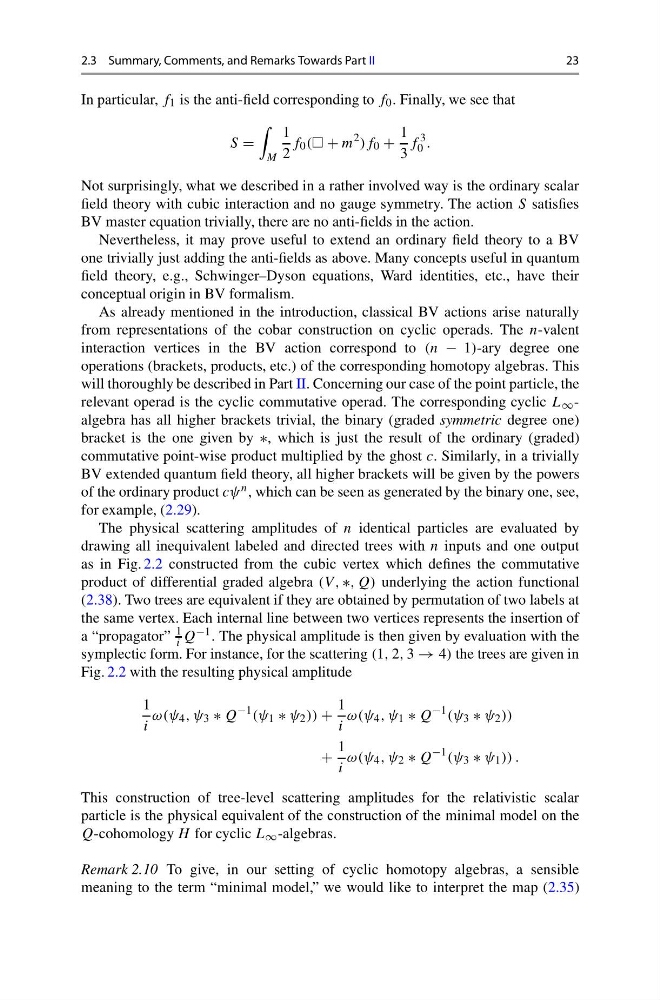
In particular, f 1 is the anti-field corresponding to f 0 . Finally, we see that
S =
M
1
2
f 0 ( + m
2 )f 0 +
1
3
f
3
0 .
Not surprisingly, what we described in a rather involved way is the ordinary scalar
field theory with cubic interaction and no gauge symmetry. The action S satisfies
BV master equation trivially, there are no anti-fields in the action.
Nevertheless, it may prove useful to extend an ordinary field theory to a BV
one trivially just adding the anti-fields as above. Many concepts useful in quantum
field theory, e.g., Schwinger–Dyson equations, Ward identities, etc., have their
conceptual origin in BV formalism.
As already mentioned in the introduction, classical BV actions arise naturally
from representations of the cobar construction on cyclic operads. The n-valent
interaction vertices in the BV action correspond to (n − 1)-ary degree one
operations (brackets, products, etc.) of the corresponding homotopy algebras. This
will thoroughly be described in Part II. Concerning our case of the point particle, the
relevant operad is the cyclic commutative operad. The corresponding cyclic L ∞ -
algebra has all higher brackets trivial, the binary (graded symmetric degree one)
bracket is the one given by ∗, which is just the result of the ordinary (graded)
commutative point-wise product multiplied by the ghost c. Similarly, in a trivially
BV extended quantum field theory, all higher brackets will be given by the powers
of the ordinary product cψ n , which can be seen as generated by the binary one, see,
for example, (2.29).
The physical scattering amplitudes of n identical particles are evaluated by
drawing all inequivalent labeled and directed trees with n inputs and one output
as in Fig. 2.2 constructed from the cubic vertex which defines the commutative
product of differential graded algebra (V , ∗, Q) underlying the action functional
(2.38). Two trees are equivalent if they are obtained by permutation of two labels at
the same vertex. Each internal line between two vertices represents the insertion of
a “propagator”
1
i Q −1 . The physical amplitude is then given by evaluation with the
symplectic form. For instance, for the scattering (1, 2, 3 → 4) the trees are given in
Fig. 2.2 with the resulting physical amplitude
1
i
ω(ψ 4 , ψ 3 ∗ Q
−1 (ψ 1 ∗ ψ 2 )) +
1
i
ω(ψ 4 , ψ 1 ∗ Q
−1 (ψ 3 ∗ ψ 2 ))
+
1
i
ω(ψ 4 , ψ 2 ∗ Q
−1 (ψ 3 ∗ ψ 1 )) .
This construction of tree-level scattering amplitudes for the relativistic scalar
particle is the physical equivalent of the construction of the minimal model on the
Q-cohomology H for cyclic L ∞ -algebras.
Remark 2.10 To give, in our setting of cyclic homotopy algebras, a sensible
meaning to the term “minimal model,” we would like to interpret the map (2.35)
23
In particular, f 1 is the anti-field corresponding to f 0 . Finally, we see that
S =
M
1
2
f 0 ( + m
2 )f 0 +
1
3
f
3
0 .
Not surprisingly, what we described in a rather involved way is the ordinary scalar
field theory with cubic interaction and no gauge symmetry. The action S satisfies
BV master equation trivially, there are no anti-fields in the action.
Nevertheless, it may prove useful to extend an ordinary field theory to a BV
one trivially just adding the anti-fields as above. Many concepts useful in quantum
field theory, e.g., Schwinger–Dyson equations, Ward identities, etc., have their
conceptual origin in BV formalism.
As already mentioned in the introduction, classical BV actions arise naturally
from representations of the cobar construction on cyclic operads. The n-valent
interaction vertices in the BV action correspond to (n − 1)-ary degree one
operations (brackets, products, etc.) of the corresponding homotopy algebras. This
will thoroughly be described in Part II. Concerning our case of the point particle, the
relevant operad is the cyclic commutative operad. The corresponding cyclic L ∞ -
algebra has all higher brackets trivial, the binary (graded symmetric degree one)
bracket is the one given by ∗, which is just the result of the ordinary (graded)
commutative point-wise product multiplied by the ghost c. Similarly, in a trivially
BV extended quantum field theory, all higher brackets will be given by the powers
of the ordinary product cψ n , which can be seen as generated by the binary one, see,
for example, (2.29).
The physical scattering amplitudes of n identical particles are evaluated by
drawing all inequivalent labeled and directed trees with n inputs and one output
as in Fig. 2.2 constructed from the cubic vertex which defines the commutative
product of differential graded algebra (V , ∗, Q) underlying the action functional
(2.38). Two trees are equivalent if they are obtained by permutation of two labels at
the same vertex. Each internal line between two vertices represents the insertion of
a “propagator”
1
i Q −1 . The physical amplitude is then given by evaluation with the
symplectic form. For instance, for the scattering (1, 2, 3 → 4) the trees are given in
Fig. 2.2 with the resulting physical amplitude
1
i
ω(ψ 4 , ψ 3 ∗ Q
−1 (ψ 1 ∗ ψ 2 )) +
1
i
ω(ψ 4 , ψ 1 ∗ Q
−1 (ψ 3 ∗ ψ 2 ))
+
1
i
ω(ψ 4 , ψ 2 ∗ Q
−1 (ψ 3 ∗ ψ 1 )) .
This construction of tree-level scattering amplitudes for the relativistic scalar
particle is the physical equivalent of the construction of the minimal model on the
Q-cohomology H for cyclic L ∞ -algebras.
Remark 2.10 To give, in our setting of cyclic homotopy algebras, a sensible
meaning to the term “minimal model,” we would like to interpret the map (2.35)