

212
8 Structures Relevant to Physics
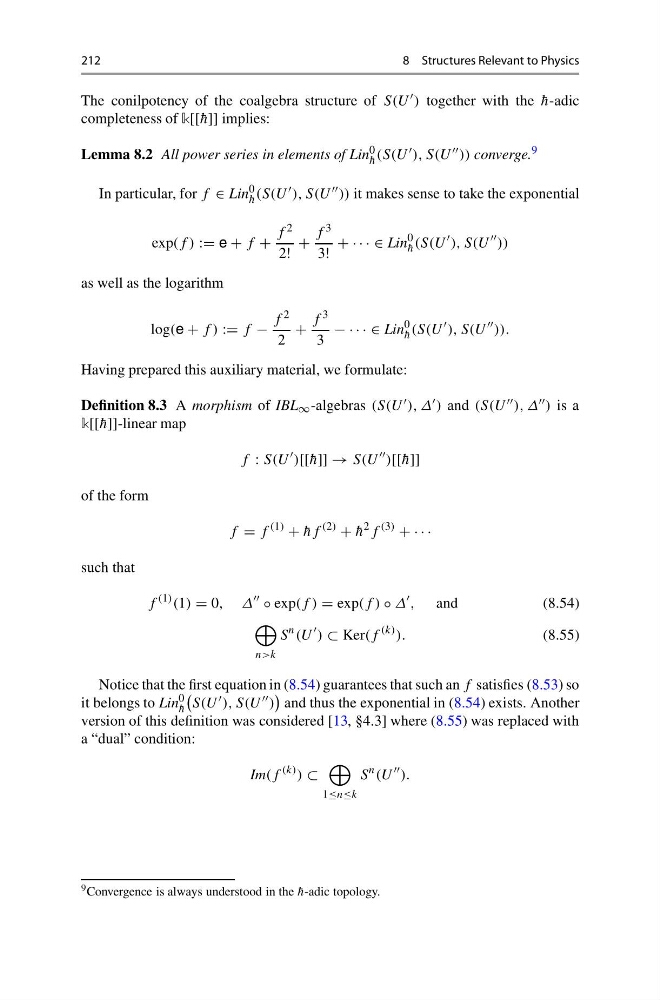
The conilpotency of the coalgebra structure of S(U ) together with the ¯
h-adic
completeness of k[[ ¯
h]] implies:
Lemma 8.2 All power series in elements of Lin 0
¯
h (S(U ), S(U )) converge. 9
In particular, for f ∈ Lin
0
¯
h (S(U ), S(U )) it makes sense to take the exponential
exp(f ) := e + f +
f 2
2!
+
f 3
3!
+ · · · ∈ Lin
0
¯
h (S(U
), S(U
))
as well as the logarithm
log(e + f ) := f −
f 2
2
+
f 3
3
− · · · ∈ Lin
0
¯
h (S(U
), S(U
)).
Having prepared this auxiliary material, we formulate:
Definition 8.3 A morphism of IBL ∞ -algebras (S(U ), Δ ) and (S(U ), Δ ) is a
k[[ ¯
h]]-linear map
f : S(U
)[[ ¯
h]] → S(U
)[[ ¯
h]]
of the form
f = f
(1)
+ ¯
hf
(2)
+ ¯
h
2 f
(3)
+ · · ·
such that
f
(1) (1) = 0, Δ
◦ exp(f ) = exp(f ) ◦ Δ
, and
(8.54)
n>k
S
n (U
) ⊂ Ker(f
(k) ).
(8.55)
Notice that the first equation in (8.54) guarantees that such an f satisfies (8.53) so
it belongs to Lin
0
¯
h
S(U ), S(U )
and thus the exponential in (8.54) exists. Another
version of this definition was considered [13, §4.3] where (8.55) was replaced with
a “dual” condition:
Im(f
(k) ) ⊂
1≤n≤k
S
n (U
).
9 Convergence is always understood in the ¯
h-adic topology.
8 Structures Relevant to Physics
The conilpotency of the coalgebra structure of S(U ) together with the ¯
h-adic
completeness of k[[ ¯
h]] implies:
Lemma 8.2 All power series in elements of Lin 0
¯
h (S(U ), S(U )) converge. 9
In particular, for f ∈ Lin
0
¯
h (S(U ), S(U )) it makes sense to take the exponential
exp(f ) := e + f +
f 2
2!
+
f 3
3!
+ · · · ∈ Lin
0
¯
h (S(U
), S(U
))
as well as the logarithm
log(e + f ) := f −
f 2
2
+
f 3
3
− · · · ∈ Lin
0
¯
h (S(U
), S(U
)).
Having prepared this auxiliary material, we formulate:
Definition 8.3 A morphism of IBL ∞ -algebras (S(U ), Δ ) and (S(U ), Δ ) is a
k[[ ¯
h]]-linear map
f : S(U
)[[ ¯
h]] → S(U
)[[ ¯
h]]
of the form
f = f
(1)
+ ¯
hf
(2)
+ ¯
h
2 f
(3)
+ · · ·
such that
f
(1) (1) = 0, Δ
◦ exp(f ) = exp(f ) ◦ Δ
, and
(8.54)
n>k
S
n (U
) ⊂ Ker(f
(k) ).
(8.55)
Notice that the first equation in (8.54) guarantees that such an f satisfies (8.53) so
it belongs to Lin
0
¯
h
S(U ), S(U )
and thus the exponential in (8.54) exists. Another
version of this definition was considered [13, §4.3] where (8.55) was replaced with
a “dual” condition:
Im(f
(k) ) ⊂
1≤n≤k
S
n (U
).
9 Convergence is always understood in the ¯
h-adic topology.